

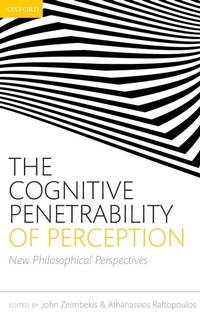
The Cognitive Penetrability of Perception
New Philosophical Perspectives
Published on 2. July 2015
Book
Hardback
464 pages
978-0-19-873891-6 (ISBN)
Description
According to the cognitive penetrability hypothesis, our beliefs, desires, and possibly our emotions literally affect how we see the world. This book elucidates the nature of the cognitive penetrability and impenetrability hypotheses, assesses their plausibility, and explores their philosophical consequences. It connects the topic's multiple strands (the psychological findings, computationalist background, epistemological consequences of cognitive architecture, and recent philosophical developments) at a time when the outcome of many philosophical debates depends on knowing whether and how cognitive states can influence perception. All sixteen chapters were written especially for the book. The first chapters provide methodological and conceptual clarification of the topic and give an account of the relations between penetrability, encapsulation, modularity, and cross-modal interactions in perception. Assessments of psychological and neuroscientific evidence for cognitive penetration are given by several chapters. Most of the contributions analyse the impact of cognitive penetrability and impenetrability on specific philosophical topics: high-level perceptual contents, the epistemological consequences of penetration, nonconceptual content, the phenomenology of late perception, metacognitive feelings, and action. The book includes a comprehensive introduction which explains the history of the debate, its key technical concepts (informational encapsulation, early and late vision, the perception-cognition distinction, hard-wired perceptual processing, perceptual learning, theory-ladenness), and the debate's relevance to current topics in the philosophy of mind and perception, epistemology, and philosophy of psychology.
Reviews / Votes
... what this volume displays in spades, is that careful and creative work, both empirical and conceptual, continues to shine further light on and raise fruitful new questions regarding these fascinating topics. Steven Gross, Notre Dame Philosophical Reviews OnlineMore details
Other editions
Additional editions
John Zeimbekis | Athanassios Raftopoulos
The Cognitive Penetrability of Perception
New Philosophical Perspectives
E-Book
07/2015
1st Edition
OUP eBook
€61.49
Available for download
Persons
John Zeimbekis is Assistant Professor of Philosophy at the University of Patras. He works on the philosophy of perception, especially demonstrative thought, the metaphysics of qualities, and the relations between thought, perception, imagery, memory, and pictures. He has published papers on perception in Nous and Philosophical Studies. He also works on topics in aesthetics and is the author of a book on aesthetic value, Qu'est-ce qu'un Jugement Esthetique (Paris, Vrin, 2006).
Athanassios Raftopoulos is Professor of Epistemology and Cognitive Science in the Department of Psychology at the University of Cyprus. He is the author of Cognition and Perception: How Do Psychology and Neural Sciences Inform Philosophy (MIT, 2009), and co-author with Philippos Kargopoulos of The Science of Logic and the Art of Thinking (Equinox, 1999). He is editor of Cognitive Penetrability of Perception: Attention, Action, Planning, and Bottom-up Constraints (Nova Science, 2005), co-editor of Perception, Realism, and the Problem of Reference (CUP, 2012), and of Cognitive Developmental Change: Theories, Models and Measurement (CUP, 2004). Raftopoulos has published over one hundred papers on the philosophy of science, cognitive science, perception, epistemology, and philosophy of mind.
Athanassios Raftopoulos is Professor of Epistemology and Cognitive Science in the Department of Psychology at the University of Cyprus. He is the author of Cognition and Perception: How Do Psychology and Neural Sciences Inform Philosophy (MIT, 2009), and co-author with Philippos Kargopoulos of The Science of Logic and the Art of Thinking (Equinox, 1999). He is editor of Cognitive Penetrability of Perception: Attention, Action, Planning, and Bottom-up Constraints (Nova Science, 2005), co-editor of Perception, Realism, and the Problem of Reference (CUP, 2012), and of Cognitive Developmental Change: Theories, Models and Measurement (CUP, 2004). Raftopoulos has published over one hundred papers on the philosophy of science, cognitive science, perception, epistemology, and philosophy of mind.
Content
I. DEFINITIONAL AND METHODOLOGICAL ISSUES; II. MODULARITY, ENCAPSULATION AND IMPENETRABILITY; III. SUBSTANTIVE IMPENETRABILITY AND PENETRABILITY CLAIMS; IV. COGNITIVE PENETRABILITY AND THE PHENOMENOLOGY OF PERCEPTION; V. COGNITIVE PENETRABILITY AND NONCONCEPTUAL CONTENT; VI. COGNITIVE PENETRABILITY AND REALISM