

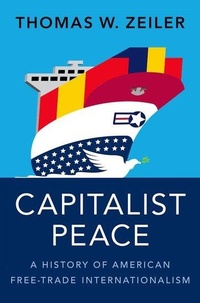
Capitalist Peace
A History of American Free-Trade Internationalism
Published on 14. November 2022
Book
Hardback
384 pages
978-0-19-762136-3 (ISBN)
Description
A wide-ranging history of modern America that argues that free trade has been an engine of US foreign policy and the key to global prosperity.
Surprisingly, exports and imports, tariffs and quotas, and trade deficits and surpluses are central to American foreign relations. Ever since Franklin D. Roosevelt took office during the Great Depression, the United States has linked trade to its long-term diplomatic objectives and national security. Washington, DC saw free trade as underscoring its international leadership and as instrumental to global prosperity, to winning wars and peace, and to shaping the liberal internationalist world order. Free trade, in short, was a cornerstone of an ideology of "capitalist peace."
Covering nearly a century, Capitalist Peace provides the first chronologically sweeping look at the intersection of trade and diplomacy. This policy has been pursued oftentimes at a cost to US producers and workers, whose interests were sacrificed to serve the purpose of grand strategy. To be sure, capitalists sought a particular type of global trade, which harnessed the market through free trade. This liberal trade policy sought the common good as defined by the needs, aims, and strengths of the capitalist and democratic world. Leaders believed that free trade advanced private enterprise, which, in turn, promoted prosperity, democracy, security, and attendant by-products like development, cooperation, integration, and human rights. The capitalist peace took liberalization as integral to cooperation among nations and even to morality in global affairs. Drawing on new research from the Reagan, George H.W. Bush, Clinton, and George W. Bush presidential libraries, as well as business/ industry and civic association archives, Thomas W. Zeiler narrates this history from the road to World War II, through the Cold War, to the resurgent protectionism of the Trump era and up to the present.
Offering a new interpretation of diplomatic history, Capitalist Peace shows how US power, interests, and values were projected into the international arena even as capitalism brought both positive and negative results to the global order.
Surprisingly, exports and imports, tariffs and quotas, and trade deficits and surpluses are central to American foreign relations. Ever since Franklin D. Roosevelt took office during the Great Depression, the United States has linked trade to its long-term diplomatic objectives and national security. Washington, DC saw free trade as underscoring its international leadership and as instrumental to global prosperity, to winning wars and peace, and to shaping the liberal internationalist world order. Free trade, in short, was a cornerstone of an ideology of "capitalist peace."
Covering nearly a century, Capitalist Peace provides the first chronologically sweeping look at the intersection of trade and diplomacy. This policy has been pursued oftentimes at a cost to US producers and workers, whose interests were sacrificed to serve the purpose of grand strategy. To be sure, capitalists sought a particular type of global trade, which harnessed the market through free trade. This liberal trade policy sought the common good as defined by the needs, aims, and strengths of the capitalist and democratic world. Leaders believed that free trade advanced private enterprise, which, in turn, promoted prosperity, democracy, security, and attendant by-products like development, cooperation, integration, and human rights. The capitalist peace took liberalization as integral to cooperation among nations and even to morality in global affairs. Drawing on new research from the Reagan, George H.W. Bush, Clinton, and George W. Bush presidential libraries, as well as business/ industry and civic association archives, Thomas W. Zeiler narrates this history from the road to World War II, through the Cold War, to the resurgent protectionism of the Trump era and up to the present.
Offering a new interpretation of diplomatic history, Capitalist Peace shows how US power, interests, and values were projected into the international arena even as capitalism brought both positive and negative results to the global order.
Reviews / Votes
This book provides detailed evidence of how, from the Great Depression to the present, the United States has used economic influence to promote its foreign policy objectives...This book shows how important the deliberate use of economic influence was in shaping the postwar world. It offers a formidable defense of free trade as critical to maintaining the international order and outlines the serious consequences of US's neglect of its leadership role * Choice * This book provides detailed evidence of how, from the Great Depression to the present, the United States has used economic influence to promote its foreign policy objectives....For most of this period, 'free-trade internationalism' was the policy of both Democratic and Republican presidential administrations. However, particularly during times of economic stress, domestic political forces challenged this policy. Zeiler argues that advocates of free-trade internationalism were aware of the economic and political costs, but the diplomatic benefits-namely, curbing the influence of the Soviet Union and promoting peace-outweighed the costs. This book shows how important the deliberate use of economic influence was in shaping the postwar world. It offers a formidable defense of free trade as critical to maintaining the international order and outlines the serious consequences of US's neglect of its leadership role. * Choice * At a time when the world order seems to be crumbling, Thomas Zeiler provides a detailed examination of how US foreign policymakers have tried for decades to construct a 'capitalist peace.' This topical and fascinating contribution deserves our attention. * Douglas Irwin, Dartmouth College * In this sweeping survey of free trade ideology since the Great Depression, Thomas Zeiler offers a robust defense of capitalist liberalism as having shaped American history-and the world-mostly for the better. Richly researched, innovative, and thoughtful, this is a book to be reckoned with. * Barbara Keys, author of Reclaiming American Virtue: The Human Rights Revolution of the 1970s * Capitalist Peace is a highly significant and timely intervention in the ongoing debate over the proper role of American economic power in the international system. Richly documented and argued with sophistication and clarity, Thomas Zeiler's work provides a fresh examination of twentieth-century America's free trade policy and the ideological imperatives its advocates proclaimed. With the importance of international trade once again paramount in our political debates, the book is essential reading for policymakers and the public alike. * Thomas A. Schwartz, author of Henry Kissinger and American Power: A Political Biography * Thomas Zeiler provides a learned account of an essential subject: America's use of trade liberalization as an instrument not just of domestic prosperity but also of international peace and security. Spanning from the rise of free-trade internationalism in the 1930s to the agenda's possible fall today, Zeiler reveals how profoundly Donald Trump and other nationalists have turned away from the longstanding pursuit of 'capitalist peace'-but also how the seeds of the revolt were planted long ago. This history of economic statecraft across the American Century could not be more timely. * Stephen Wertheim, author of Tomorrow, the World: The Birth of U.S. Global Supremacy *More details
Language
English
Place of publication
New York
United States
Target group
Professional and scholarly
Illustrations
25 black and white halftones
Dimensions
Height: 164 mm
Width: 237 mm
Thickness: 33 mm
Weight
671 gr
ISBN-13
978-0-19-762136-3 (9780197621363)
Copyright in bibliographic data and cover images is held by Nielsen Book Services Limited or by the publishers or by their respective licensors: all rights reserved.
Schweitzer Classification
Other editions
Additional editions
E-Book
08/2022
OUP eBook
€15.49
Available for download
E-Book
08/2022
OUP eBook
€15.49
Available for download
Person
Thomas W. Zeiler is a Professor of History and Director of the Program in International Affairs at the University of Colorado Boulder. He is the author and editor of numerous books, including Free Trade, Free World: America and the Advent of GATT, Globalization and the American Century, and Annihilation: A Global Military History of World War II (OUP, 2010). He served as the President of the Society for Historians of American Foreign Relations and as editor of its journal, Diplomatic History.
Content
Acknowledgments
Abbreviations
Introduction Capitalist Peace
Chapter 1 Depression, 1930-1935
Chapter 2 Dictators, 1936-1940
Chapter 3 Universalism, 1941-1945
Chapter 4 Security, 1946-1950
Chapter 5 Containment, 1951-1954
Chapter 6 Offensive, 1955-1958
Chapter 7 Competition, 1959-1963
Chapter 8 Revolt, 1964-1970
Chapter 9 Shock, 1971-1979
Chapter 10 Victory, 1980-1990
Chapter 11 Globalization, 1991-2000
Chapter 12 Crisis, 2001-2021
Conclusion A Near-Century of Capitalist Peace
Notes
Bibliography
Index
Abbreviations
Introduction Capitalist Peace
Chapter 1 Depression, 1930-1935
Chapter 2 Dictators, 1936-1940
Chapter 3 Universalism, 1941-1945
Chapter 4 Security, 1946-1950
Chapter 5 Containment, 1951-1954
Chapter 6 Offensive, 1955-1958
Chapter 7 Competition, 1959-1963
Chapter 8 Revolt, 1964-1970
Chapter 9 Shock, 1971-1979
Chapter 10 Victory, 1980-1990
Chapter 11 Globalization, 1991-2000
Chapter 12 Crisis, 2001-2021
Conclusion A Near-Century of Capitalist Peace
Notes
Bibliography
Index