

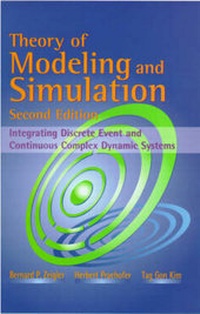
Theory of Modeling and Simulation
Discrete Event & Iterative System Computational Foundations
2nd Edition
Published on 18. January 2000
Book
Hardback
536 pages
978-0-12-778455-7 (ISBN)
Description
The increased computational power and software tools available to engineers have increased the use and dependence on modeling and computer simulation throughout the design process. These tools have given engineers the capability of designing highly complex systems and computer architectures that were previously unthinkable. Every complex design project, from integrated circuits, to aerospace vehicles, to industrial manufacturing processes requires these new methods. This book fulfills the essential need of system and control engineers at all levels in understanding modeling and simulation. This book, written as a true text/reference has become a standard sr./graduate level course in all EE departments worldwide and all professionals in this area are required to update their skills.The book provides a rigorous mathematical foundation for modeling and computer simulation. It provides a comprehensive framework for modeling and simulation integrating the various simulation approaches. It covers model formulation, simulation model execution, and the model building process with its key activities model abstraction and model simplification, as well as the organization of model libraries. Emphasis of the book is in particular in integrating discrete event and continuous modeling approaches as well as a new approach for discrete event simulation of continuous processes. The book also discusses simulation execution on parallel and distributed machines and concepts for simulation model realization based on the High Level Architecture (HLA) standard of the Department of Defense.
Reviews / Votes
From Book News, Inc."In addition to students of general and mathematical systems theory or of computer and information sciences, Zeigler (electrical and computer engineering, U. of Arizona) argues that students of any science and of business also benefit from knowing the theory of modeling. For students with a solid background in mathematics at the graduate or senior undergraduate level, he constructs a framework in which the concepts can be sketched in abstract forms and embodied in concrete modeling situations to further illuminate them. The first edition was published by Wiley Interscience in 1976; the second has been almost totally rewritten, for which task Zeigler has conscripted Herbert Praehoffer (systems science, Johannes Kepler U., Linz, Austria) and Tag Gon Kim (electrical engineering, Korea Advanced Institute of Science and Technology, Taejon)" --Book News, Inc. (R), Portland, OR
More details
Edition
2nd edition
Language
English
Place of publication
San Diego
United States
Publishing group
Elsevier Science Publishing Co Inc
Target group
College/higher education
Senior undergraduate and graduate courses in departments of electrical engineering, systems science, and computer engineering. Professional engineers in the following areas, control, system engineering, system theory, modeling and simulation, and computer science.
Edition type
New edition
Dimensions
Height: 254 mm
Width: 178 mm
Weight
1080 gr
ISBN-13
978-0-12-778455-7 (9780127784557)
Copyright in bibliographic data and cover images is held by Nielsen Book Services Limited or by the publishers or by their respective licensors: all rights reserved.
Schweitzer Classification
Other editions
New editions
Bernard P. Zeigler | Alexandre Muzy | Ernesto Kofman
Theory of Modeling and Simulation
Discrete Event & Iterative System Computational Foundations
Book
08/2018
3rd Edition
Academic Press
€121.31
Shipment within 15-20 days
Persons
Bernard P. Zeigler, is a Professor of Electrical & Computer Engineering at the University of Arizona and co-director of the Arizona Center for Integrative Modeling and Simulation. He is the author of numerous books and publications, a Fellow of the IEEE, and of the Society for Modeling and Simulation International. Zeigler is currently heading a project for the Joint Interoperability Test Command (JITC) where he is leading the design of the future architecture for large distributed simulation events for the Joint Distributed Engineering Plant (JDEP). He is also developing DEVS-methodology approaches for testing mission thread end-to-end interoperability and combat effectiveness of Defense Department acquisitions and transitions to the Global Information Grid with its Service Oriented Architecture (GIG/SOA). Herbert Praehofer is an Assistant Professor at the Johannes Kepler University in Linz, Austria. He has over 50 publications in international journals and conference proceedings on Modeling and Computer Simulation, Systems Theory, and Software Engineering. Tag Gon Kim is a Professor of Electrical Engineering at the Korea Advanced Institute of Science and Technology (KAIST), Taejon, Korea. His research interests include discrete event systems modeling/simulation, computer/communication systems analysis, and object-oriented simulation engineering. He is a senior member of IEEE and SCS, and a member of ACM.
Content
Part I: Basics.
Introduction to Systems Modeling Concepts.
Framework for Modeling and Simulation.
Modeling Formalisms and Their Simulators.
Introduction to Discrete Event System Specifications (DEVS).
Hierarchy of System Specifications.
Part II: Modeling Formalisms and Simulation Algorithms.
Basic Formalisms: DEVS, DTSS, DESS.
Basic Formalisms: Coupled Multicomponent Systems.
Simulators for Basic Formalisms.
Multiformalism Modeling and Simulation.
DEVS-Based Extended Formalisms.
Parallel and Distributed Discrete Event Simulation.
Part III: System Morphisms: Abstraction, Representation, Approximation.
Hierarchy of System Morphisms.
Abstraction: Constructing Model Families.
Verification, Validation, Approximate Morphisms: Living with Error.
DEVS and DEVS-like Systems: Universality and Uniqueness.
DEVS Representation of Systems.
Part IV: System Design and Modeling and Simulation Environments.
DEVS-Based Design Methodology.
System Entity Structure/Model Base Framework.
Collaboration and the Future.
Introduction to Systems Modeling Concepts.
Framework for Modeling and Simulation.
Modeling Formalisms and Their Simulators.
Introduction to Discrete Event System Specifications (DEVS).
Hierarchy of System Specifications.
Part II: Modeling Formalisms and Simulation Algorithms.
Basic Formalisms: DEVS, DTSS, DESS.
Basic Formalisms: Coupled Multicomponent Systems.
Simulators for Basic Formalisms.
Multiformalism Modeling and Simulation.
DEVS-Based Extended Formalisms.
Parallel and Distributed Discrete Event Simulation.
Part III: System Morphisms: Abstraction, Representation, Approximation.
Hierarchy of System Morphisms.
Abstraction: Constructing Model Families.
Verification, Validation, Approximate Morphisms: Living with Error.
DEVS and DEVS-like Systems: Universality and Uniqueness.
DEVS Representation of Systems.
Part IV: System Design and Modeling and Simulation Environments.
DEVS-Based Design Methodology.
System Entity Structure/Model Base Framework.
Collaboration and the Future.