

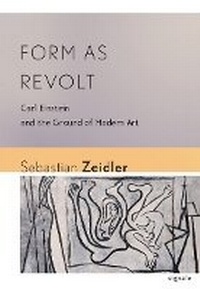
Form As Revolt
Carl Einstein and the Ground of Modern Art
Published on 22. January 2016
Book
Hardback
277 pages
978-1-5017-0208-2 (ISBN)
Description
The German writer and art critic Carl Einstein (1885-1940) has long been acknowledged as an important figure in the history of modern art, and yet he is often sidelined as an enigma. In Form as Revolt Sebastian Zeidler recovers Einstein's multifaceted career, offering the first comprehensive intellectual biography of Einstein in English.
Einstein first emerged as a writer of experimental prose through his involvement with the anarchist journal Die Aktion. After a few limited forays into art criticism, he burst onto the art scene in 1915 with his book Negro Sculpture, at once a formalist intervention into the contemporary theory and practice of European sculpture and a manifesto for the sophistication of African art. Einstein would go on to publish seminal texts on the cubist paintings of Georges Braque and Pablo Picasso. His contributions to the surrealist magazine Documents (which Einstein cofounded with Georges Bataille), including writings on Picasso and Paul Klee, remain unsurpassed in their depth and complexity. In a series of close visual analyses-illustrated with major works by Braque, Picasso, and Klee-Zeidler retrieves the theoretical resources that Einstein brought to bear on their art. Form as Revolt shows us that to rediscover Einstein's art criticism is to see the work of great modernist artists anew through the eyes of one of the most gifted left-wing formalists of the twentieth century.
Einstein first emerged as a writer of experimental prose through his involvement with the anarchist journal Die Aktion. After a few limited forays into art criticism, he burst onto the art scene in 1915 with his book Negro Sculpture, at once a formalist intervention into the contemporary theory and practice of European sculpture and a manifesto for the sophistication of African art. Einstein would go on to publish seminal texts on the cubist paintings of Georges Braque and Pablo Picasso. His contributions to the surrealist magazine Documents (which Einstein cofounded with Georges Bataille), including writings on Picasso and Paul Klee, remain unsurpassed in their depth and complexity. In a series of close visual analyses-illustrated with major works by Braque, Picasso, and Klee-Zeidler retrieves the theoretical resources that Einstein brought to bear on their art. Form as Revolt shows us that to rediscover Einstein's art criticism is to see the work of great modernist artists anew through the eyes of one of the most gifted left-wing formalists of the twentieth century.
Reviews / Votes
Sebastian Zeidler presents not only a detailed, rigorous analysis of Einstein's fragmentary, gnomic writings, but a provocative extrapolation of their potentials.... Among other things, Form as Revolt is an impressive exercise in intellectual history, ranging with ease from Novalis and Hegel to Rosa Luxemburg, Lucien Levy-Bruhl, and beyond.... Form as Revolt is a far-reaching, learned, and ambitious volume.... In this book, over and above the vital contribution he makes to the reception of his hero, Carl Einstein, Sebastian Zeidler takes his own place among the leading critical historians of modernist art.(CAA Reviews) Zeidlers Buch fuehrt in Eisteins literarisches und kunsttheoretisches Werk ein, sprengt aber zugleich das Format der Monografie an so gut wie jedem Punkt seines Textes. Form as Revolt handelt entschieden weniger ueber den historischen Autor als mit ihm. Im skrupuloesen, am Poststrukturalismus, an Derrida und Deleuze geschulten Versuch, die spezifische Verschraenkung von Formen und Inhalten in Einsteins Denken und Schreiben herauszuarbeiten, um Einstein gewissermassen neu zu schaffen, entdeckt und entwickelt Zeilder die Elemente einer Kunstgeschichte der Moderne vor dem Hintergrund der offenkundigen Krise wesentlicher Achsen der Disziplin, von der Semiologie bis zur social art history.
(Kunstform) Form as Revolt is the inverse of esoteric; it ceaselessly winnows away the abstruse to place difficult art and thought within reach, but not in dumbed-down ways. To say this volume offers a remarkably insightful contribution to scholarship on the history and criticism of early twentieth-century art would certainly be true, but even such an accolade would hardly speak to the significance-and the courage-of Zeidler's study.
(Critical Inquiry)
More details
Series
Language
English
Place of publication
Ithaca
United States
Publishing group
Cornell University Press
Product notice
Paper over boards
Illustrations
41 halftones, 22 color illustrations, 3 color plates - 41 Halftones, black and white
Dimensions
Height: 254 mm
Width: 178 mm
Weight
907 gr
ISBN-13
978-1-5017-0208-2 (9781501702082)
Copyright in bibliographic data and cover images is held by Nielsen Book Services Limited or by the publishers or by their respective licensors: all rights reserved.
Schweitzer Classification
Other editions
Additional editions
E-Book
01/2016
Cornell University Press and Cornell University Library
€28.49
Available for download
Person
Sebastian Zeidler is Associate Professor of the History of Art at Yale University.
Content
Carl Einstein: A LifeCarl Einstein: An Introduction1. The Lost Wanderer2. Sculpture Ungrounded3. Cubism's Passion4. The Double Style5. Private Mythologies