

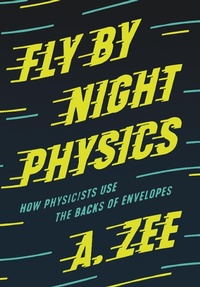
Fly by Night Physics
How Physicists Use the Backs of Envelopes
Published on 27. October 2020
Book
Hardback
448 pages
978-0-691-18254-4 (ISBN)
Description
The essential primer for physics students who want to build their physical intuition
Presented in A. Zee's incomparably engaging style, this book introduces physics students to the practice of using physical reasoning and judicious guesses to get at the crux of a problem. An essential primer for advanced undergraduates and beyond, Fly by Night Physics reveals the simple and effective techniques that researchers use to think through a problem to its solution-or failing that, to smartly guess the answer-before starting any calculations.
In typical physics classrooms, students seek to master an enormous toolbox of mathematical methods, which are necessary to do the precise calculations used in physics. Consequently, students often develop the unfortunate impression that physics consists of well-defined problems that can be solved with tightly reasoned and logical steps. Idealized textbook exercises and homework problems reinforce this erroneous impression. As a result, even the best students can find themselves completely unprepared for the challenges of doing actual research.
In reality, physics is replete with back of the envelope estimates, order of magnitude guesses, and fly by night leaps of logic. Including exciting problems related to cutting-edge topics in physics, from Hawking radiation to gravity waves, this indispensable book will help students more deeply understand the equations they have learned and develop the confidence to start flying by night to arrive at the answers they seek. For instructors, a solutions manual is available upon request.
Presented in A. Zee's incomparably engaging style, this book introduces physics students to the practice of using physical reasoning and judicious guesses to get at the crux of a problem. An essential primer for advanced undergraduates and beyond, Fly by Night Physics reveals the simple and effective techniques that researchers use to think through a problem to its solution-or failing that, to smartly guess the answer-before starting any calculations.
In typical physics classrooms, students seek to master an enormous toolbox of mathematical methods, which are necessary to do the precise calculations used in physics. Consequently, students often develop the unfortunate impression that physics consists of well-defined problems that can be solved with tightly reasoned and logical steps. Idealized textbook exercises and homework problems reinforce this erroneous impression. As a result, even the best students can find themselves completely unprepared for the challenges of doing actual research.
In reality, physics is replete with back of the envelope estimates, order of magnitude guesses, and fly by night leaps of logic. Including exciting problems related to cutting-edge topics in physics, from Hawking radiation to gravity waves, this indispensable book will help students more deeply understand the equations they have learned and develop the confidence to start flying by night to arrive at the answers they seek. For instructors, a solutions manual is available upon request.
More details
Language
English
Place of publication
New Jersey
United States
Target group
College/higher education
Professional and scholarly
Product notice
Trade binding
Illustrations
76 b/w illus. 2 tables.
Dimensions
Height: 256 mm
Width: 178 mm
Thickness: 27 mm
Weight
954 gr
ISBN-13
978-0-691-18254-4 (9780691182544)
Copyright in bibliographic data and cover images is held by Nielsen Book Services Limited or by the publishers or by their respective licensors: all rights reserved.
Schweitzer Classification
Other editions
Additional editions
E-Book
10/2020
1st Edition
Princeton University Press
€63.49
Available for download
Person
A. Zee is professor of physics at the Kavli Institute for Theoretical Physics at the University of California, Santa Barbara. His many books include On Gravity, Group Theory in a Nutshell for Physicists, Einstein Gravity in a Nutshell, Quantum Field Theory in a Nutshell, and Fearful Symmetry (all Princeton).