

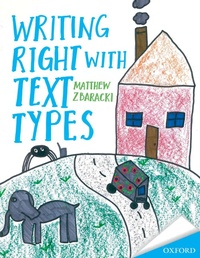
Writing Right with text Types
Published on 22. October 2015
Book
Paperback/Softback
288 pages
978-0-19-552791-9 (ISBN)
Description
Writing Right with Text Types is a practical and accessible text for pre-service teachers to learn about teaching writing.
The book focuses on how to teach children to write in different styles and to understand how texts are constructed. It highlights how different text types fit into multiple genres, and by incorporating samples of authentic children's writing, significant children's literature examples, and technology resources, it provides pre-service teachers with a range of innovative, fun, and engaging teaching ideas and classroom strategies to get children writing.
The book focuses on how to teach children to write in different styles and to understand how texts are constructed. It highlights how different text types fit into multiple genres, and by incorporating samples of authentic children's writing, significant children's literature examples, and technology resources, it provides pre-service teachers with a range of innovative, fun, and engaging teaching ideas and classroom strategies to get children writing.
More details
Language
English
Place of publication
Melbourne
Australia
Publishing group
Oxford University Press Australia
Target group
College/higher education
Product notice
Paperback (trade)
Unsewn / adhesive bound
Dimensions
Height: 244 mm
Width: 188 mm
Thickness: 23 mm
Weight
612 gr
ISBN-13
978-0-19-552791-9 (9780195527919)
Copyright in bibliographic data and cover images is held by Nielsen Book Services Limited or by the publishers or by their respective licensors: all rights reserved.
Schweitzer Classification
Person
Matthew Zbaracki is a Senior Lecturer in the Faculty of Education and Arts at the Australian Catholic University.
Content
1: IntroductionTeaching writingChildren's vocabulary developmentThe writing processGenres and text typesIntroducing the genre chaptersUsing children's literature to motivate young writersConclusion 2: GrammarIntroductionTraditional grammar: Knowing the parts of speech and what they doTraditional grammar versus functional grammarTeaching grammar meaningfullyConclusion 3: Getting ReadyIntroductionSpace to writeTime to writeInspiration to writeTools for writingFreedom to writeConclusion 4: AssessmentIntroductionAssessment for learningAssessment of learningAssessment as learningRubricsAssessment in this bookConclusion 5: HumourIntroductionIncongruity: The basis of humourIn depth: A short narrativeConclusion 6: NarrativesIntroductionStructuring and planning narrativesLanguage and grammar features of narrativesIn depth: A short narrativeConclusion 7: RecountsIntroductionStructuring and planning narrativesLanguage and grammar features of narrativesIn depth: A short narrativeConclusion 8: PersuasiveIntroductionStructuring and planning persuasive textsLanguage and grammar features of persuasive textsIn depth: Letters and advertisementsConclusion 9: Information ReportsIntroductionStructuring and planning information reportsLanguage and grammar features of information reportsIn depth: Book and news reportsConclusion 10: Procedural TextsIntroductionStructuring and planning procedural textsLanguage and grammar features of procedural textsIn depth: RecipesConclusion 11: ExplanationIntroductionStructures, language features, and planningIn depth: Explanation reportsThe importance of visualsConclusion 12: TransactionalIntroductionStructures, language features, and planningIn depth: Technology correspondenceConclusion 13: PoetryIntroductionLanguage and grammar features of poetryStructureIn depth: Key forms and types of poetryConclusion 14: Future GazingIntroduction: Technology and multimodalityBlended narratives and blended genresMultimodality, technology, and blended narratives in this bookPushing the boundariesConclusion