

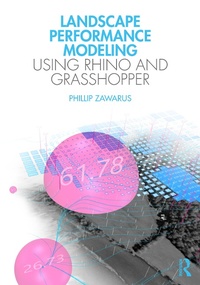
Landscape Performance Modeling Using Rhino and Grasshopper
1st Edition
Published on 30. December 2022
Book
Paperback/Softback
292 pages
978-1-032-07630-0 (ISBN)
Description
This is a guidebook for landscape architects to learn the fundamental practices and use of the computational software Rhino 3D and the plugin Grasshopper for parametric modeling, landscape inventory, and performative analysis. This process visually connects intangible and abstract information with physical and spatial relationships to signify the impact ecological, climate, and cultural factors have on landscape performance and decision making.
Each chapter begins with a summary of the performance method and its application in different projects, outlining the expected goals from industry standard equations and operations. Chapters cover parametric modeling scripts to measure ecosystem services of stormwater management, erosion control, tree benefits, outdoor comfort, accessibility, and many others. Using photographs, tables, and parametric scripts to create qualitative and quantitative representations of landscape performance and ecosystem services, readers will learn to communicate the impact and significance of their outputs.
This book will be beneficial to educators, students, and professionals interested in using computational modeling as a performance assessment and graphic visualization tool.
Each chapter begins with a summary of the performance method and its application in different projects, outlining the expected goals from industry standard equations and operations. Chapters cover parametric modeling scripts to measure ecosystem services of stormwater management, erosion control, tree benefits, outdoor comfort, accessibility, and many others. Using photographs, tables, and parametric scripts to create qualitative and quantitative representations of landscape performance and ecosystem services, readers will learn to communicate the impact and significance of their outputs.
This book will be beneficial to educators, students, and professionals interested in using computational modeling as a performance assessment and graphic visualization tool.
More details
Language
English
Place of publication
London
United Kingdom
Publishing group
Taylor & Francis Ltd
Target group
College/higher education
Professional and scholarly
Postgraduate, Professional, and Undergraduate Advanced
Illustrations
249 farbige Abbildungen, 243 Farbfotos bzw. farbige Rasterbilder, 6 farbige Zeichnungen
6 Line drawings, color; 243 Halftones, color; 249 Illustrations, color
Dimensions
Height: 254 mm
Width: 178 mm
Weight
1120 gr
ISBN-13
978-1-032-07630-0 (9781032076300)
Copyright in bibliographic data and cover images is held by Nielsen Book Services Limited or by the publishers or by their respective licensors: all rights reserved.
Schweitzer Classification
Other editions
Additional editions
Phillip Zawarus
Landscape Performance Modeling Using Rhino and Grasshopper
E-Book
12/2022
1st Edition
Routledge
€48.49
Available for download
Phillip Zawarus
Landscape Performance Modeling Using Rhino and Grasshopper
E-Book
12/2022
1st Edition
Routledge
€48.49
Available for download
Phillip Zawarus
Landscape Performance Modeling Using Rhino and Grasshopper
Book
12/2022
1st Edition
Routledge
€193.12
Shipment within 10-20 days
Person
Phillip Zawarus is an Associate Professor at the University of Nevada, Las Vegas. He utilizes technology and computational modeling methods as decision-making tools for the analysis and design response to sensitive ecological systems. His approach attempts to bridge the gap between abstract conventions and perceptual experiences within our living environment to bring comprehension of intangible ecosystem services. His exploration and use of graphic visualizations, interactive media, parametric modeling, and augmented reality create dynamic datascapes demonstrating landscape performance methods and metrics in the field of landscape architecture.
Content
Section 1 1. Introduction 2. Landscape Performance 3. Computational Modeling 4. Plugins Section 2 5. Landscape Conditions 6. Landscape Inventory Section 3 7. Runoff Rates - Rational Method 8. Runoff Volume - NRCS Method 9. Erodibility 10. Tree Benefits 11. Forest Succession 12. Shade Envelopes 13. Outdoor Comfort 14. Windbreaks 15. Walkability 16. Viewsheds Section 4 17. Conclusion