

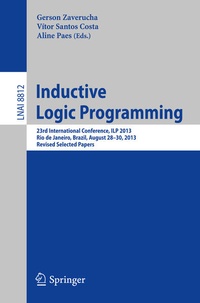
Inductive Logic Programming
23rd International Conference, ILP 2013, Rio de Janeiro, Brazil, August 28-30, 2013, Revised Selected Papers
Published on 7. October 2014
Book
Paperback/Softback
XIII, 141 pages
978-3-662-44922-6 (ISBN)
Description
This book constitutes the thoroughly refereed post-proceedings of the 23rd International Conference on Inductive Logic Programming, ILP 2013, held in Rio de Janeiro, Brazil, in August 2013.
The 9 revised extended papers were carefully reviewed and selected from 42 submissions. The conference now focuses on all aspects of learning in logic, multi-relational learning and data mining, statistical relational learning, graph and tree mining, relational reinforcement learning, and other forms of learning from structured data.
The 9 revised extended papers were carefully reviewed and selected from 42 submissions. The conference now focuses on all aspects of learning in logic, multi-relational learning and data mining, statistical relational learning, graph and tree mining, relational reinforcement learning, and other forms of learning from structured data.
More details
Series
Edition
2014 ed.
Language
English
Place of publication
Berlin
Germany
Publishing group
Springer Berlin
Target group
Professional and scholarly
Research
Illustrations
31 s/w Abbildungen
XIII, 141 p. 31 illus.
Dimensions
Height: 235 mm
Width: 155 mm
Thickness: 9 mm
Weight
248 gr
ISBN-13
978-3-662-44922-6 (9783662449226)
DOI
10.1007/978-3-662-44923-3
Schweitzer Classification
Other editions
Additional editions
Gerson Zaverucha | Vítor Santos Costa | Aline Paes
Inductive Logic Programming
23rd International Conference, ILP 2013, Rio de Janeiro, Brazil, August 28-30, 2013, Revised Selected Papers
E-Book
09/2014
Springer
€42.79
Available for download
Content
MetaBayes: Bayesian Meta-Interpretative Learning Using Higher-Order Stochastic Refinement.- On Differentially Private Inductive Logic Programming.- Learning Through Hypothesis Refinement Using Answer Set Programming.- A BDD-Based Algorithm for Learning from Interpretation Transition.- Accelerating Imitation Learning in Relational Domains via Transfer by Initialization.- A Direct Policy-Search Algorithm for Relational Reinforcement Learning.- AND Parallelism for ILP: The APIS System.- Generalized Counting for Lifted Variable Elimination.- A FOIL-Like Method for Learning under Incompleteness and Vagueness.