

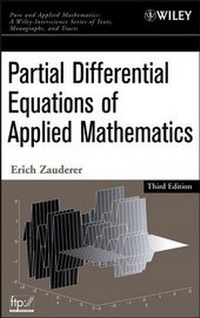
Partial Differential Equations of Applied Mathematics
3rd Edition
Published on 22. August 2006
Book
Hardback
968 pages
978-0-471-69073-3 (ISBN)
Description
This new edition features the latest tools for modeling, characterizing, and solving partial differential equations
The Third Edition of this classic text offers a comprehensive guide to modeling, characterizing, and solving partial differential equations (PDEs). The author provides all the theory and tools necessary to solve problems via exact, approximate, and numerical methods. The Third Edition retains all the hallmarks of its previous editions, including an emphasis on practical applications, clear writing style and logical organization, and extensive use of real-world examples.
Among the new and revised material, the book features:
* A new section at the end of each original chapter, exhibiting the use of specially constructed Maple procedures that solve PDEs via many of the methods presented in the chapters. The results can be evaluated numerically or displayed graphically.
* Two new chapters that present finite difference and finite element methods for the solution of PDEs. Newly constructed Maple procedures are provided and used to carry out each of these methods. All the numerical results can be displayed graphically.
* A related FTP site that includes all the Maple code used in the text.
* New exercises in each chapter, and answers to many of the exercises are provided via the FTP site. A supplementary Instructor's Solutions Manual is available.
The book begins with a demonstration of how the three basic types of equations-parabolic, hyperbolic, and elliptic-can be derived from random walk models. It then covers an exceptionally broad range of topics, including questions of stability, analysis of singularities, transform methods, Green's functions, and perturbation and asymptotic treatments. Approximation methods for simplifying complicated problems and solutions are described, and linear and nonlinear problems not easily solved by standard methods are examined in depth. Examples from the fields of engineering and physical sciences are used liberally throughout the text to help illustrate how theory and techniques are applied to actual problems.
With its extensive use of examples and exercises, this text is recommended for advanced undergraduates and graduate students in engineering, science, and applied mathematics, as well as professionals in any of these fields. It is possible to use the text, as in the past, without use of the new Maple material.
More details
Product info
gebunden
Series
Edition
3. Auflage
Language
English
Place of publication
United States
Publishing group
John Wiley & Sons Inc
Target group
Professional and scholarly
Product notice
Unsewn / adhesive bound
Paper over boards
Illustrations
Drawings: 23 B&W, 0 Color; Graphs: 43 B&W, 0 Color
Dimensions
Height: 244 mm
Width: 164 mm
Thickness: 50 mm
Weight
1442 gr
ISBN-13
978-0-471-69073-3 (9780471690733)
Schweitzer Classification
Other editions
Additional editions
Erich Zauderer
Partial Differential Equations of Applied Mathematics
E-Book
10/2011
3rd Edition
Wiley
€165.99
Available for download
Previous edition

Erich Zauderer
Partial Differential Equations of Applied Mathematics
Book
07/1989
2nd Edition
Wiley
€146.08
Article exhausted; check for reprint
Person
ERICH ZAUDERER, PhD, is Professor of Mathematics in the Department of Mathematics at Polytechnic University. Prior to joining the faculty of Polytechnic University, he was a Senior Weizmann Fellow at the Weizmann Institute of Science. His research interests include applied mathematics and nonlinear wave propagation, as well as perturbation and asymptotic solutions of partial differential equations.
Content
Preface.
1. Random Walks and Partial Differential Equations.
2. First Order Partial Differential Equations.
3. Classification of Equations and Characteristics.
4. Initial and Boundary Value Problems in Bounded Regions.
5. Integral Transforms.
6. Integral Relations.
7. Green's Functions.
8. variational and Other Methods.
9. Regular Perturbation Methods.
10. Asymptotic Methods.
11. Finite Difference Methods.
12. Finite Element Methods in Two Dimensions.
Bibliography.
Index.