

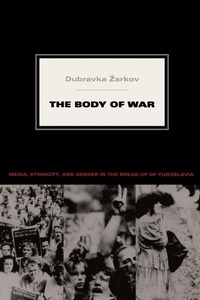
The Body of War
Media, Ethnicity, and Gender in the Break-up of Yugoslavia
Published on 3. September 2007
Book
Paperback/Softback
296 pages
978-0-8223-3966-3 (ISBN)
Description
In The Body of War, Dubravka Zarkov analyzes representations of female and male bodies in the Croatian and Serbian press in the late 1980s and in the early 1990s, during the war in which Yugoslavia disintegrated. Zarkov proposes that the Balkan war was not a war between ethnic groups; rather, ethnicity was produced by the war itself. Zarkov explores the process through which ethnicity was generated, showing how lived and symbolic female and male bodies became central to it. She does not posit a direct causal relationship between hate speech published in the press during the mid-1980s and the acts of violence in the war. Instead, she argues that both the representational practices of the "media war" and the violent practices of the "ethnic war" depended on specific, shared notions of femininity and masculinity, norms of (hetero)sexuality, and definitions of ethnicity. Tracing the links between the war and press representations of ethnicity, gender, and sexuality, Zarkov examines the media's coverage of two major protests by women who explicitly identified themselves as mothers, of sexual violence against women and men during the war, and of women as militants. She draws on contemporary feminist analyses of violence to scrutinize international and local feminist writings on the war in former Yugoslavia. Demonstrating that some of the same essentialist ideas of gender and sexuality used to produce and reinforce the significance of ethnic differences during the war often have been invoked by feminists, she points out the political and theoretical drawbacks to grounding feminist strategies against violence in ideas of female victimhood.
Reviews / Votes
"Dubravka Zarkov's remarkable book brings new insights to bear on the feminist theorizing of war. Nuanced, complex, lucid, and empirically grounded, Zarkov's powerful combination of the insider's understanding, passion, and emotional attachment with the academic's distance and rigor, makes this a hard-to-put-down read."-Urvashi Butalia, author of The Other Side of Silence: Voices from the Partition of India "Theoretically sophisticated and passionately argued, The Body of War shows how women's (and men's) bodies are implicated in the war in former Yugoslavia and its aftermath. Dubravka Zarkov courageously goes where others have feared to tread, rejecting too-easy assumptions that this was just a conflict between ethnic groups. Her book is a 'must read' for anyone interested in the ways gender and sexuality intersect to produce differences in ethnicity, thereby creating the pretext and the context for conflict and war."-Kathy Davis, author of The Making of Our Bodies, Ourselves: How Feminism Travels across Borders "The Body of War is the crowning achievement of Dubravka Zarkov's year-long research in media, gender and ethnicity during ethnic conflict in the former Yugoslavia. . . . The book is highly recommended to those interested not only in gender studies and issues of violence against women, but also to criminologists, victimologists, as well as scholars and activists in conflict, media and peace studies." - Vesna Nikolic-Ristanovic (Feminist Review) "This illuminating book is erudite and systematic. There is a lot in it that is very valuable, particularly the discussion on victimized fe/male bodies, making this book an important addition to the literature on how gender and sexuality intersect with ethnicity and produce war and war violence in specific circumstances and points in time." - Maja Korac (Nations and Nationalism) "While The Body of War provides an extremely useful feminist analysis for scholars and general readers on the discourses of the media during the Balkans conflict, it goes beyond discourse analysis to reflect upon, and intervene, in crucial current debates on feminist narrativization, historiography and practice. . . . Zarkov's treatment of themedia, feminist discourse and questions of history and representation in the context of armed conflict provides a very thoughtful, accessible and timely platform towards this goal." - Neloufer de Mel (European Journal of Women's Studies)More details
Series
Language
English
Place of publication
North Carolina
United States
Target group
Professional and scholarly
Product notice
Paperback (trade)
Illustrations
15 illustrations
Dimensions
Height: 234 mm
Width: 156 mm
Thickness: 18 mm
Weight
514 gr
ISBN-13
978-0-8223-3966-3 (9780822339663)
Copyright in bibliographic data and cover images is held by Nielsen Book Services Limited or by the publishers or by their respective licensors: all rights reserved.
Schweitzer Classification
Other editions
Additional editions

Dubravka Zarkov | Caren Kaplan | Robyn Wiegman
The Body of War
Media, Ethnicity, and Gender in the Break-up of Yugoslavia
E-Book
09/2007
1st Edition
De Gruyter
€198.99
Available for download
Person
Dubravka Zarkov is an Associate Professor in Gender, Conflict, and Development Studies at the Institute of Social Studies in The Hague. She is a coeditor of The Postwar Moment: Militaries, Masculinities, and International Peacekeeping and an associate editor of Focaal: European Journal of Anthropology.
Content
Acknowledgments ix
Introduction 1
Part I. The Maternal Body
1. The Whore against the Mother of All Serbs 19
2. Pictures of the Wall of Love 43
3. Troubles with Motherhood 69
Part II. The Victimized Body
4. The Body of All Serbs 85
5. All the Bodies of Croatia 102
6. Sexual Geographies of Ethnicity 116
7. On Victims and Villains 143
8. The Body of the Other Man 155
9. Troubles with the Victim 170
Part III. The Armed Body
10. Soldirs of Tradition 191
11. Troubles with Arms 212
Notes 233
Bibliography 257
Index 281
Introduction 1
Part I. The Maternal Body
1. The Whore against the Mother of All Serbs 19
2. Pictures of the Wall of Love 43
3. Troubles with Motherhood 69
Part II. The Victimized Body
4. The Body of All Serbs 85
5. All the Bodies of Croatia 102
6. Sexual Geographies of Ethnicity 116
7. On Victims and Villains 143
8. The Body of the Other Man 155
9. Troubles with the Victim 170
Part III. The Armed Body
10. Soldirs of Tradition 191
11. Troubles with Arms 212
Notes 233
Bibliography 257
Index 281