

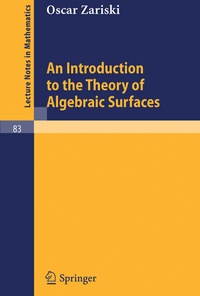
An Introduction to the Theory of Algebraic Surfaces
Published on 1. January 1969
Book
Paperback/Softback
CXII, 106 pages
978-3-540-04602-8 (ISBN)
Description
Homogeneous and non-homogeneous point coordinates.- Coordinate rings of irreducible varieties.- Normal varieties.- Divisorial cycles on a normal projective variety V/k (dim(V)=r?1).- Linear systems.- Divisors on an arbitrary variety V.- Intersection theory on algebraic surfaces (k algebraically closed).- Differentials.- The canonical system on a variety V.- Trace of a differential.- The arithemetic genus.- Normalization and complete systems.- The Hilbert characteristic function and the arithmetic genus of a variety.- The Riemann-Roch theorem.- Subadjoint polynomials.- Proof of the fundamental lemma.
More details
Series
Edition
1st ed. 1969. 2nd printing 1972
Language
English
Place of publication
Berlin
Germany
Publishing group
Springer Berlin
Target group
Professional and scholarly
Research
Illustrations
CXII, 106 p.
Dimensions
Height: 235 mm
Width: 155 mm
Thickness: 7 mm
Weight
178 gr
ISBN-13
978-3-540-04602-8 (9783540046028)
DOI
10.1007/BFb0082246
Schweitzer Classification
Person
Biography of Oscar Zariski
Oscar Zariski (24.4.1899-4.7.1986) was born in Kobryn, Poland, and studied at the universities of Kiev and Rome. He held positions at Rome University, John Hopkins University, the University of Illinois and from 1947 at Harvard University.
Zariski's main fields of activity were in algebraic geometry, algebra, algebraic function theory and topology. His most influential results bear on algebraic surfaces, the resolution of singularities and the foundations of algebraic geometry over arbitrary fields.
Content
Homogeneous and non-homogeneous point coordinates.- Coordinate rings of irreducible varieties.- Normal varieties.- Divisorial cycles on a normal projective variety V/k (dim(V)=r?1).- Linear systems.- Divisors on an arbitrary variety V.- Intersection theory on algebraic surfaces (k algebraically closed).- Differentials.- The canonical system on a variety V.- Trace of a differential.- The arithemetic genus.- Normalization and complete systems.- The Hilbert characteristic function and the arithmetic genus of a variety.- The Riemann-Roch theorem.- Subadjoint polynomials.- Proof of the fundamental lemma.