

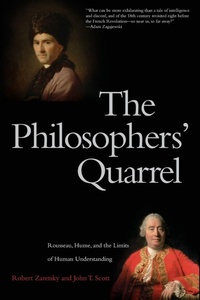
The Philosophers' Quarrel
Rousseau, Hume, and the Limits of Human Understanding
Will be published approx. on 2. March 2010
Book
Paperback/Softback
264 pages
978-0-300-16428-2 (ISBN)
Description
The dramatic collapse of the friendship between Rousseau and Hume, in the context of their grand intellectual quest to conquer the limits of human understanding.
The rise and spectacular fall of the friendship between the two great philosophers of the eighteenth century, barely six months after they first met, reverberated on both sides of the Channel. As the relationship between Jean-Jacques Rousseau and David Hume unraveled, a volley of rancorous letters was fired off, then quickly published and devoured by aristocrats, intellectuals, and common readers alike. Everyone took sides in this momentous dispute between the greatest of Enlightenment thinkers.
In this lively and revealing book, Robert Zaretsky and John T. Scott explore the unfolding rift between Rousseau and Hume. The authors are particularly fascinated by the connection between the thinkers' lives and thought, especially the way that the failure of each to understand the other-and himself-illuminates the limits of human understanding. In addition, they situate the philosophers' quarrel in the social, political, and intellectual milieu that informed their actions, as well as the actions of the other participants in the dispute, such as James Boswell, Adam Smith, and Voltaire. By examining the conflict through the prism of each philosopher's contribution to Western thought, Zaretsky and Scott reveal the implications for the two men as individuals and philosophers as well as for the contemporary world.
The rise and spectacular fall of the friendship between the two great philosophers of the eighteenth century, barely six months after they first met, reverberated on both sides of the Channel. As the relationship between Jean-Jacques Rousseau and David Hume unraveled, a volley of rancorous letters was fired off, then quickly published and devoured by aristocrats, intellectuals, and common readers alike. Everyone took sides in this momentous dispute between the greatest of Enlightenment thinkers.
In this lively and revealing book, Robert Zaretsky and John T. Scott explore the unfolding rift between Rousseau and Hume. The authors are particularly fascinated by the connection between the thinkers' lives and thought, especially the way that the failure of each to understand the other-and himself-illuminates the limits of human understanding. In addition, they situate the philosophers' quarrel in the social, political, and intellectual milieu that informed their actions, as well as the actions of the other participants in the dispute, such as James Boswell, Adam Smith, and Voltaire. By examining the conflict through the prism of each philosopher's contribution to Western thought, Zaretsky and Scott reveal the implications for the two men as individuals and philosophers as well as for the contemporary world.
More details
Language
English
Place of publication
United States
Target group
College/higher education
Professional and scholarly
Product notice
Paperback (trade)
Illustrations
10 b-w illus.
Dimensions
Height: 235 mm
Width: 157 mm
Thickness: 23 mm
Weight
311 gr
ISBN-13
978-0-300-16428-2 (9780300164282)
Copyright in bibliographic data and cover images is held by Nielsen Book Services Limited or by the publishers or by their respective licensors: all rights reserved.
Schweitzer Classification
Persons
Robert Zaretsky is professor of French, Honors College, University of Houston. John T. Scott is professor of political science, University of California, Davis. Zaretsky and Scott are also coauthors of Frail Happiness: An Essay on Rousseau.