

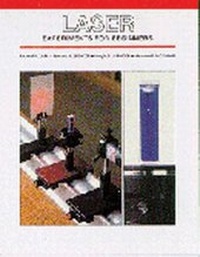
Laser Experiments For Beginners
Will be published approx. on 4. May 1995
Book
Paperback/Softback
256 pages
978-0-935702-36-1 (ISBN)
Description
The book presents a series of experiments for in-class demonstrations or student activities, using a low-cost, low-power laser. Quick-reference instructions identify needed equipment, recommend safety practices and help select desired experiments. The book is designed to enhance existing courses in chemistry, physics and biology.
"... I heartily recommend this book as a source of experiments and ideas for those of us teaching optical physics and chemistry to undergraduates." Physics Today
"... I heartily recommend this book as a source of experiments and ideas for those of us teaching optical physics and chemistry to undergraduates." Physics Today
More details
Persons
Richard N. Zare is the Marguerite Blake Wilbur Professor in Natural Science at Stanford University. He is a graduate of Harvard University, where he received his B.A. degree in chemistry and physics in 1961 and his Ph.D. in chemical physics in 1964. In 1965 he became an assistant professor at the Massachusetts Institute of Technology, but moved to the University of Colorado in 1966, remaining there until 1969 while holding joint appointments in the departments of chemistry, and physics and astrophysics. In 1969 he was appointed to a full professorship in the chemistry department at Columbia University, becoming the Higgins Professor of Natural Science in 1975. In 1977 he moved to Stanford University. He was named Chair of the Department of Chemistry at Stanford University in 2005. In 2006 he was named a Howard Hughes Medical Institute (HHMI) Professor.
Content
Introduction: Choosing an Experiment
l. Equipment, Safety, and Disposal
2. Light Scattering from Disordered Systems
3. Diffraction: Light Scattering from Ordered Systems
4. Refraction of Light
5. The Electronic Structure of Matter
6. Photochemistry
Appendix: Chemical Safety
l. Equipment, Safety, and Disposal
2. Light Scattering from Disordered Systems
3. Diffraction: Light Scattering from Ordered Systems
4. Refraction of Light
5. The Electronic Structure of Matter
6. Photochemistry
Appendix: Chemical Safety