

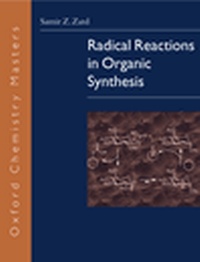
Radical Reactions in Organic Synthesis
Published on 23. October 2003
Book
Hardback
268 pages
978-0-19-850241-8 (ISBN)
Description
The Oxford Chemistry Masters Series is designed to provide clear and concise accounts of important topics - both established and emergent - that may be encountered by chemistry students as they progress from the senior undergraduate stage through post-graduate study to leadership in research. These Masters assume little prior knowledge, other than the foundations provided by an undergraduate degree in chemistry, and lead the reader through to an appreciation of the
state of the art in the topic whilst providing an entree to the primary literature in the field.
Radical reactions exhibit many of the characteristics desired by synthetic organic chemists: mild, generally neutral experimental conditions; diminished susceptibility to eliminations and rearrangements; relative insensitivity to the nature of the solvent and to steric effects; a compatibility with functional groups that is often complementary to that of ionic and organometallic reactions, obviating in many situations the need for laborious and costly protection-deprotection steps. Yet
elementary radical reactions are ultra-fast processes and their taming requires some knowledge of their kinetics and rate constants, which have only relatively recently become available. Not surprisingly, transformations involving radical intermediates have long harboured the reputation of beeing difficult
to control, suitable only for the synthesis of polymers and tars.
This book provides a description of radical reactions and their applications in organic synthesis. It attempts to show that armed with an elementary knowledge of kinetics and some common sense, it is possible to harness radicals into a tremendously powerful tool for solving synthetic problems. The book starts with a brief historical account and presentation of the basics. It then blends the discussion of the properties of radical processes with the now familiar chemistry of stannanes. Radicals
being the same entities, whichever method is used to generate them, a study of the various processes for the creation and capture of radicals constitutes the remainder of the book. Silicon and mercury based techniques as well as the Barton and related decarboxylation procedures are discussed in
detail, followed by the Kharasch type atom and group transfer reactions. The increasingly important persistent radical effect, also known as the Fischer-Ingold effect, is examined in the context of non-chain reactions. Both the Kharasch based methods and the persistent radical effect have recently been applied in the emerging field of controlled radical polymerisations. Finally, the vast domain of redox processes is presented in a unified manner with the aim of providing a simple rationale for
the multitude of possible transformation. The book concludes with a brief overview and some general practical hints for conducting radical reactions. More than 700 references provide access to the primary literature.
state of the art in the topic whilst providing an entree to the primary literature in the field.
Radical reactions exhibit many of the characteristics desired by synthetic organic chemists: mild, generally neutral experimental conditions; diminished susceptibility to eliminations and rearrangements; relative insensitivity to the nature of the solvent and to steric effects; a compatibility with functional groups that is often complementary to that of ionic and organometallic reactions, obviating in many situations the need for laborious and costly protection-deprotection steps. Yet
elementary radical reactions are ultra-fast processes and their taming requires some knowledge of their kinetics and rate constants, which have only relatively recently become available. Not surprisingly, transformations involving radical intermediates have long harboured the reputation of beeing difficult
to control, suitable only for the synthesis of polymers and tars.
This book provides a description of radical reactions and their applications in organic synthesis. It attempts to show that armed with an elementary knowledge of kinetics and some common sense, it is possible to harness radicals into a tremendously powerful tool for solving synthetic problems. The book starts with a brief historical account and presentation of the basics. It then blends the discussion of the properties of radical processes with the now familiar chemistry of stannanes. Radicals
being the same entities, whichever method is used to generate them, a study of the various processes for the creation and capture of radicals constitutes the remainder of the book. Silicon and mercury based techniques as well as the Barton and related decarboxylation procedures are discussed in
detail, followed by the Kharasch type atom and group transfer reactions. The increasingly important persistent radical effect, also known as the Fischer-Ingold effect, is examined in the context of non-chain reactions. Both the Kharasch based methods and the persistent radical effect have recently been applied in the emerging field of controlled radical polymerisations. Finally, the vast domain of redox processes is presented in a unified manner with the aim of providing a simple rationale for
the multitude of possible transformation. The book concludes with a brief overview and some general practical hints for conducting radical reactions. More than 700 references provide access to the primary literature.
More details
Series
Language
English
Place of publication
Oxford
United Kingdom
Target group
Professional and scholarly
Illustrations
numerous figures
Dimensions
Height: 254 mm
Width: 194 mm
Thickness: 19 mm
Weight
660 gr
ISBN-13
978-0-19-850241-8 (9780198502418)
Copyright in bibliographic data and cover images is held by Nielsen Book Services Limited or by the publishers or by their respective licensors: all rights reserved.
Schweitzer Classification
Other editions
Additional editions
Samir Z. Zard
Radical Reactions in Organic Synthesis
Book
10/2003
Oxford University Press
€103.50
Shipment within 15-20 days
Person
Professor Samir Z. Zard
Departement de Synthese Organique, Ecole Polytechnique, 91128 Palaiseau, France
+ 33 (0)1 69 28 57 39
+ 33 (0)1 69 28 38 51
zard@poly.polytechnique.fr
Member of the RSC, the ACS, and the Societe Francaise de Chimie and has received a number of professional awards (The Organic Chemistry Division Prize of the Societe Francaise de Chimie (1992); the Clavel-Lespiau Prize of the French Academy of Science (1995); the Rhodia 2000 Prize)
Departement de Synthese Organique, Ecole Polytechnique, 91128 Palaiseau, France
+ 33 (0)1 69 28 57 39
+ 33 (0)1 69 28 38 51
zard@poly.polytechnique.fr
Member of the RSC, the ACS, and the Societe Francaise de Chimie and has received a number of professional awards (The Organic Chemistry Division Prize of the Societe Francaise de Chimie (1992); the Clavel-Lespiau Prize of the French Academy of Science (1995); the Rhodia 2000 Prize)
Content
Preface ; 1. Introduction and some general concepts ; 2. General principles: chain reactions based on stannane chemistry ; 3. Further chain reactions of stannanes ; 4. Organo-silicon, -germanium, and -mercury hydrides ; 5. The Barton decarboxylation and related reactions ; 6. Atom and group transfer reactions ; 7. The persistent radical effect: non-chain processes ; 8. Redox processes ; 9. Some concluding remarks