

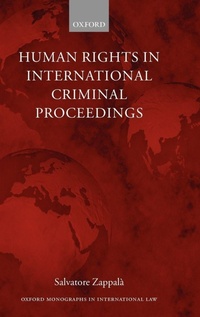
Human Rights in International Criminal Proceedings
Published on 6. March 2003
Book
Hardback
308 pages
978-0-19-925891-8 (ISBN)
Description
This book takes a procedural approach to human rights guarantees in international criminal proceedings and covers both the systems of the ad hoc Tribunals for the former Yugoslavia and Rwanda and the International Criminal Court. It analyzes the rights conferred on individuals involved in international criminal trials from the commencement of investigations to the sentencing stage, as well as the procedural rights of victims and witnesses.
The study focuses on problems which have emerged in three main areas: (i) length of proceedings; (ii) absence of specific sanctions and other remedies for violation of procedural rules; (iii) the need to strengthen the protection of the accused from undue interference with his rights (likely to be caused by a variety of factors, such as conflicting governmental interests, the presence of malicious witnesses, or inadequate legal assistance). Three general suggestions are made to reduce the impact of these weaknesses. First, it could be helpful to adopt specific sanctions for violation of procedural rules (such as, the exclusion of evidence as a remedy for violations of rules on discovery). Second, (as has already been provided for in the ICC Statute,) the Prosecutor of the ad hoc Tribunals should play a proactive role in the search for the truth, by among other things gathering evidence that might exonerate the accused. Third, the right of compensation for unlawful arrest (or detention) and unjust conviction, provided for in the ICC Statute, should be extended to other serious violations of fundamental rights, and in addition should be laid down in the Statutes of the ICTY and ICTR.
The study focuses on problems which have emerged in three main areas: (i) length of proceedings; (ii) absence of specific sanctions and other remedies for violation of procedural rules; (iii) the need to strengthen the protection of the accused from undue interference with his rights (likely to be caused by a variety of factors, such as conflicting governmental interests, the presence of malicious witnesses, or inadequate legal assistance). Three general suggestions are made to reduce the impact of these weaknesses. First, it could be helpful to adopt specific sanctions for violation of procedural rules (such as, the exclusion of evidence as a remedy for violations of rules on discovery). Second, (as has already been provided for in the ICC Statute,) the Prosecutor of the ad hoc Tribunals should play a proactive role in the search for the truth, by among other things gathering evidence that might exonerate the accused. Third, the right of compensation for unlawful arrest (or detention) and unjust conviction, provided for in the ICC Statute, should be extended to other serious violations of fundamental rights, and in addition should be laid down in the Statutes of the ICTY and ICTR.
Reviews / Votes
Human Rights in International Criminal Proceedings is a remarkable enquiry into the progressive consolidation of due process rights before international courts and tribunals. The author's analysis is at the same time wide-ranging and detailed. Contemporary issues are systematically put in historical perspective through a series of vivid sketches of the law and practice of the postwar international military tribunals. * Leiden Journal of International Law * The bulk of the book - note, however, that the author's concise style prevented the book from being bulky - is devoted to a fairly in-depth analysis of the jurisprudence of the International Criminal Tribunals for the former Yugoslavia (ICTY) and for the Rwanda (ICTR). Each chapter or section ends with comments on the relevant parts of the Statute of the International Criminal Court (ICC). * Leiden Journal of International Law * Zappala's monograph is above all an intelligently conceived, evenly structured book. It invites the reader to join the author on a smooth journey through the various stages of international criminal proceedings, contains valuable insights on the dynamics of the international criminal justice systems, and is not unforthcoming with practical suggestions for improvement...I am suggesting the reading of Zappala's book to all those who are interested in international law and have not yet read it.. * Leiden Journal of International Law *More details
Series
Language
English
Place of publication
Oxford
United Kingdom
Target group
Professional and scholarly
Dimensions
Height: 240 mm
Width: 161 mm
Thickness: 21 mm
Weight
634 gr
ISBN-13
978-0-19-925891-8 (9780199258918)
Copyright in bibliographic data and cover images is held by Nielsen Book Services Limited or by the publishers or by their respective licensors: all rights reserved.
Schweitzer Classification
Other editions
Additional editions
Salvatore Zappala
Human Rights in International Criminal Proceedings
Book
01/2005
Oxford University Press
€73.50
Shipment within 15-20 days
Person
Salvatore Zappala is Professor of international law at the University of Florence.
Content
1. INTRODUCTION ; A HUMAN RIGHTS APPROACH TO INTERNATIONAL CRIMINAL JUSTICE ; THE EXTENSION OF THE NOTION OF FAIR TRIAL TO INTERNATIONAL CRIMINAL PROCEEDINGS ; WHAT TYPE OF RELATIONSHIP EXISTS BETWEEN HUMAN RIGHTS MONITORING SYSTEMS AND INTERNATIONAL CRIMINAL COURTS? ; ACCUSATORIAL AND INQUISITORIAL MODELS IN INTERNATIONAL CRIMINAL PROCEDURE - TO WHAT EXTENT DO THEY IMPINGE UPON THE RIGHTS OF INDIVIDUALS? ; 2. THE RIGHTS OF PERSONS DURING INVESTIGATIONS ; THE INITIATION OF INVESTIGATIONS AND THE POWERS OF THE INVESTIGATIVE AUTHORITY ; THE RIGHTS OF SUSPECTS IN INTERNATIONAL CRIMINAL PROCEEDINGS ; 3. THE RIGHTS OF THE ACCUSED IN TRIAL PROCEEDINGS ; THE PRESUMPTION OF INNOCENCE ; THE RIGHT TO BE JUDGED BY AN INDEPENDENT AND IMPARTIAL TRIBUNAL ; THE RIGHT TO A FAIR AND EXPEDITIOUS TRIAL ; RULES OF EVIDENCE AND RIGHTS OF THE ACCUSED - SOME PROBLEMATICAL ISSUES ; 4. THE RIGHT OF THE ACCUSED TO APPEAL AND REVISION ; GENERAL - THE RIGHTS OF APPEAL AND REVISION AS A MEANS FOR OBTAINING REDRESS (JUDICIAL AND NON-JUDICIAL REMEDIES ; THE RIGHT OF THE ACCUSED TO APPEAL: FROM NUREMBERG AND TOKYO TO THE AD HOC TRIBUNALS AND THE ICC ; THE RIGHT OF CONVICTED PERSONS TO REVIEW ; CONCLUDING REMARKS ; 5. PENALTIES, ENFORCEMENT MECHANISMS AND THE RIGHTS OF CONVICTED PERSONS ; THE MAJOR GOALS OF INTERNATIONAL PENALTIES AND THE LEGAL EXPECTATIONS OF CONVICTED PERSONS ; THE ENFORCEMENT MECHANISMS AND THE RIGHTS OF SENTENCED PERSONS ; 6. THE POSITION OF PERSONS OTHER THAN THE ACCUSED ; VICTIMS ; WITNESSES ; 7. CONCLUDING REMARKS ; THE CENTRAL ROLE OF HUMAN RIGHTS IN INTERNATIONAL TRIALS: FROM NUREMBERG TO ROME ; THE PROBLEM OF PROCEDURAL MODELS: THE NEED FOR A PRINCIPLED APPROACH TO INTERNATIONAL CRIMINAL PROCEDURE ; RESPECT FOR HUMAN RIGHTS IN INTERNATIONAL TRIALS: A FEW OUTSTANDING PROBLEMS ; GENERAL SUGGESTIONS FOR IMPROVING HUMAN RIGHTS PROTECTION IN INTERNATIONAL CRIMINAL PROCEEDINGS