

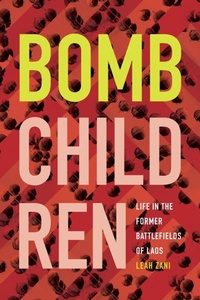
Bomb Children
Life in the Former Battlefields of Laos
Published on 26. July 2019
Book
Paperback/Softback
184 pages
978-1-4780-0485-1 (ISBN)
Description
Half a century after the CIA's Secret War in Laos-the largest bombing campaign in history-explosive remnants of war continue to be part of people's everyday lives. In Bomb Children Leah Zani offers a perceptive analysis of the long-term, often subtle, and unintended effects of massive air warfare. Zani traces the sociocultural impact of cluster submunitions-known in Laos as "bomb children"-through stories of explosives clearance technicians and others living and working in these old air strike zones. Zani presents her ethnography alongside poetry written in the field, crafting a startlingly beautiful analysis of state terror, authoritarian revival, rapid development, and ecological contamination. In so doing, she proposes that postwar zones are their own cultural and area studies, offering new ways to understand the parallel relationship between ongoing war violence and postwar revival.
Reviews / Votes
"Bomb Children is a riveting and reflexive account of war remains, military waste, and 'development' in contemporary Laos. As a document it bears/bares the hazardous conditions of its making, poised on the edge of blasts in the margins of safety zones that are never safe, in the collision and convergence between social ecologies riddled with minefields, and between remains and (economic) revival. Tacking between these 'paired conceptual frames' and a set of parallelisms that collapse war and peace and life and death, Bomb Children labors in an ethnographic mode that eschews the pornography of detailing mutilated bodies and instead looks to the war damages that are not over and that remain viscerally present in the everyday of people's lives." - Ann Laura Stoler, author of (Duress: Imperial Durabilities in Our Times) "Bomb Children is nothing short of breathtaking. Leah Zani presents little-known and incredibly important material on the everyday aftermath of the Secret War for the people of Laos. Her topic is not only ethnographically underexplored, but has been deliberately concealed by the U.S. government for decades. In Zani's hands, fieldwork becomes a flexible toolkit, selectively and strategically deployed to grasp the object of military wasting in a revealing and ethically responsible way." - Joshua O. Reno, author of (Waste Away: Working and Living with a North American Landfill) "A thoroughly original work, Bomb Children is likely to become a useful reference for students and scholars alike, and indeed anyone interested in the social consequences of airstrikes. It is also an arresting personal account of the hazards of fieldwork in a highly monitored and dangerous country." - Erin LIn (Pacific Affairs) "The book is a compelling study of the multifarious hazards haunting former war landscapes in Laos and a fascinating literary project. As an innovative and creative reflection of anthropological methods and epistemologies, the book is an excellent contribution to the discipline." - Oliver Tappe (Sojourn) "This is a daring, adventurous and inspiring ethnography of a kind rarely seen in this region. Zani's book will be a must-read for scholars of military waste and provides a valuable contribution to ongoing conversations about power in Lao PDR." - Holly High (South East Asia Research)More details
Language
English
Place of publication
North Carolina
United States
Target group
Professional and scholarly
Product notice
Paperback (trade)
Illustrations
17 illustrations
Dimensions
Height: 229 mm
Width: 152 mm
Thickness: 12 mm
Weight
404 gr
ISBN-13
978-1-4780-0485-1 (9781478004851)
Copyright in bibliographic data and cover images is held by Nielsen Book Services Limited or by the publishers or by their respective licensors: all rights reserved.
Schweitzer Classification
Other editions
Additional editions
E-Book
08/2019
1st Edition
De Gruyter
€188.99
Available for download
Person
Leah Zani is a Junior Fellow in the Social Science Research Network at the University of California, Irvine.
Content
Acknowledgments vii
Note on the Lao Language ix
Fieldpoem 30: Postwar 1
Introduction: The Fruit Eaters 3
Fieldpoem 11: The Fruit Eaters 36
1. The Dragon and the River 37
Fieldpoem 15: "The Rice Is More Delicious after Bomb Clearance" 64
2. Ghost Mine 65
Fieldpoem 23: Blast Radius 97
3. Blast Radius 98
Fieldpoem 26: House Blessings 130
Conclusion: Phaseout 131
Fieldpoem 18: Children 149
Appendix: Notes on Fieldpoems 151
References 155
Index 165
Note on the Lao Language ix
Fieldpoem 30: Postwar 1
Introduction: The Fruit Eaters 3
Fieldpoem 11: The Fruit Eaters 36
1. The Dragon and the River 37
Fieldpoem 15: "The Rice Is More Delicious after Bomb Clearance" 64
2. Ghost Mine 65
Fieldpoem 23: Blast Radius 97
3. Blast Radius 98
Fieldpoem 26: House Blessings 130
Conclusion: Phaseout 131
Fieldpoem 18: Children 149
Appendix: Notes on Fieldpoems 151
References 155
Index 165