

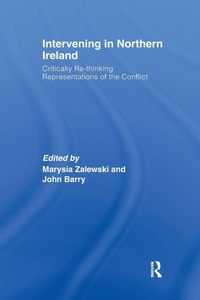
Intervening in Northern Ireland
Critically Re-thinking Representations of the Conflict
1st Edition
Published on 26. May 2016
Book
Paperback/Softback
176 pages
978-1-138-97316-9 (ISBN)
Description
The articles in this special issue, drawn from a workshop hosted by the Institute of Governance, Queen's University, Belfast, explicitly engage with and challenge conventional academic analyses in order to confront the ways in which the conflict on Northern Ireland has traditionally been represented and understood.
Part of the reason for adopting this approach is because it is suggested that to a certain extent, academic analyses have defined the parameters of the conflict which has necessarily had implications for the shape of ensuing solutions. A further claim is that the persistent historical and political search for causes and solutions may be constitutive of the problems that conventional analysts seek to resolve. The articles in the first part introduce and problematize traditional analyses of the conflict. Additionally, these essays explain alternative approaches offering other ways of thinking about how the 'problem' of Northern Ireland has been constituted. The second part comprises empirically focused essays, each either engaging with or confronting the issue of the liberal hegemony that defines most analyses of the conflict. The final essay returns to more explicitly re-consider how the 'problem' of Northern Ireland has been theorized, represented and understood.
This book was previously published as a special issue of Critical Review of International Social and Political Philosophy.
Part of the reason for adopting this approach is because it is suggested that to a certain extent, academic analyses have defined the parameters of the conflict which has necessarily had implications for the shape of ensuing solutions. A further claim is that the persistent historical and political search for causes and solutions may be constitutive of the problems that conventional analysts seek to resolve. The articles in the first part introduce and problematize traditional analyses of the conflict. Additionally, these essays explain alternative approaches offering other ways of thinking about how the 'problem' of Northern Ireland has been constituted. The second part comprises empirically focused essays, each either engaging with or confronting the issue of the liberal hegemony that defines most analyses of the conflict. The final essay returns to more explicitly re-consider how the 'problem' of Northern Ireland has been theorized, represented and understood.
This book was previously published as a special issue of Critical Review of International Social and Political Philosophy.
More details
Language
English
Place of publication
London
United Kingdom
Publishing group
Taylor & Francis Ltd
Target group
College/higher education
Professional and scholarly
Dimensions
Height: 234 mm
Width: 156 mm
Thickness: 10 mm
Weight
281 gr
ISBN-13
978-1-138-97316-9 (9781138973169)
Copyright in bibliographic data and cover images is held by Nielsen Book Services Limited or by the publishers or by their respective licensors: all rights reserved.
Schweitzer Classification
Other editions
Additional editions
Marysia Zalewski | John Barry
Intervening in Northern Ireland
Critically Re-thinking Representations of the Conflict
E-Book
02/2014
1st Edition
Routledge
€64.49
Available for download
Marysia Zalewski | John Barry
Intervening in Northern Ireland
Critically Re-thinking Representations of the Conflict
E-Book
02/2014
1st Edition
Routledge
€64.49
Available for download
Marysia Zalewski | John Barry
Intervening in Northern Ireland
Critically Re-thinking Representations of the Conflict
Book
09/2007
1st Edition
Routledge
€231.30
Shipment within 15-20 days
Persons
Dr Marysia Zalewski is Director of the Centre for Gender Studies at the University of Aberdeen, Scotland.,
Dr John Barry is Director of the Institute of Irish Studies at Queen's University Belfast.
Dr John Barry is Director of the Institute of Irish Studies at Queen's University Belfast.
Content
Chapter 1 Intervening in Northern Ireland: Critically re-thinking representations of the conflict, Marysia Zalewski; Chapter 2 The Local, the Global and the Troubling, Jenny Edkins; Chapter 3 Towards a Problematisation of the Problematisations that Reduce Northern Ireland to a 'Problem', Nick Vaughan-Williams; Chapter 4 Heidegger and the Aporia: Translation and Cultural Authenticity, Fiona Sampson; Chapter 5 'What's the Problem?': Political Theory, Rhetoric and Problem-Setting, Alan Finlayson; Chapter 6 Public Institutions, Overlapping Consensus and Trust, Ciaran O'Kelly; Chapter 7 The Virgin Mary Connection: Reflecting on Feminism and Northern Irish Politics, Fidelma Ashe; Chapter 8 Queering Community: Reimagining the Public Sphere in Northern Ireland, Kathryn Conrad; Chapter 9 The Politics of Community, Dominic Bryan; Chapter 10 Genealogies of Partition; History, History-Writing and 'the Troubles' in Ireland, Margaret O'Callaghan;