

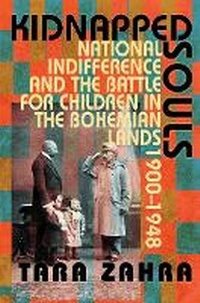
Kidnapped Souls
National Indifference and the Battle for Children in the Bohemian Lands, 1900-1948
Published on 7. July 2011
Book
Paperback/Softback
304 pages
978-0-8014-7760-7 (ISBN)
Description
Throughout the nineteenth and into the early decades of the twentieth century, it was common for rural and working-class parents in the Czech-German borderlands to ensure that their children were bilingual by sending them to live with families who spoke the "other" language. As nationalism became a more potent force in Central Europe, however, such practices troubled pro-German and pro-Czech activists, who feared that the children born to their nation could literally be "lost" or "kidnapped" from the national community through such experiences and, more generally, by parents who were either flexible about national belonging or altogether indifferent to it. Highlighting this indifference to nationalism-and concerns about such apathy among nationalists-Kidnapped Souls offers a surprising new perspective on Central European politics and society in the first half of the twentieth century.
Drawing on Austrian, Czech, and German archives, Tara Zahra shows how nationalists in the Bohemian Lands worked to forge political cultures in which children belonged more rightfully to the national collective than to their parents. Through their educational and social activism to fix the boundaries of nation and family, Zahra finds, Czech and German nationalists reveal the set of beliefs they shared about children, family, democracy, minority rights, and the relationship between the individual and the collective. Zahra shows that by 1939 a vigorous tradition of Czech-German nationalist competition over children had created cultures that would shape the policies of the Nazi occupation and the Czech response to it. The book's concluding chapter weighs the prehistory and consequences of the postwar expulsion of German families from the Bohemian Lands.
Kidnapped Souls is a significant contribution to our understanding of the genealogy of modern nationalism in Central Europe and a groundbreaking exploration of the ways in which children have been the objects of political contestation when national communities have sought to shape, or to reshape, their futures.
Drawing on Austrian, Czech, and German archives, Tara Zahra shows how nationalists in the Bohemian Lands worked to forge political cultures in which children belonged more rightfully to the national collective than to their parents. Through their educational and social activism to fix the boundaries of nation and family, Zahra finds, Czech and German nationalists reveal the set of beliefs they shared about children, family, democracy, minority rights, and the relationship between the individual and the collective. Zahra shows that by 1939 a vigorous tradition of Czech-German nationalist competition over children had created cultures that would shape the policies of the Nazi occupation and the Czech response to it. The book's concluding chapter weighs the prehistory and consequences of the postwar expulsion of German families from the Bohemian Lands.
Kidnapped Souls is a significant contribution to our understanding of the genealogy of modern nationalism in Central Europe and a groundbreaking exploration of the ways in which children have been the objects of political contestation when national communities have sought to shape, or to reshape, their futures.
Reviews / Votes
Tara Zahra captures and exhibits the elusive with remarkable documentation, impressive hard work, and exemplary historian's craft. Kidnapped Souls is not only an excellent book for providing the history of the essentially invisible actors (children), but, is also an exceptional achievement in writing the history of an absence (indifference to nationalism).(Canadian Journal of History) This innovative, thoroughly researched, comprehensive book breaks with traditional scholarship in important respects and poses fresh new historical questions. It is sure to be mined by a generation of readers for its rich contextualization and thoughtful analyses.
(American Historical Review) Solidly anchored in archival research, this book is situated squarely within the history of the European welfare state and helps blur the line between 'us' and 'them/the Other' that still exists between 'Eastern' and 'Western' European historiography. With her judicious use of comparative material, Zahra not only provides fascinating comparisons between Nazi treatment of children and families in the wartime Protectorate and occupied Poland during the war, but also with France. This volume is of interest to modern European historians in general and especially those interested in family history and nationalism studies. A tour de force, it is among the most innovative monographs on Habsburg Central European history to appear in recent years.
(German Studies Review)
More details
Language
English
Place of publication
Ithaca
United States
Product notice
Paperback (trade)
Illustrations
5 halftones, 2 maps - 4 Halftones, black and white - 7 Maps
Dimensions
Height: 235 mm
Width: 155 mm
Thickness: 21 mm
Weight
454 gr
ISBN-13
978-0-8014-7760-7 (9780801477607)
Copyright in bibliographic data and cover images is held by Nielsen Book Services Limited or by the publishers or by their respective licensors: all rights reserved.
Schweitzer Classification
Other editions
Additional editions

Tara Zahra
Kidnapped Souls
National Indifference and the Battle for Children in the Bohemian Lands, 1900-1948
E-Book
07/2011
Cornell University Press
€24.49
Available for download
Person
Tara Zahra is Associate Professor of History at the University of Chicago.
Content
Introduction
1. "Czech Schools for Czech Children!"
2. Teachers, Orphans, and Social Workers
3. Warfare, Welfare, and the End of Empire
4. Reclaiming Children for the Nation
5. Freudian Nationalists and Heimat Activists
6. Borderland Children and Volkstumsarbeit under Nazi Rule
7. Stay-at-Home Nationalism
8. Reich-Loyal Czech Nationalism
Epilogue
Index
1. "Czech Schools for Czech Children!"
2. Teachers, Orphans, and Social Workers
3. Warfare, Welfare, and the End of Empire
4. Reclaiming Children for the Nation
5. Freudian Nationalists and Heimat Activists
6. Borderland Children and Volkstumsarbeit under Nazi Rule
7. Stay-at-Home Nationalism
8. Reich-Loyal Czech Nationalism
Epilogue
Index