

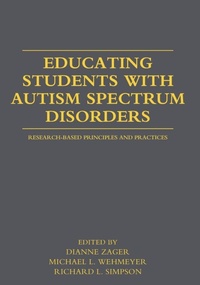
Educating Students with Autism Spectrum Disorders
Research-Based Principles and Practices
1st Edition
Published on 28. June 2011
Book
Paperback/Softback
338 pages
978-0-415-87757-2 (ISBN)
Description
Similar to a handbook in its comprehensive description of the theory and research supporting current practices in the treatment of autism spectrum disorders, this interdisciplinary text shows how the existing knowledge base can be used to explore promising new possibilities related to the field's many unanswered questions. Key features include the following:
Comprehensive - This is the first book to consider the history and current state of autism as a field in transition, to cover its varied approaches and philosophies, and to describe the interventions used throughout the developmental cycle.
Cross Disciplinary - Serving students with autism necessitates communication and collaboration among professionals from several disciplines as well as family members. The editors have, therefore, brought together divergent perspectives, theories and philosophies in order to demonstrate that scientific evidence, rather than educational orientation, must determine which practices should be selected for use in particular situations.
Research Based - Whereas many existing texts advocate a particular type of treatment, this one recognizes that interventions must be selected and evaluated based on the scientific evidence of their effectiveness.
Integrated Methodology -Chapter authors consider findings from studies that employed single-subject designs, experimental large-scale studies, and qualitative methodology. The inter-relatedness of therapies and disciplines will be highlighted throughout.
Expertise - The volume editors are all highly visible researchers in autism and developmental disabilities. Likewise, each chapter is directed by a senior, highly accomplished author who is nationally recognized for his/her work in the topic being addressed.
This book is appropriate for practicing professionals in education and psychology and for speech/language therapists and other clinicians. It is also suitable as a graduate level text in these fields.
Comprehensive - This is the first book to consider the history and current state of autism as a field in transition, to cover its varied approaches and philosophies, and to describe the interventions used throughout the developmental cycle.
Cross Disciplinary - Serving students with autism necessitates communication and collaboration among professionals from several disciplines as well as family members. The editors have, therefore, brought together divergent perspectives, theories and philosophies in order to demonstrate that scientific evidence, rather than educational orientation, must determine which practices should be selected for use in particular situations.
Research Based - Whereas many existing texts advocate a particular type of treatment, this one recognizes that interventions must be selected and evaluated based on the scientific evidence of their effectiveness.
Integrated Methodology -Chapter authors consider findings from studies that employed single-subject designs, experimental large-scale studies, and qualitative methodology. The inter-relatedness of therapies and disciplines will be highlighted throughout.
Expertise - The volume editors are all highly visible researchers in autism and developmental disabilities. Likewise, each chapter is directed by a senior, highly accomplished author who is nationally recognized for his/her work in the topic being addressed.
This book is appropriate for practicing professionals in education and psychology and for speech/language therapists and other clinicians. It is also suitable as a graduate level text in these fields.
More details
Language
English
Place of publication
London
United Kingdom
Publishing group
Taylor & Francis Ltd
Target group
Professional and scholarly
Professional Practice & Development
Illustrations
16 s/w Tabellen, 9 s/w Zeichnungen
16 Tables, black and white; 9 Line drawings, black and white
Dimensions
Height: 254 mm
Width: 178 mm
Thickness: 19 mm
Weight
663 gr
ISBN-13
978-0-415-87757-2 (9780415877572)
Copyright in bibliographic data and cover images is held by Nielsen Book Services Limited or by the publishers or by their respective licensors: all rights reserved.
Schweitzer Classification
Other editions
Additional editions
Dianne Zager | Michael L. Wehmeyer | Richard L. Simpson
Educating Students with Autism Spectrum Disorders
Research-Based Principles and Practices
E-Book
05/2012
1st Edition
Routledge
€94.99
Available for download
Dianne Zager | Michael L. Wehmeyer | Richard L. Simpson
Educating Students with Autism Spectrum Disorders
Research-Based Principles and Practices
E-Book
05/2012
1st Edition
Routledge
€94.99
Available for download
Dianne Zager | Michael L. Wehmeyer | Richard L. Simpson
Educating Students with Autism Spectrum Disorders
Research-Based Principles and Practices
Book
06/2011
1st Edition
Routledge
€260.80
Shipment within 15-20 days
Persons
Dianne Zager is Michael C. Koffler Professor in Autism at Pace University.
Michael L. Wehmeyer is Gene A. Budig Teaching Professor of Special Education at the University of Kansas.
Richard L. Simpson is Professor of Special Education at the University of Kansas.
Michael L. Wehmeyer is Gene A. Budig Teaching Professor of Special Education at the University of Kansas.
Richard L. Simpson is Professor of Special Education at the University of Kansas.
Content
Preface
I. Knowledge of the Field of Autism
1. Autism Spectrum Disorders: Historical, Legislative, and Current Perspectives, Mary L. White, J. David Smith, Tom E.C. Smith, Robert Stodden
2. Definitions and Clinical Characteristics of Autism Spectrum Disorders, Joel D. Bregman & Claudine Higdon
3. Identification and Diagnosis of Autism Spectrum Disorders, Constanza Columbi, Sophy Kim, Alayna Schreier, Catherine Lord
II. Approaches and Philosophies in Educating Students with Autism
4. Applied Behavior Analysis and Learners with Autism Spectrum Disorders, Jack Scott & Kyle Bennett
5. DIR: The Developmental, Individual Difference, Relationship-Based Model: A Dynamic Model for the 21st Century, Serena Wieder
6. Structured Teaching and the TEACCH Program, Gary B. Mesibov, Victoria Shea, Stephanie McCaskill
7. Academic Development through Integrated Behavioral Experiential Teaching, Dianne Zager & Francine Dreyfus
8. The Ziggurat Model and Comprehensive Autism Planning System, Brenda Smith Myles, Sheila M. Smith, Ruth Aspy, Barry G. Grossman, Shawn A. Henry
III. Education through the Developmental Stages
9. Cultural and Linguistic Diversity and Learners with Autism Spectrum Disorders, Elizabeth A. West & Pei-Yu Chen
10. Early Intervention and Early Childhood Years, E. Amanda Boutot & Jennifer L. Walberg
11. Education through the Developmental Stages: School-Age Children and Adolescents, L. Juane Heflin & Jackie S. Isbell
12. Social Skills Interventions and Programming for Learners with Autism Spectrum Disorders, Richard Simpson, Jennifer B. Ganz, Rose Mason
13. Promoting Self-Determination and Social Inclusion: A Review of Research-Based Practices, Michael L. Wehmeyer & Tom E. C. Smith
14. Transition to Postsecondary Education, Employment, and Adult Living, Michael L. Wehmeyer & James R. Patton
15. Family Support and Involvement throughout the School Years, Teresa Taber-Doughty & Emily C. Bouck
IV. Inter-Related Disciplines in Autism
16. Enhancing Language and Communication Development, Carol Alpern
17. Assistive Technology to Support People with Autism Spectrum Disorders, Kim Spence-Cochran & Cynthia Pearl
18. Collaboration and Cooperative Teaching for System-Wide Change, Jack Hourcade & Gardner Umbarger
I. Knowledge of the Field of Autism
1. Autism Spectrum Disorders: Historical, Legislative, and Current Perspectives, Mary L. White, J. David Smith, Tom E.C. Smith, Robert Stodden
2. Definitions and Clinical Characteristics of Autism Spectrum Disorders, Joel D. Bregman & Claudine Higdon
3. Identification and Diagnosis of Autism Spectrum Disorders, Constanza Columbi, Sophy Kim, Alayna Schreier, Catherine Lord
II. Approaches and Philosophies in Educating Students with Autism
4. Applied Behavior Analysis and Learners with Autism Spectrum Disorders, Jack Scott & Kyle Bennett
5. DIR: The Developmental, Individual Difference, Relationship-Based Model: A Dynamic Model for the 21st Century, Serena Wieder
6. Structured Teaching and the TEACCH Program, Gary B. Mesibov, Victoria Shea, Stephanie McCaskill
7. Academic Development through Integrated Behavioral Experiential Teaching, Dianne Zager & Francine Dreyfus
8. The Ziggurat Model and Comprehensive Autism Planning System, Brenda Smith Myles, Sheila M. Smith, Ruth Aspy, Barry G. Grossman, Shawn A. Henry
III. Education through the Developmental Stages
9. Cultural and Linguistic Diversity and Learners with Autism Spectrum Disorders, Elizabeth A. West & Pei-Yu Chen
10. Early Intervention and Early Childhood Years, E. Amanda Boutot & Jennifer L. Walberg
11. Education through the Developmental Stages: School-Age Children and Adolescents, L. Juane Heflin & Jackie S. Isbell
12. Social Skills Interventions and Programming for Learners with Autism Spectrum Disorders, Richard Simpson, Jennifer B. Ganz, Rose Mason
13. Promoting Self-Determination and Social Inclusion: A Review of Research-Based Practices, Michael L. Wehmeyer & Tom E. C. Smith
14. Transition to Postsecondary Education, Employment, and Adult Living, Michael L. Wehmeyer & James R. Patton
15. Family Support and Involvement throughout the School Years, Teresa Taber-Doughty & Emily C. Bouck
IV. Inter-Related Disciplines in Autism
16. Enhancing Language and Communication Development, Carol Alpern
17. Assistive Technology to Support People with Autism Spectrum Disorders, Kim Spence-Cochran & Cynthia Pearl
18. Collaboration and Cooperative Teaching for System-Wide Change, Jack Hourcade & Gardner Umbarger