

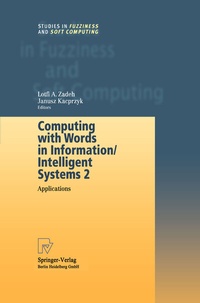
Computing with Words in Information/Intelligent Systems 2
Applications
Published on 16. July 1999
Book
Hardback
IX, 610 pages
978-3-7908-1218-3 (ISBN)
Description
These two volumes consisting of Foundations and Applications provide the current status of theoretical and empirical developments in "computing with words". In philosophy, the twentieth century is said to be the century of language. This is mainly due to Wittgenstein who said: "The meaning of a word is its use in the language game". "The concept game is a concept with blurred edges". In the first phrase, "the language game" implies the everyday human activity with language, and in the latter, "game" simply implies an ordinary word. Thus, Wittgenstein precisely stated that a word is fuzzy in real life. Unfortunately this idea about a word was not accepted in the conventional science. We had to wait for Zadeh's fuzzy sets theory. Remembering Wittgenstein's statement, we should consider, on the one hand, the concept of "computing with words" from a philosophical point of view. It deeply relates to the everyday use of a word in which the meaning of a word is fuzzy in its nature.
More details
Series
Edition
1999 ed.
Language
English
Place of publication
Heidelberg
Germany
Target group
College/higher education
Professional and scholarly
Research
Illustrations
IX, 610 p.
Dimensions
Height: 241 mm
Width: 160 mm
Thickness: 39 mm
Weight
1090 gr
ISBN-13
978-3-7908-1218-3 (9783790812183)
DOI
10.1007/978-3-7908-1872-7
Schweitzer Classification
Other editions
Additional editions
Book
10/2010
Physica
€160.49
Shipment within 10-15 days
Content
1. Neuro-Fuzzy and Genetic Systems for Computing with Words.- Neural Fuzzy Intelligent Agents.- Neuro Fuzzy Systems for Data Analysis.- A New Fuzzy Inference System Based on Artificial Neural Network and Its Applications.- Encouraging Cooperation in the Genetic Iterative Rule Learning Approach for Qualitative Modeling.- 2. Tools for Linguistic Data Modeling and Analysis.- Fuzzy Graphs with Linguistic Input-Outputs by Fuzzy Approximation Models.- Fuzzy Random Variables: Modeling Linguistic Statistical Data.- 3. Linguistic Models in System Reliability, Quality Control and Risk Analyses.- Linguistic Model of System Reliability Analysis.- Lifetime Tests for Vague Data.- Systems Analytic Models for Fuzzy Risk Estimation.- 4. Linguistic Models in Decision Making, Optimization and Control.- Decision Analysis by Advanced Fuzzy Systems.- Group Decision Making and a Measure of Consensus under Fuzzy Preferences and a Fuzzy Linguistic Majority.- Linear Programming with Words.- Computing with Words in Control.- On Linguistic Fuzzy Constraint Satisfaction Problems.- 5. Linguistic and Imprecise Information in Databases and Information Systems.- Data Models for Dealing with Linguistic and Imprecise Information.- Fuzzy Set Approaches to Model Uncertainty in Spatial Data and Geographic Information Systems.- Computing Fuzzy Dependencies with Linguistic Labels.- The Paradigm of Computing with Words in Intelligent Database Querying.- Linguistic Data Mining.- Evaluation of Connectionist Information Retrieval in a Legal Documemt Collection.- 6. Applications.- Using Linguistic Models in Medical Decison Making.- The Fuzzy Logic Advisor for Social Judgements: A First Attempt.- Conceptualisation with GABEK: Ideas on Social Change in South Africa.- A Linguistic Decision Model to Suppliers Selection in International Purchasing.- Fuzzy System for Air Traffic Flow Management.- A Fuzzy Approach to Contracting Electrical Energy in Competitive Electricity Markets.- Fuzzy Logic and Intelligent Computing in Nuclear Engineering.- Computational Intelligence Techniques in Landmine Detection.