

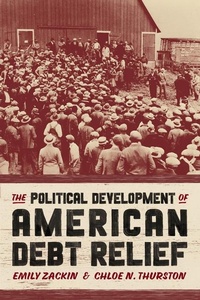
The Political Development of American Debt Relief
Published on 21. June 2024
Book
Paperback/Softback
256 pages
978-0-226-83237-1 (ISBN)
Description
A political history of the rise and fall of American debt relief.
Americans have a long history with debt. They also have a long history of mobilizing for debt relief. Throughout the nineteenth century, indebted citizens demanded government protection from their financial burdens, challenging readings of the Constitution that exalted property rights at the expense of the vulnerable. Their appeals shaped the country's periodic experiments with state debt relief and federal bankruptcy law, constituting a pre-industrial safety net. Yet, the twentieth century saw the erosion of debtor politics and the eventual retrenchment of bankruptcy protections.
The Political Development of American Debt Relief traces how geographic, sectoral, and racial politics shaped debtor activism over time, enhancing our understanding of state-building, constitutionalism, and social policy.
Americans have a long history with debt. They also have a long history of mobilizing for debt relief. Throughout the nineteenth century, indebted citizens demanded government protection from their financial burdens, challenging readings of the Constitution that exalted property rights at the expense of the vulnerable. Their appeals shaped the country's periodic experiments with state debt relief and federal bankruptcy law, constituting a pre-industrial safety net. Yet, the twentieth century saw the erosion of debtor politics and the eventual retrenchment of bankruptcy protections.
The Political Development of American Debt Relief traces how geographic, sectoral, and racial politics shaped debtor activism over time, enhancing our understanding of state-building, constitutionalism, and social policy.
Reviews / Votes
"As impressive as this surge of populist fervor was, it represented only one chapter in a much longer conflict between debtors and creditors in the United States-a conflict that is foundational to American politics and yet, for some reason, is mostly forgotten. The Political Development of American Debt Relief seeks to recover this history. . . .The Political Development of American Debt Relief offers important history lessons and even some strategic insights for those of us who are determined to change this situation." -- Astra Taylor * The Nation * "Until the early 19th century, Americans in debt had few mechanisms by which to dig themselves out. But beginning in the 1810s and 1820s, Emily Zackin and Chloe N. Thurston write in The Political Development of American Debt Relief, white farmers in the southern and Plains states, who sometimes had to take out loans if their crops failed, began demanding that their political representatives do something to help. Thanks in part to those efforts, legislators began working to create a process by which people could take their creditors to court, with the goal of erasing what they owed; the debtors would be free to start over." -- Michael Waters * The Atlantic * "In The Black Tax: 150 Years of Theft, Exploitation, and Dispossession in America (U Chicago Press, 2024), [Kahrl] uncovers the history of inequitable and predatory tax laws in the United States. [Kahrl] examines the structural traps within America's tax system that have forced Black Americans to pay more for less despite being taxpayers with fewer resources compared to white taxpayers. Kahrl exposes these practices, from Reconstruction up to the present, Kahrl exposes these practices to describe how discrimination continues to take new forms, even as people continue to fight for their rights, their assets, and their power." * New Book Network * "Emily Zackin and Chloe Thurston have written an essential book on the history of debt relief in the United States. This is a must-read for anyone interested in American political economy, political development, and constitutional history." -- Ganesh Sitaraman | author of "The Crisis of the Middle Class Constitution" "Zackin and Thurston have given us a brilliant, sweeping account of the politics of debt in the United States. Situating debt relief in the context of racialized social policy, they illuminate how the interplay of economic context, organized interests, and constitutional interpretation shaped American bankruptcy laws over the past century and a half. This book is essential reading." -- Kathleen Thelen | Massachusetts Institute of Technology "The Political Development of American Debt Relief is a gem of a book-deeply researched, elegantly written, and a truly compelling account of the entire trajectory of the unique political economy of consumer debt relief in the United States. Zackin and Thurston tell the story of how debt-relief politics emerged in the nineteenth century and receded in the twentieth before beginning to re-emerge today. Along the way, they produce a model for future scholars of how to do this kind of work: how to thread complex legal and constitutional questions together with the dynamics of class, race, political mobilization, lobbying, and political power." -- Joseph Fishkin | coauthor of "The Anti-Oligarchy Constitution"More details
Language
English
Place of publication
Chicago
United States
Publishing group
The University of Chicago Press
Target group
Professional and scholarly
Product notice
Paperback (trade)
Unsewn / adhesive bound
Illustrations
1 halftones, 4 line drawings, 4 tables
Dimensions
Height: 227 mm
Width: 149 mm
Thickness: 15 mm
Weight
380 gr
ISBN-13
978-0-226-83237-1 (9780226832371)
Copyright in bibliographic data and cover images is held by Nielsen Book Services Limited or by the publishers or by their respective licensors: all rights reserved.
Schweitzer Classification
Other editions
Additional editions
Zackin Emily Zackin | Thurston Chloe N. Thurston
Political Development of American Debt Relief
E-Book
06/2024
University of Chicago Press
€36.99
Available for download
Persons
Emily Zackin is associate professor of political science at Johns Hopkins University. Chloe Thurston is associate professor of political science at Northwestern University.
Content
List of Tables and Figures
Preface: The Mortgage Mill Grinds On
Introduction: Bankruptcy Is Not a Crime
1. Debt Relief and the States in Times of Crisis
2. Federal Bankruptcy Law: From Punishment to Protection
3. Reconstruction and the Meaning of Freedom
4. Bankruptcy Law as American Statebuilding: The Act of 1898
5. A Tale of Two Bankruptcies: Protective and Punitive Bankruptcy Law in the New Deal
6. The Missing Movement: Consumer Debtors and Their Advocates in the Twentieth Century
7. Creditor Coordination and the Erosion of Debt Relief
Conclusion: Debtor Politics in the Twenty-First Century
Acknowledgments
Notes
Bibliography
Index
Preface: The Mortgage Mill Grinds On
Introduction: Bankruptcy Is Not a Crime
1. Debt Relief and the States in Times of Crisis
2. Federal Bankruptcy Law: From Punishment to Protection
3. Reconstruction and the Meaning of Freedom
4. Bankruptcy Law as American Statebuilding: The Act of 1898
5. A Tale of Two Bankruptcies: Protective and Punitive Bankruptcy Law in the New Deal
6. The Missing Movement: Consumer Debtors and Their Advocates in the Twentieth Century
7. Creditor Coordination and the Erosion of Debt Relief
Conclusion: Debtor Politics in the Twenty-First Century
Acknowledgments
Notes
Bibliography
Index