

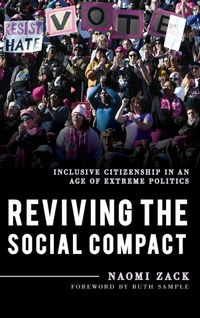
Reviving the Social Compact
Inclusive Citizenship in an Age of Extreme Politics
Published on 5. November 2018
Book
Hardback
208 pages
978-1-5381-2011-8 (ISBN)
Description
Naomi Zack's Reviving the Social Compact:Inclusive Citizenship in an Age of Extreme Politics addresses current political and social upheaval and distress with new concepts for the relationship between citizens and government. Politics has become turbo-charged as a form of agonistic contest where candidates and the public become more focused on winning than on governing or holding the government accountable for the benefit of the people. This failure of the government to fulfill its part of the social contract calls for a new social compact wherein citizens as a collective whole make long-term resolutions outside of government institutions.
Analyzing present and evolving events, Zackreveals how race has exceeded intersection after formal rights have failed to correct ongoing discrimination; how class is no longer based on real life interests and has been manufactured and manipulated for political contest; how women have made spectacular progress but how the fame of elite women has left out poor, non-white women, transgender people, and sex workers; how natural disasters have not been (and perhaps cannot be) adequately prepared for or responded to by government; how environmental preservation becomes politicized; how homelessness could be fixed through capitalism; and how immigration reform has pivoted from inclusion to expulsion and why hospitality is an important civic virtue.
Reviving the Social Compact is a call for good citizenship. Voting is the first step-because in a divided two-party system, a change from one party to the other is tantamount to revolution-and a new understanding of the social compact can lead to the stable civic life we need at this time.
Analyzing present and evolving events, Zackreveals how race has exceeded intersection after formal rights have failed to correct ongoing discrimination; how class is no longer based on real life interests and has been manufactured and manipulated for political contest; how women have made spectacular progress but how the fame of elite women has left out poor, non-white women, transgender people, and sex workers; how natural disasters have not been (and perhaps cannot be) adequately prepared for or responded to by government; how environmental preservation becomes politicized; how homelessness could be fixed through capitalism; and how immigration reform has pivoted from inclusion to expulsion and why hospitality is an important civic virtue.
Reviving the Social Compact is a call for good citizenship. Voting is the first step-because in a divided two-party system, a change from one party to the other is tantamount to revolution-and a new understanding of the social compact can lead to the stable civic life we need at this time.
Reviews / Votes
Elected officials have lost sight of Locke's vision and the founders' interpretation of the social contract. Government has become an arena for partisan bickering and turbocharged politics, where little is accomplished and the common good is ignored. According to Zack (Univ. of Oregon), when government protects only the few and elected officials lose their moral compass, everyone suffers. When tribalism and hyper-partisanship replace community and compromise is a dirty word, Americans must be saved from themselves. The challenge is for citizens to reimagine change and do what politicians refuse to do. Herein lies the concept of the social compact, in which a commonwealth (a small group) or a coalition instigates action when all levels of government "abdicate" responsibility in a vital area, such environmental matters or racial-ethnic discrimination. Zack views elections as "a bridge between the social compact and the social contract," which can be tantamount to a "revolution" in an era of intense polarization. She reminds readers what being a good citizen means: "Good citizenship requires a moral dimension, as well as knowledge and action." * Choice Reviews * A timely analysis of the contemporary political scene combined with a prescription for revitalizing the social compact that underlies it. This is political philosophy at its best! -- James P. Sterba, Philosophy Department, University of Notre Dame What happens when government breaks the social contract? In this insightful and compelling book, Zack answers that residents must step up to fill the void with an inclusive social compact to buffer the disasters of a corrupt and morally bankrupt government. She powerfully demonstrates that current conceptions of race, class, and gender do not adequately represent the reality on the ground. Deftly moving between philosophical discourse and current events, Zack's analysis pushes up against the limits of identity politics, and conceptions of the good citizen, to illuminate the way forward. -- Kelly Oliver, author of Carceral Humanitarianism: Logics of Refugee Detention and Hunting Girls: Sexual Violence from The Hunger Games to Campus Rape. Zack's book addresses a critical moral issue in modern American society: how social contracts and social compacts function in the presence of the changing dynamics of political systems and political parties, in terms of its impact on the issues of race, class, disasters, terrorism and immigration. Where social contracts become outdated or fail, then the more informal social compacts in society become critical to the continued and effective functioning of a liberal democratic society. This is an important book with a message that needs to be heard and understood by those with both formal and informal voices, who care about living in a moral society. -- David Etkin, York University, author of Disaster Theory: An Interdisciplinary Approach to Concepts and Causes Supercharged politics prevents government from meeting its obligations to the people according to the social contract and endangers our democracy. Naomi Zack's brilliant book argues that we can save it if we reclaim the almost forgotten idea that it depends on a social compact among the people that is prior to government and requires that they work independently of government to create a culture of inclusion. -- Bernard Boxill, professor emeritus, University of North Carolina at Chapel HillMore details
Series
Language
English
Place of publication
United States
Publishing group
Bloomsbury Publishing Plc
Target group
College/higher education
US School Grade: From College Freshman to College Graduate Student, Interest Age: From 18 to 22 years
Illustrations
3 Tables
Dimensions
Height: 235 mm
Width: 157 mm
Thickness: 17 mm
Weight
496 gr
ISBN-13
978-1-5381-2011-8 (9781538120118)
Copyright in bibliographic data and cover images is held by Nielsen Book Services Limited or by the publishers or by their respective licensors: all rights reserved.
Schweitzer Classification
Other editions
Additional editions
E-Book
11/2018
1st Edition
Rowman & Littlefield Publishers
€30.49
Available for download
Persons
Naomi Zack is professor of philosophy at the University of Oregon and is author of Applicative Justice: A Pragmatic Empirical Approach to Racial Injustice, White Privilegeand Black Rights: The Injustice of U.S. Police Racial Profiling and Homicide, The Ethicsand Mores of Race: Equality after the History of Philosophy, and Ethics for Disaster.
Content
Foreword by Ruth Sample
Author's Preface and Acknowledgments
Introduction
Part I - Politics, Race, Class, and Feminism
1. Turbo-Charged Politics
2. The Junction of Race
3. The Political Creation of Class
4. The Amazing Success of Feminism
Part II -- The Need for the Social Compact
5. The Social Contract and the Social Compact
6. Natural Disaster in Society
7. Unnatural Disaster in Nature
8. Homelessness and Monetization
9. Immigration and Expulsion
Conclusion
Index
Author's Preface and Acknowledgments
Introduction
Part I - Politics, Race, Class, and Feminism
1. Turbo-Charged Politics
2. The Junction of Race
3. The Political Creation of Class
4. The Amazing Success of Feminism
Part II -- The Need for the Social Compact
5. The Social Contract and the Social Compact
6. Natural Disaster in Society
7. Unnatural Disaster in Nature
8. Homelessness and Monetization
9. Immigration and Expulsion
Conclusion
Index