

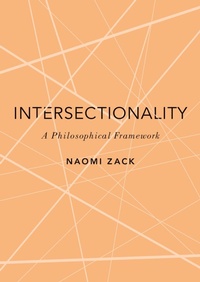
Intersectionality
A Philosophical Framework
Published on 19. June 2024
Book
Hardback
200 pages
978-0-19-769307-0 (ISBN)
Description
In Intersectionality, philosopher Naomi Zack presents a novel philosophical account of intersectionality - the process by which people already oppressed, experience more oppression because of their intersecting identities. Examples include women who experience racism or poor people who are under-served. Identifying such intersections allows for more precise analysis of oppression, as well as newly recognized identities, such as blackwomen or homeless people of colour.
Zack here explores the meaning of intersectionality through analysis of current events and controversies including the #MeToo movement, the COVID-19 pandemic, and class opportunities for minorities in higher education. Her analysis develops a robust definition of intersectionality in terms of inclusion, recognition, and diversity; works out ontological issues about the relationship between persons, labels, and identity; explores the distinction between abstract philosophical thinking and activism; and discusses how intersectionality can be an effective basis for empowerment, as well as understanding.
Zack's distinctively philosophical account explains how intersectionality, considered as a method of analysis, works and can be employed in many areas of progressive thought across varying disciplines. She concludes that identifying and challenging the injustice of oppressions logically requires a broad humanistic framework, that intersectionality cannot be reduced to mere talk of diversity and inclusion, and that intersectionality itself is a progressive method of analysis worthy of philosophical attention.
Zack here explores the meaning of intersectionality through analysis of current events and controversies including the #MeToo movement, the COVID-19 pandemic, and class opportunities for minorities in higher education. Her analysis develops a robust definition of intersectionality in terms of inclusion, recognition, and diversity; works out ontological issues about the relationship between persons, labels, and identity; explores the distinction between abstract philosophical thinking and activism; and discusses how intersectionality can be an effective basis for empowerment, as well as understanding.
Zack's distinctively philosophical account explains how intersectionality, considered as a method of analysis, works and can be employed in many areas of progressive thought across varying disciplines. She concludes that identifying and challenging the injustice of oppressions logically requires a broad humanistic framework, that intersectionality cannot be reduced to mere talk of diversity and inclusion, and that intersectionality itself is a progressive method of analysis worthy of philosophical attention.
Reviews / Votes
Intersectionality is particularly rich in thoughtful discussions of the many and very real contexts and intersections that we find in the contemporary world, from racial violence to labor conditions under COVID-19 to the violence children have to endure in a country where school shootings are the norm and not the exception. * Hilkje Charlotte Haenel, Ethics *More details
Series
Language
English
Place of publication
New York
United States
Target group
College/higher education
Product notice
sewn/stitched
Cloth over boards
Dimensions
Height: 189 mm
Width: 133 mm
Thickness: 22 mm
Weight
280 gr
ISBN-13
978-0-19-769307-0 (9780197693070)
Copyright in bibliographic data and cover images is held by Nielsen Book Services Limited or by the publishers or by their respective licensors: all rights reserved.
Schweitzer Classification
Other editions
Additional editions
E-Book
02/2024
OUP eBook
€19.49
Available for download
E-Book
02/2024
OUP eBook
€19.49
Available for download
Person
Naomi Zack is Professor of Philosophy at Lehman College, CUNY. She is the author of 12 monographs and 10 textbooks and edited anthologies.
Content
Part I: What is Intersectionality?
Theory and Overview - Origins and Methods Of Intersectionality
1. Intersectionality In Hollywood - Diversity and Inclusion
2. # Say Her Name, #Me Too, Me Too, and Prince Harry - Strong and Weak Intersections
3. Women And Racial/Ethnic Minorities During COVID-19 Part II: Problems with Intersectionality and Solutions
Theory and Overview - Imperatives in the Present
4. Climate Change - Women, Hunger and Famine, and Refugees
5. Violence as an Intersecting Factor -Jewish Americans, Asian Americans, and School Children
6. Intersections within Intersections - Transgender People, Sex Workers, Multi/Mixed Racial People, and Transracial People Part III: Positive Intersections in Higher Education
Theory and Overview - Standing Intersectionality on its Head with Positive Intersections?
7. Minorities and Higher Education - The Achievement Gap in Degrees and Standardized Tests
8. Intersectional Structures in Higher Education - Affirmative Action And Diversity
9. Class and Race in Higher Education - Cultural Capital, Leisure, and The Life Of The Mind
Conclusion: Wide Intersectionality and Egalitarian Humanism Select Bibliography
Index
Theory and Overview - Origins and Methods Of Intersectionality
1. Intersectionality In Hollywood - Diversity and Inclusion
2. # Say Her Name, #Me Too, Me Too, and Prince Harry - Strong and Weak Intersections
3. Women And Racial/Ethnic Minorities During COVID-19 Part II: Problems with Intersectionality and Solutions
Theory and Overview - Imperatives in the Present
4. Climate Change - Women, Hunger and Famine, and Refugees
5. Violence as an Intersecting Factor -Jewish Americans, Asian Americans, and School Children
6. Intersections within Intersections - Transgender People, Sex Workers, Multi/Mixed Racial People, and Transracial People Part III: Positive Intersections in Higher Education
Theory and Overview - Standing Intersectionality on its Head with Positive Intersections?
7. Minorities and Higher Education - The Achievement Gap in Degrees and Standardized Tests
8. Intersectional Structures in Higher Education - Affirmative Action And Diversity
9. Class and Race in Higher Education - Cultural Capital, Leisure, and The Life Of The Mind
Conclusion: Wide Intersectionality and Egalitarian Humanism Select Bibliography
Index