

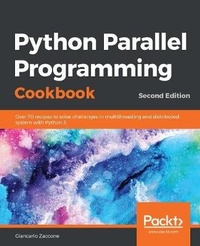
Python Parallel Programming Cookbook
Over 70 recipes to solve challenges in multithreading and distributed system with Python 3
2nd Edition
Published on 6. September 2019
Book
Paperback/Softback
370 pages
978-1-78953-373-6 (ISBN)
Description
Implement effective programming techniques in Python to build scalable software that saves time and memory
Key Features
Design distributed computing systems and massive computational tasks coherently
Learn practical recipes with concise explanations that address development pain points encountered while coding parallel programs
Understand how to host your parallelized applications on the cloud
Book Description
Nowadays, it has become extremely important for programmers to understand the link between the software and the parallel nature of their hardware so that their programs run efficiently on computer architectures. Applications based on parallel programming are fast, robust, and easily scalable.
This updated edition features cutting-edge techniques for building effective concurrent applications in Python 3.7. The book introduces parallel programming architectures and covers the fundamental recipes for thread-based and process-based parallelism. You'll learn about mutex, semaphores, locks, queues exploiting the threading, and multiprocessing modules, all of which are basic tools to build parallel applications. Recipes on MPI programming will help you to synchronize processes using the fundamental message passing techniques with mpi4py. Furthermore, you'll get to grips with asynchronous programming and how to use the power of the GPU with PyCUDA and PyOpenCL frameworks. Finally, you'll explore how to design distributed computing systems with Celery and architect Python apps on the cloud using PythonAnywhere, Docker, and serverless applications.
By the end of this book, you will be confident in building concurrent and high-performing applications in Python.
What you will learn
Synchronize multiple threads and processes to manage parallel tasks
Use message passing techniques to establish communication between processes to build parallel applications
Program your own GPU cards to address complex problems
Manage computing entities to execute distributed computational task
Write efficient programs by adopting the event-driven programming model
Explore cloud technology with Django and Google App Engine
Apply parallel programming techniques that can lead to performance improvements
Who this book is for
The Python Parallel Programming Cookbook is for software developers who are well-versed with Python and want to use parallel programming techniques to write powerful and efficient code. This book will help you master the basics and the advanced of parallel computing.
Key Features
Design distributed computing systems and massive computational tasks coherently
Learn practical recipes with concise explanations that address development pain points encountered while coding parallel programs
Understand how to host your parallelized applications on the cloud
Book Description
Nowadays, it has become extremely important for programmers to understand the link between the software and the parallel nature of their hardware so that their programs run efficiently on computer architectures. Applications based on parallel programming are fast, robust, and easily scalable.
This updated edition features cutting-edge techniques for building effective concurrent applications in Python 3.7. The book introduces parallel programming architectures and covers the fundamental recipes for thread-based and process-based parallelism. You'll learn about mutex, semaphores, locks, queues exploiting the threading, and multiprocessing modules, all of which are basic tools to build parallel applications. Recipes on MPI programming will help you to synchronize processes using the fundamental message passing techniques with mpi4py. Furthermore, you'll get to grips with asynchronous programming and how to use the power of the GPU with PyCUDA and PyOpenCL frameworks. Finally, you'll explore how to design distributed computing systems with Celery and architect Python apps on the cloud using PythonAnywhere, Docker, and serverless applications.
By the end of this book, you will be confident in building concurrent and high-performing applications in Python.
What you will learn
Synchronize multiple threads and processes to manage parallel tasks
Use message passing techniques to establish communication between processes to build parallel applications
Program your own GPU cards to address complex problems
Manage computing entities to execute distributed computational task
Write efficient programs by adopting the event-driven programming model
Explore cloud technology with Django and Google App Engine
Apply parallel programming techniques that can lead to performance improvements
Who this book is for
The Python Parallel Programming Cookbook is for software developers who are well-versed with Python and want to use parallel programming techniques to write powerful and efficient code. This book will help you master the basics and the advanced of parallel computing.
More details
Edition
2nd Revised edition
Language
English
Place of publication
Birmingham
United Kingdom
Edition type
Revised edition
Dimensions
Height: 93 mm
Width: 75 mm
ISBN-13
978-1-78953-373-6 (9781789533736)
Copyright in bibliographic data and cover images is held by Nielsen Book Services Limited or by the publishers or by their respective licensors: all rights reserved.
Schweitzer Classification
Person
Giancarlo Zaccone has over fifteen years' experience of managing research projects in the scientific and industrial domains. He is a software and systems engineer at the European Space Agency (ESTEC), where he mainly deals with the cybersecurity of satellite navigation systems.
Giancarlo holds a master's degree in physics and an advanced master's degree in scientific computing.
Giancarlo has already authored the following titles, available from Packt: Python Parallel Programming Cookbook (First Edition), Getting Started with TensorFlow, Deep Learning with TensorFlow (First Edition), and Deep Learning with TensorFlow (Second Edition).
Giancarlo holds a master's degree in physics and an advanced master's degree in scientific computing.
Giancarlo has already authored the following titles, available from Packt: Python Parallel Programming Cookbook (First Edition), Getting Started with TensorFlow, Deep Learning with TensorFlow (First Edition), and Deep Learning with TensorFlow (Second Edition).
Content
Table of Contents
Getting Started with Parallel Computing and Python
Thread-based Parallelism
Process-based Parallelism
Message Passing
Asynchronous Programming
Distributed Python
Cloud Computing
Heterogeneous Computing
Python Debugging and Testing
Getting Started with Parallel Computing and Python
Thread-based Parallelism
Process-based Parallelism
Message Passing
Asynchronous Programming
Distributed Python
Cloud Computing
Heterogeneous Computing
Python Debugging and Testing