

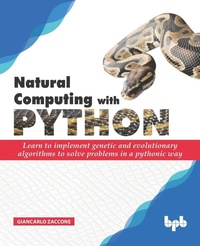
Natural Computing with Python
Learn to implement genetic and evolutionary algorithms to solve problems in a pythonic way
Published on 21. June 2019
Book
Paperback/Softback
280 pages
978-93-88511-61-2 (ISBN)
Description
Step-by-step guide to learn and solve complex computational problems with Nature Inspired algorithms.
Key FeaturesArtificial Neural Networks
Deep Learning models using Keras
Quantum Computers and Programming
Genetic Algorithms, CNN and RNNs
Swarm Intelligence Systems
Reinforcement Learning using OpenAI
Artificial Life
DNA computing
Fractals
Description
Natural Computing is the field of research inspired by nature, that allows the development of new algorithms to solve complex problems, leads to the synthesis of natural models, and may result in the design of new computing systems. This book exactly aims to educate you with practical examples on topics of importance associated with research field of Natural computing.
The initial few chapters will quickly walk you through Neural Networks while describing deep learning architectures such as CNN, RNN and AutoEncoders using Keras. As you progress further, you'll gain understanding to develop genetic algorithm to solve traveling saleman problem, implement swarm intelligence techniques using the SwarmPackagePy and Cellular Automata techniques such as Game of Life, Langton's ant, etc.
The latter half of the book will introduce you to the world of Fractals such as such as the Cantor Set and the Mandelbro Set, develop a quantum program with the QiSkit tool that runs on a real quantum computing platform, namely the IBM Q Machine and a Python simulation of the Adleman experiment that showed for the first time the possibility of performing computations at the molecular level.
What Will You Learn
Mastering Artificial Neural Networks
Developing Artificial Intelligence systems
Resolving complex problems with Genetic Programming and Swarm intelligence algorithms
Programming Quantum Computers
Exploring the mathematical world of fractals
Simulating complex systems by Cellular Automata
Understanding the basics of DNA computation
Who This Book Is For
This book is for all science enthusiasts, in particular who want to understand what are the links between computer sciences and natural systems. Interested readers should have good skills in math and python programming along with some basic knowledge of physics and biology. . Although, some knowledge of the topics covered in the book will be helpful, it is not essential to have worked with the tools covered in the book.
Table of Contents
Neural Networks
Deep Learning
Genetic Programming
Swarm Intelligence
Cellular Automata
Fractals
Quantum Computing
DNA Computing
About the Author
Giancarlo Zaccone has over ten years of experience in managing research projects in scientific and industrial areas.
He is a Software and Systems Engineer Consultant at European Space Agency (ESTEC).
Giancarlo holds a master's degree in Physics and an advanced master's degree in Scientific Computing at La Sapienza of Rome.
His LinkedIn Profile: https://www.linkedin.com/in/giancarlozaccone/
More details
Language
English
Place of publication
New Delhi
India
Product notice
Paperback (trade)
Unsewn / adhesive bound
Dimensions
Height: 235 mm
Width: 191 mm
Thickness: 16 mm
Weight
528 gr
ISBN-13
978-93-88511-61-2 (9789388511612)
Copyright in bibliographic data and cover images is held by Nielsen Book Services Limited or by the publishers or by their respective licensors: all rights reserved.
Schweitzer Classification
Other editions
Additional editions
Giancarlo Zaccone
Natural Computing with Python
Learn to implement genetic and evolutionary algorithms to solve problems in a pythonic way
E-Book
01/2019
1st Edition
De Gruyter
€14.49
Available for download
Person
Giancarlo Zaccone has over fifteen years' experience of managing research projects in the scientific and industrial domains. He is a software and systems engineer at the European Space Agency (ESTEC), where he mainly deals with the cybersecurity of satellite navigation systems. Giancarlo holds a master's degree in physics and an advanced master's degree in scientific computing. Giancarlo has already authored the following titles, available from Packt: Python Parallel Programming Cookbook (First Edition), Getting Started with TensorFlow, Deep Learning with TensorFlow (First Edition), and Deep Learning with TensorFlow (Second Edition).