

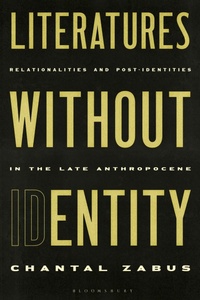
Literatures Without Identity
Relationalities and Post-Identities in the Late Anthropocene
Will be published approx. on 4. February 2027
Book
Hardback
272 pages
979-8-216-38270-6 (ISBN)
Description
Chantal Zabus develops the notion of 'post-identity' and documents the gradual dissolution of the traditional pillars of identity formation through readings of postcolonial, Indigenous and diasporic literature.
Literatures without Identity argues that the four bastions of identity formation have been ousted by enhanced 'relationalities' in postcolonial, Indigenous and diasporic literature at the beginning of the 21st century. In this new world of culture, writers have denounced the fixed and impermeable: The mother tongue and the monolingual paradigm in favor of the post-monolingual. The notion of 'race' extended to speciesism has been transplanted by post-racial and interspecies identities. The binding 'religion' of an individual has become the transnational. And the male/female binary has given way to preferred gendered identities.
Encompassing a wide range of global literature from North America and Africa to Australasia, Chantal Zabus demonstrates how contemporary writers have opted for interconnected histories and mobilities, extended selves, interspecies 'kinnings' and the porosity of state borders through refugeeism and other divergent crossings.
Literatures without Identity provokes imaginative leaps and conversations across cultures around the shifts in identity formation in the late 20th and early 21st centuries while grounding itself in analog cultural productions as well as digital, anthropological and philosophical texts. It anticipates the advent of the 'late' Anthropocene and a future beyond racial classification, human exceptionalism and mass destruction.
Literatures without Identity argues that the four bastions of identity formation have been ousted by enhanced 'relationalities' in postcolonial, Indigenous and diasporic literature at the beginning of the 21st century. In this new world of culture, writers have denounced the fixed and impermeable: The mother tongue and the monolingual paradigm in favor of the post-monolingual. The notion of 'race' extended to speciesism has been transplanted by post-racial and interspecies identities. The binding 'religion' of an individual has become the transnational. And the male/female binary has given way to preferred gendered identities.
Encompassing a wide range of global literature from North America and Africa to Australasia, Chantal Zabus demonstrates how contemporary writers have opted for interconnected histories and mobilities, extended selves, interspecies 'kinnings' and the porosity of state borders through refugeeism and other divergent crossings.
Literatures without Identity provokes imaginative leaps and conversations across cultures around the shifts in identity formation in the late 20th and early 21st centuries while grounding itself in analog cultural productions as well as digital, anthropological and philosophical texts. It anticipates the advent of the 'late' Anthropocene and a future beyond racial classification, human exceptionalism and mass destruction.
More details
Language
English
Place of publication
New York
United States
Publishing group
Bloomsbury Publishing Plc
Target group
College/higher education
Professional and scholarly
Product notice
sewn/stitched
Cloth over boards
With dust jacket
Dimensions
Height: 229 mm
Width: 152 mm
Thickness: 25 mm
Weight
454 gr
ISBN-13
979-8-216-38270-6 (9798216382706)
Copyright in bibliographic data and cover images is held by Nielsen Book Services Limited or by the publishers or by their respective licensors: all rights reserved.
Schweitzer Classification
Person
Chantal Zabus is Professor of Postcolonial and Gender Studies at the University Sorbonne Paris Nord, France; a Researcher with CEPED-UMR 196; and Editor-in-Chief of Postcolonial Text. She is co-editor of Transafrica: The Languages of Postqueerness (Zed Books, 2025; with Chris Dunton) and author of Out in Africa (2014) and Between Rites and Rights (2007; 2016).
Content
Acknowledgments
Introduction: Fallen Pillars
1. The Nativity Scene Revisited: The Demise of the Mother Tongue
2. The Dna of (Post-)Identity: The Demise Of Race
3. Religious Interstices
4. Genders Without Identity
Works Cited
Introduction: Fallen Pillars
1. The Nativity Scene Revisited: The Demise of the Mother Tongue
2. The Dna of (Post-)Identity: The Demise Of Race
3. Religious Interstices
4. Genders Without Identity
Works Cited