

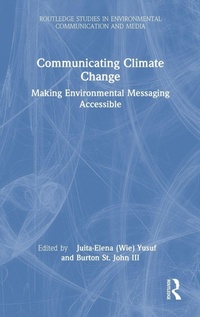
Communicating Climate Change
Making Environmental Messaging Accessible
1st Edition
Published on 11. November 2021
Book
Hardback
212 pages
978-0-367-47952-7 (ISBN)
Description
This edited collection focuses on theoretical and applied research-based observations concerning how experts, advocates, and institutions make climate change information accessible to different audiences.
Communicating Climate Change concentrates on three key elements of climate change communication - access, relevance, and understandability - to provide an overview of how these aspects allow multiple groups of stakeholders to act on climate-related information to build resilience. Featuring contributions from a wide range of scholars from across different disciplines, this book explores a multitude of different scenarios and communication methods, including social media; public opinion surveys; participatory mapping; and video. Overall, climate change communication is addressed from three different perspectives: communicating with the public; communicating for stakeholder engagement; and organizational, institutional, risk, and disaster communication.
With each chapter focusing on implications and applications for practice, this book will be of great interest to students and researchers of climate change and environmental communication, as well as practitioners interested in understanding how to better engage stakeholders through climate change-related communication.
Communicating Climate Change concentrates on three key elements of climate change communication - access, relevance, and understandability - to provide an overview of how these aspects allow multiple groups of stakeholders to act on climate-related information to build resilience. Featuring contributions from a wide range of scholars from across different disciplines, this book explores a multitude of different scenarios and communication methods, including social media; public opinion surveys; participatory mapping; and video. Overall, climate change communication is addressed from three different perspectives: communicating with the public; communicating for stakeholder engagement; and organizational, institutional, risk, and disaster communication.
With each chapter focusing on implications and applications for practice, this book will be of great interest to students and researchers of climate change and environmental communication, as well as practitioners interested in understanding how to better engage stakeholders through climate change-related communication.
More details
Series
Language
English
Place of publication
London
United Kingdom
Publishing group
Taylor & Francis Ltd
Target group
College/higher education
Professional and scholarly
Postgraduate, Professional, and Professional Practice & Development
Illustrations
21 s/w Abbildungen, 3 s/w Photographien bzw. Rasterbilder, 18 s/w Zeichnungen, 6 s/w Tabellen
6 Tables, black and white; 18 Line drawings, black and white; 3 Halftones, black and white; 21 Illustrations, black and white
Dimensions
Height: 240 mm
Width: 161 mm
Thickness: 17 mm
Weight
517 gr
ISBN-13
978-0-367-47952-7 (9780367479527)
Copyright in bibliographic data and cover images is held by Nielsen Book Services Limited or by the publishers or by their respective licensors: all rights reserved.
Schweitzer Classification
Other editions
Additional editions
Juita-Elena (Wie) Yusuf | Burton St. John III
Communicating Climate Change
Making Environmental Messaging Accessible
Book
11/2021
1st Edition
Routledge
€44.63
Shipment within 15-20 days
Juita-Elena (Wie) Yusuf | Burton St. John III
Communicating Climate Change
Making Environmental Messaging Accessible
E-Book
11/2021
1st Edition
Routledge
€47.49
Available for download
Juita-Elena (Wie) Yusuf | Burton St. John III
Communicating Climate Change
Making Environmental Messaging Accessible
E-Book
11/2021
1st Edition
Routledge
€47.49
Available for download
Persons
Juita-Elena (Wie) Yusuf is a professor of public service in the Strome College of Business, Old Dominion University (ODU), USA and Assistant Director of the ODU Institute for Coastal Adaptation and Resilience.
Burton St. John III is a professor of public relations and associate chair of the Advertising, Public Relations, and Media Design Department at the University of Colorado-Boulder, USA.
Burton St. John III is a professor of public relations and associate chair of the Advertising, Public Relations, and Media Design Department at the University of Colorado-Boulder, USA.
Content
1. Introduction: The Challenges of Communicating about Climate Change in the Modern Era Part 1: Communicating with the Public 2. Asking Questions for Adaptation: Using Public and Stakeholder Surveys as a Tool Within Coastal Climate Change Policy Processes 3. Engaging Residents in Policy and Planning for Sea Level Rise: Application of the Action-Oriented Stakeholder Engagement for a Resilient Tomorrow (ASERT) Framework 4. Communicating Within Immersion and Presence: The Use of 360-Degree-Video to Make Climate Change Touchable Part 2: Communicating for Stakeholder Engagement 5. Communicating and Co-Producing Information with Stakeholders: Examples of Participatory Mapping Approaches Related to Sea Level Rise Risks and Impacts 6. Social Media and Climate Change Dialogue: A Review of the Research and Guidance for Science Communicators 7. Key Elements of User Preferences for Flood Alerts and Implications for the Design and Development of Flood Alert or Warning Systems Part 3: Organizational, Institutional, Risk and Disaster Communication 8. The Standing Rock Water Protests Against Dakota Access Pipeline: Addressing Environmental Degradation Through Indigenous Political Ecology as the "Trickster Science" 9. Risk Communication in the Tourism Industry 10. Risk Management and Biases in How Drivers Respond to Nuisance Flooding 11. Rethinking Disaster Communication Ecology: Exploring Context in Isolated Communities in The Philippines Part 4: Conclusion 12. Toward Accessible Messaging and Effective Climate Change Communication