

Moving Color
Early Film, Mass Culture, Modernism
Published on 17. July 2012
Book
Paperback/Softback
230 pages
978-0-8135-5297-2 (ISBN)
Description
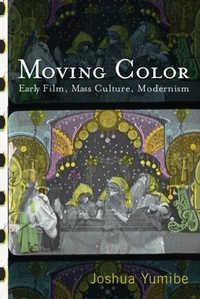
Color was used in film well before The Wizard of Oz. Thomas Edison, for example, projected two-colored films at his first public screening in New York City on April 23, 1896. These first colors of early cinema were not photographic; they were applied manually through a variety of laborious processes-most commonly by the hand-coloring and stenciling of prints frame by frame, and the tinting and toning of films in vats of chemical dyes. The results were remarkably beautiful.
Moving Color is the first book-length study of the beginnings of color cinema. Looking backward, Joshua Yumibe traces the legacy of color history from the beginning of the nineteenth century to the cinema of the early twentieth century. Looking forward, he explores the implications of this genealogy on experimental and contemporary digital cinemas in which many colors have become, once again, vividly unhinged from photographic reality. Throughout this history, Moving Color revolves around questions pertaining to the sensuousness of color: how color moves us in the cinema-visually, emotionally, and physically.
Moving Color is the first book-length study of the beginnings of color cinema. Looking backward, Joshua Yumibe traces the legacy of color history from the beginning of the nineteenth century to the cinema of the early twentieth century. Looking forward, he explores the implications of this genealogy on experimental and contemporary digital cinemas in which many colors have become, once again, vividly unhinged from photographic reality. Throughout this history, Moving Color revolves around questions pertaining to the sensuousness of color: how color moves us in the cinema-visually, emotionally, and physically.
Reviews / Votes
"Moving Color is a vital contribution to our understanding of the American cultural landscape a century ago."(Afterimage) "Eye-opening. The first book-length history of the formative years of color film. The book is most effective when it focuses on historical details: the fascinating processes by which color was applied; the approaches taken by the film industry to manufacture, manipulate, and market movies; and the reception of colored films by early audiences."
(Historical Journal of Film, Radio, and Television) "Moving Color is an enjoyable, well-written addition to the study of colour cinema, which addresses a major gap in our understanding of applied film colour. The hard work Yumibe has done is extremely commendable."
(Screening the Past) "This is a work of great imagination and exemplary research."
(Moving Image) "Thoroughly researched, clearly argued, and well-written, Moving Color convincingly asserts the foundational role of color in cinema...a highly engaging and informative read."
- Matthew Solomon (author of Disappearing Tricks) "With astounding research into the original documents and films of the pre-1912 period, this innovative book fills a crucial gap in our knowledge of applied color in early cinema."
- John Belton (Rutgers University) "An admirable contribution to film studies."
(Early Popular Visual Culture)
More details
Series
Language
English
Place of publication
New Brunswick NJ
United States
Product notice
Paperback (trade)
Unsewn / adhesive bound
Illustrations
32 color and 29 b-w photographs
Dimensions
Height: 228 mm
Width: 156 mm
Thickness: 15 mm
Weight
377 gr
ISBN-13
978-0-8135-5297-2 (9780813552972)
Copyright in bibliographic data and cover images is held by Nielsen Book Services Limited or by the publishers or by their respective licensors: all rights reserved.
Schweitzer Classification
Person
JOSHUA YUMIBE is a lecturer in film studies at the University of St. Andrews and is also the co-director of the Davide Turconi Project preserved at George Eastmaan House, Rochester, NY.
Content
List of Illustrations
Foreword by Paolo Cherchi Usai
Acknowledgements
Introduction
1 The Colors of Modernity
2 Hand Coloring anf the Intermediality of Cinema
3 Transforming and Uplift: Stenciling, Tinting, and Toning
4 Color Cinema, fromGentility to Abstraction
Conclusion
Notes
Selected Bibliography
Index
Foreword by Paolo Cherchi Usai
Acknowledgements
Introduction
1 The Colors of Modernity
2 Hand Coloring anf the Intermediality of Cinema
3 Transforming and Uplift: Stenciling, Tinting, and Toning
4 Color Cinema, fromGentility to Abstraction
Conclusion
Notes
Selected Bibliography
Index