

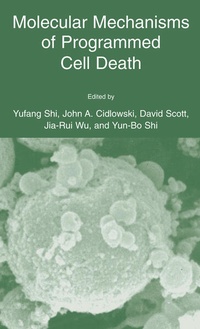
Molecular Mechanisms of Programmed Cell Death
Published on 31. December 2003
Book
Hardback
X, 229 pages
978-0-306-47778-2 (ISBN)
Description
The 2002 Nobel Prize in Physiology or Medicine was awarded to Sydney Brenner, H. Robert Horvitz, and John E. Sulston for their seminal discoveries concerning "genetic regulation of organ development and programmed cell death." This clearly marked the prime importance of understanding the molecular mechanisms controlling cell death. The 1 st International Symposium on Programmed Cell Death was held in the Shanghai Science Center of the Chinese Academy of Sciences on September 8-12, 1996. A number of key issues in apoptosis were discussed at the meeting, and progress in major areas of apopto sis research was summarized by expert participants at the meeting and published by Plenum Publishing Corporation as a book entitled Programmed Cell Death. In the last six years, we have witnessed a real explosion in our knowledge on how cells undergo apoptosis, thereby participating in various developmental and pathophysiological processes. At this ever exciting time, we organized the 2nd International Symposium on Programmed Cell Death.
More details
Edition
2003 ed.
Language
English
Place of publication
New York
United States
Publishing group
Springer Science+Business Media
Target group
Professional and scholarly
College/higher education
Research
Illustrations
26 s/w Abbildungen
X, 229 p. 26 illus.
Dimensions
Height: 257 mm
Width: 170 mm
Thickness: 20 mm
Weight
659 gr
ISBN-13
978-0-306-47778-2 (9780306477782)
DOI
10.1007/978-1-4757-5890-0
Schweitzer Classification
Other editions
Additional editions
Yufang Shi | John A. Cidlowski | David W. Scott
Molecular Mechanisms of Programmed Cell Death
E-Book
06/2013
Springer
€149.79
Available for download
Yufang Shi | John A. Cidlowski | David W. Scott
Molecular Mechanisms of Programmed Cell Death
Book
12/2010
Springer
€160.49
Shipment within 15-20 days
Content
1. Akt and Bcl-xL Are Independent Regulators of the Mitochondrial Cell Death Pathways.- 2. Thyroid Hormone-Induced Apoptosis during Amphibian Metamorphosis.- 3. The Endoplasmic Reticulum Stress Response in Health and Disease.- 4. The Role of the PI3K Pathway in Anti-IgM (Anti-?) -Sensitive and -Resistant B-cell Lymphomas: Failure to Disengage PI3K Pathway Signaling Confers Anti-? Resistance on the CH12 B Cell Lymphoma.- 5. Signaling for Inducible Fas-Resistance in Primary B Lymphocytes.- 6. Apoptosis and Autoimmune Diseases.- 7. Oxidative Stress and Thymocyte Apoptosis.- 8. Activation-Induced Cell Death and T Helper Subset Differentiation.- 9. The Bax-/- Bak-/- Mouse: a Model for Apoptosis.- 10. Novel Transcriptional Regulatory Pathways of IL-3-Dependent Survival Responses.- 11. MAP-1 Is a Putative Ligand for the Multidomain Proapoptotic Protein Bax.- 12. The Mechanisms and Significance of Apoptotic Cell-Mediated Immune Regulation.- 13. Neuroprotection against Apoptosis: What Has it Got to Do with the Mood Stabilizer Lithium?.- 14. Apoptosis, Cancer, and Cancer Therapy.- 15. DNA Fragmentation in Mammalian Apoptosis and Tissue Homeostasis.- 16. Ubiquitin and Intracellular Aggregation: A Common Pathway of Neurodegeneration in Chronic Dementia?.- 17. The Mechanism of Apoptosis Regulation by IAP Antagonist Smac/DIABLO.- 18. Integration of TNF-? Signaling: Crosstalk between IKK, JNK, and Caspases.