

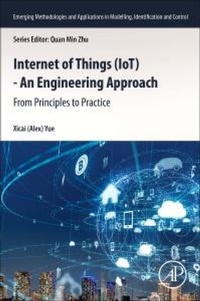
Internet of Things (IoT) - An Engineering Approach
From Principles to Practice
Published on 24. September 2025
Book
Paperback/Softback
262 pages
978-0-443-23903-8 (ISBN)
Description
Internet of Things (IoT) - An Engineering Approach: From Principles to Practice provides clear engineering practice guides on developing intelligent sensor/actuator nodes and then forming an IoT system, without the confusion of network/communication protocols.
IoT will be widely used in smart homes, smart cities, digital health, and digital manufacturers. However, the development of an IoT system can be complicated since it combines technologies in networking and security, wireless communication, broadband cellular networks, sensors and actuators, data acquisition and real-time embedded systems, edge computing with artificial intelligence, and low-power electronics technologies.
All engineering practice topics come with examples mostly from the first-hand materials of the author's research projects, e.g. digital switching, powering indoor IoT sensor nodes by photovoltaic energy harvesting, laser sensors for greenhouse plant, low-power electronics for implantable neural recording for blowfly, zero-power passive sensing, MEMs capacitor for ultrasound imaging/digital speaker, contactless electrode for physiological measurements, EoG based gaze tracking for augmented reality. Therefore, this book can be used for teaching or used as a reference for relevant research.
IoT will be widely used in smart homes, smart cities, digital health, and digital manufacturers. However, the development of an IoT system can be complicated since it combines technologies in networking and security, wireless communication, broadband cellular networks, sensors and actuators, data acquisition and real-time embedded systems, edge computing with artificial intelligence, and low-power electronics technologies.
All engineering practice topics come with examples mostly from the first-hand materials of the author's research projects, e.g. digital switching, powering indoor IoT sensor nodes by photovoltaic energy harvesting, laser sensors for greenhouse plant, low-power electronics for implantable neural recording for blowfly, zero-power passive sensing, MEMs capacitor for ultrasound imaging/digital speaker, contactless electrode for physiological measurements, EoG based gaze tracking for augmented reality. Therefore, this book can be used for teaching or used as a reference for relevant research.
More details
Series
Language
English
Place of publication
San Diego
United States
Publishing group
Elsevier Science Publishing Co Inc
Target group
Professional and scholarly
Product notice
Paperback (trade)
Unsewn / adhesive bound
Dimensions
Height: 229 mm
Width: 150 mm
Thickness: 15 mm
Weight
428 gr
ISBN-13
978-0-443-23903-8 (9780443239038)
Copyright in bibliographic data and cover images is held by Nielsen Book Services Limited or by the publishers or by their respective licensors: all rights reserved.
Schweitzer Classification
Other editions
Additional editions
E-Book
09/2025
Elsevier
€184.99
Available for download
Person
Dr. Yue received BEng in 1985, MEng and Ph.D in 1995 and 1999. From 1999 to 2016, he was a full-time researcher in Tsinghua University, China, Imperial College London, and Sharp Laboratories of Europe. Currently he is the Head of Instrumentation at the Institute of Biosensing Technology, University of the West of England, and successfully delivered UK research and innovation (UKRI) projects where he acted as the principal investigator/co-investigator.
Dr. Yue is a senior member of IEEE and has acted as session chairs/co-chairs at IEEE conferences. He is also an associate editor of Measurement Journal (Elsevier). Dr Yue has authored many tens of peer-reviewed journal papers, a patent, and a book chapter. His areas of expertise include analog/digital electronics, sensor interface and data acquisition, embedded system design (microcontroller and FPGA); signal processing and artificial intelligence, IC design in CMOS and TFT processes; power management for energy harvesting; zero-power passive sensing, and contactless electrodes for long-term physiological measurements. His work on stem cell culture process optimization won the IEEE International Symposium on Circuits and Systems (ISCAS) live-demo prize.
Dr. Yue is a senior member of IEEE and has acted as session chairs/co-chairs at IEEE conferences. He is also an associate editor of Measurement Journal (Elsevier). Dr Yue has authored many tens of peer-reviewed journal papers, a patent, and a book chapter. His areas of expertise include analog/digital electronics, sensor interface and data acquisition, embedded system design (microcontroller and FPGA); signal processing and artificial intelligence, IC design in CMOS and TFT processes; power management for energy harvesting; zero-power passive sensing, and contactless electrodes for long-term physiological measurements. His work on stem cell culture process optimization won the IEEE International Symposium on Circuits and Systems (ISCAS) live-demo prize.
Content
Part 1: Introduction
1. IoT overview
2. Internet
3. Things
Part 2: Engineering Essentials for IoT
4. Wireless technologies
5. Internet protocols and IoT structure
6. IoT application case study
Part 3: Development of IoT systems
7. Sensor nodes
8. Connecting sensor nodes to the internet
9. Application software development
Part 4: Engineering practices to meet application requirements
10. Measurements accuracy
11. Real-time implementation
12. Lower the power consumption
13. Intelligent the sensor nodes
1. IoT overview
2. Internet
3. Things
Part 2: Engineering Essentials for IoT
4. Wireless technologies
5. Internet protocols and IoT structure
6. IoT application case study
Part 3: Development of IoT systems
7. Sensor nodes
8. Connecting sensor nodes to the internet
9. Application software development
Part 4: Engineering practices to meet application requirements
10. Measurements accuracy
11. Real-time implementation
12. Lower the power consumption
13. Intelligent the sensor nodes