

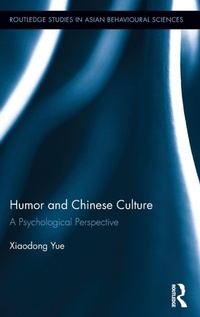
Humor and Chinese Culture
A Psychological Perspective
1st Edition
Published on 27. July 2017
Book
Hardback
216 pages
978-1-138-22062-1 (ISBN)
Description
This book addresses psychological studies of humour in Chinese societies. It starts by reviewing how the concept of humour evolves in Chinese history, and how it is perceived by Confucianism, Taoism, and Buddhism respectively. It then compares differences in the Western and the Chinese perceptions of humor and discusses empirical studies that were conducted to examine such differences. It also discusses the cultural origin and empirical evidence of the Chinese ambivalence about humor and presents empirical findings that illustrate its existence. Having done these, it proceeds to discuss psychological studies that examine how humour is related to various demographic, dispositional variables as well as how humour is related to creativity in Chinese societies. It also discusses how humour is related to emotional expressions and mental health in Chinese society as well. It concludes with a discussion on how workplace humor is reflected and developed in Chinese contexts. Taken together, this book attempts to bring together the theoretical propositions, empirical studies, and cultural analyses of humor in Chinese societies.
Reviews / Votes
"This is a fascinating exploration of the role of humor in Chinese culture. The author's knowledge of the impacts of history, philosophical teachings, and psychology enhance our understanding of both China and humor." -- Don Baird, Psy. D."Yue's quantitative research design does explain the mechanisms of using and interpreting humour in the Chinese context. It certainly contributes to the field of humour perception in psychology and linguistics. His in-depth review of how Confucianism and traditional ethos impact Chinese ambivalent attitudes about humour can shed light on further studies in similar areas." -- An excerpt of a review by Ying Cao in The European Journal of Humour Research, https://europeanjournalofhumour.org/ejhr/article/view/780
More details
Series
Language
English
Place of publication
London
United Kingdom
Publishing group
Taylor & Francis Ltd
Target group
College/higher education
Professional and scholarly
Illustrations
20 s/w Abbildungen, 20 s/w Zeichnungen, 53 s/w Tabellen
53 Tables, black and white; 20 Line drawings, black and white; 20 Illustrations, black and white
Dimensions
Height: 240 mm
Width: 161 mm
Thickness: 17 mm
Weight
502 gr
ISBN-13
978-1-138-22062-1 (9781138220621)
Copyright in bibliographic data and cover images is held by Nielsen Book Services Limited or by the publishers or by their respective licensors: all rights reserved.
Schweitzer Classification
Other editions
Additional editions
Book
03/2019
1st Edition
Routledge
€68.20
Shipment within 15-20 days
E-Book
07/2017
Routledge
€61.99
Available for download
E-Book
07/2017
Routledge
€61.99
Available for download
Person
Yue, Xiaodong earned his BA degree in English language and literature at Beijing Second Foreign Languages Institute in 1982, his MA degree in education from Tufts University in 1987, and his Ed.D degree in psychology from Harvard University in 1993. He has taught psychology courses at Department of Educational Psychology of Chinese University of Hong Kong (1993-1996) and at the Department of Applied Social Sciences of City University of Hong Kong (1997 - now). He has published widely on issues of creativity, humor, resilience, and adolescent idol worship in Chinese society. He is an adjunct professor of over 20 universities in China as well as an ad hoc reviewer of over 10 international journals of psychology and education. He is also a prolific speaker and has been invited to give keynote addresses at various conferences in China and around world.
Content
1. Humor, Philosophy and Chinese Culture
2. Chinese and Western Views of Humor
3. Chinese Ambivalence about Humor
4. Humor and Chinese Personality
5. Humor and Chinese Emotions
6. Humor and Chinese Mental Well Being
7. Humor and Chinese Creativity
8. Workplace Humor in Chinese Society
2. Chinese and Western Views of Humor
3. Chinese Ambivalence about Humor
4. Humor and Chinese Personality
5. Humor and Chinese Emotions
6. Humor and Chinese Mental Well Being
7. Humor and Chinese Creativity
8. Workplace Humor in Chinese Society