

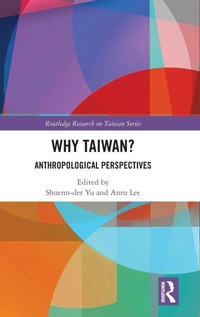
Why Taiwan
Anthropological Perspectives
1st Edition
Will be published approx. on 22. January 2026
Book
Hardback
244 pages
978-1-041-06361-2 (ISBN)
Description
This book situates Taiwan and Taiwanese actors at the center of knowledge production about Taiwan and re-asserts the ontological status of Taiwan as a legitimate object of scholarship in its own right.
Challenging the appropriateness of the thesis that Taiwan matters because China matters, this book examines how transactions between China and Taiwan are never one-dimensional but two-way flows, and that the presumed hierarchical relationship between the two is very much blurred. It discusses how cultural dynamics in Taiwan are profoundly shaped by the modern migration routes, trade networks, geopolitical circumstances within which it is enmeshed and so understanding Taiwan in a world context reveals not only how the history, culture, and society of Taiwan have evolved over time, but also how Taiwan has played a key part in transnational processes as a site of global knowledge production.
Theorizing the study of Taiwan in a global context, this book will be a valuable resource for scholars and students of Anthropology, Comparative Cultural Studies, Postcolonial Studies, Asian Studies, and Taiwan Studies.
Challenging the appropriateness of the thesis that Taiwan matters because China matters, this book examines how transactions between China and Taiwan are never one-dimensional but two-way flows, and that the presumed hierarchical relationship between the two is very much blurred. It discusses how cultural dynamics in Taiwan are profoundly shaped by the modern migration routes, trade networks, geopolitical circumstances within which it is enmeshed and so understanding Taiwan in a world context reveals not only how the history, culture, and society of Taiwan have evolved over time, but also how Taiwan has played a key part in transnational processes as a site of global knowledge production.
Theorizing the study of Taiwan in a global context, this book will be a valuable resource for scholars and students of Anthropology, Comparative Cultural Studies, Postcolonial Studies, Asian Studies, and Taiwan Studies.
More details
Series
Language
English
Place of publication
London
United Kingdom
Publishing group
Taylor & Francis Ltd
Target group
College/higher education
Postgraduate and Undergraduate Advanced
Illustrations
4 s/w Tabellen, 5 s/w Zeichnungen, 2 s/w Photographien bzw. Rasterbilder, 7 s/w Abbildungen
4 Tables, black and white; 5 Line drawings, black and white; 2 Halftones, black and white; 7 Illustrations, black and white
Dimensions
Height: 240 mm
Width: 161 mm
Thickness: 17 mm
Weight
505 gr
ISBN-13
978-1-041-06361-2 (9781041063612)
Copyright in bibliographic data and cover images is held by Nielsen Book Services Limited or by the publishers or by their respective licensors: all rights reserved.
Schweitzer Classification
Other editions
Additional editions
E-Book
01/2026
1st Edition
Routledge
€60.49
Available for download
E-Book
01/2026
1st Edition
Routledge
€60.49
Available for download
Persons
Shuenn-der Yu is a research fellow at the Institute of Ethnology, Academia Sinica, Taiwan.
Anru Lee is Professor of Anthropology and Global Asian Studies at John Jay College, the City University of New York, USA.
Anru Lee is Professor of Anthropology and Global Asian Studies at John Jay College, the City University of New York, USA.
Content
Meanings of Why Taiwan? - An Introduction 1.Why Taiwan Mattered: Oral Histories from the US Cold War Anthropology of China in Taiwan 2. Taiwan Doesn't Matter Until It Does, Navigating the Crossroads of China and Taiwan Studies 3. Indigenous Lives Matter, The Relevance of Indigeneity to Taiwan and to Anthropology 4. Learning via a Conduit, An Anthropological Encounter with Taiwan in Mainland China 5. When a Local Invented Tradition Becomes Heritage Culture for All of China, The Paradox of Taiwan's Tea Art 6. From Sea Goddess to Peace Goddess: The Export of Taiwan's Cult of Mazu 7. Gambling and Affect, Risking and Daring in Cold War Matsu 8. Revisiting "Taiwanese Food Culture", The Culinary Contact Zone of East and Southeast Asian Foodways 9. Worlding Taiwanese Aquaculture Technology, Science Diplomacy, Experts, and Know-How Transfer