

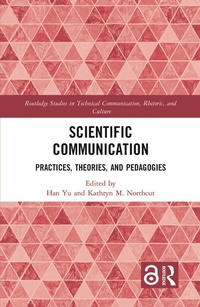
Scientific Communication
Practices, Theories, and Pedagogies
1st Edition
Published on 25. September 2017
Book
Hardback
332 pages
978-1-138-06478-2 (ISBN)
Description
This book addresses the roles and challenges of people who communicate science, who work with scientists, and who teach STEM majors how to write. In terms of practice and theory, chapters address themes encountered by scientists and communicators, including ethical challenges, visual displays, and communication with publics, as well as changed and changing contexts and genres. The pedagogy section covers topics important to instructors' everyday teaching as well as longer-term curricular development. Chapters address delivery of rhetorically informed instruction, communication from experts to the publics, writing assessment, online teaching, and communication-intensive pedagogies and curricula.
The Open Access version of this book, available at http://www.tandfebooks.com, has been made available under a Creative Commons Attribution-Non Commercial-No Derivatives 4.0 license.
The Open Access version of this book, available at http://www.tandfebooks.com, has been made available under a Creative Commons Attribution-Non Commercial-No Derivatives 4.0 license.
Reviews / Votes
"Yu and Northcut have blazed a new, important, timely, and practicable trail in the field of science communication." --Paul Dombrowski, University of Central Florida"For faculty (and grad students) who want to initiate courses in science writing, or for those who want to enrich their approaches, Yu and Northcut's new work has much to offer. The volume offers the best current thinking to support the teaching of science writing." --Stephen A. Bernhardt, University of Delaware, Emeritus
More details
Series
Language
English
Place of publication
London
United Kingdom
Publishing group
Taylor & Francis Ltd
Target group
College/higher education
Illustrations
30 s/w Abbildungen, 13 s/w Photographien bzw. Rasterbilder, 17 s/w Zeichnungen, 27 s/w Tabellen
27 Tables, black and white; 17 Line drawings, black and white; 13 Halftones, black and white; 30 Illustrations, black and white
Dimensions
Height: 229 mm
Width: 152 mm
Weight
620 gr
ISBN-13
978-1-138-06478-2 (9781138064782)
Copyright in bibliographic data and cover images is held by Nielsen Book Services Limited or by the publishers or by their respective licensors: all rights reserved.
Schweitzer Classification
Other editions
Additional editions
Book
09/2020
1st Edition
Routledge
€68.00
Shipment within 15-20 days
E-Book
09/2017
Routledge
€0.00
Available for download
E-Book
09/2017
Routledge
€0.00
Available for download
Persons
Han Yu is Professor of Technical Communication in the English Department, Kansas State University, USA. She is co-editor of Negotiating Cultural Encounters: Narrating Intercultural Engineering and Technical Communication with Gerald Savage, and is the author of The Other Kind of Funnies: Comics in Technical Communication and Communicating Genetics: Visualizations and Representations.
Kathryn Northcut is Professor of Technical Communication in the Department of English and Technical Communication at Missouri S&T, USA. She teaches courses in technical communication at the undergraduate and graduate levels. She co-edited Designing Texts: Teaching Visual Communication with Eva Brumberger.
Kathryn Northcut is Professor of Technical Communication in the Department of English and Technical Communication at Missouri S&T, USA. She teaches courses in technical communication at the undergraduate and graduate levels. She co-edited Designing Texts: Teaching Visual Communication with Eva Brumberger.
Content
Part I: Practice and Theory
1. Shifting Networks of Science: Citizen Science and Scientific Genre Change
Gwendoline Reid
2. Lines and Fields of Ethical Force in Scientific Authorship: The Legitimacy and Power of the Office of Research Integrity
Steven B. Katz and C. Claiborne Linvill
3. Science vs. Science Commercialization: Conflicts and Ethics of Information Sharing
Scott A. Mogull
4. Visualizing Science: Using Grounded Theory to Critically Evaluate Data Visualizations
Candice A. Welhausen
5. The Tree of Life in Popular Science: Assumptions, Accuracy, and Accessibility
Han Yu
6. Tweeting the Anthropocene: #400ppm as Networked Event
Lauren E. Cagle and Denise Tillery
7. From Questions of Fact to Questions of Policy and Beyond: Science Museum Communication and the Possibilities of a Rhetorical Education
Gregory Schneider-Bateman
Part II: Pedagogy and Curriculum
8. Science and Writing: A Transectional Account of Pedagogical Species
Jonathan Buehl and William FitzGerald
9. Confronting the Objectivity Paradigm: A Rhetorical Approach to Teaching Science Communication
Maria E. Gigante
10. Dissolving the Divide between Expert and Public: Improving the Science Communication Service Course
Kate Maddalena and Colleen A. Reilly
11. A Rhetorical Approach to Scientific Communication Pedagogy in Face-to-Face and Digital Contexts
Carleigh Davis and Erin A. Frost
12. MetaFeedback: A Model for Teaching Instructor Response to Student Writing in the Sciences
Lindsey Harding and Liz Studer
13. Incorporating Wikipedia in the Classroom to Improve Science Learning and Communication
Becky J. Carmichael and Metha M. Klock
1. Shifting Networks of Science: Citizen Science and Scientific Genre Change
Gwendoline Reid
2. Lines and Fields of Ethical Force in Scientific Authorship: The Legitimacy and Power of the Office of Research Integrity
Steven B. Katz and C. Claiborne Linvill
3. Science vs. Science Commercialization: Conflicts and Ethics of Information Sharing
Scott A. Mogull
4. Visualizing Science: Using Grounded Theory to Critically Evaluate Data Visualizations
Candice A. Welhausen
5. The Tree of Life in Popular Science: Assumptions, Accuracy, and Accessibility
Han Yu
6. Tweeting the Anthropocene: #400ppm as Networked Event
Lauren E. Cagle and Denise Tillery
7. From Questions of Fact to Questions of Policy and Beyond: Science Museum Communication and the Possibilities of a Rhetorical Education
Gregory Schneider-Bateman
Part II: Pedagogy and Curriculum
8. Science and Writing: A Transectional Account of Pedagogical Species
Jonathan Buehl and William FitzGerald
9. Confronting the Objectivity Paradigm: A Rhetorical Approach to Teaching Science Communication
Maria E. Gigante
10. Dissolving the Divide between Expert and Public: Improving the Science Communication Service Course
Kate Maddalena and Colleen A. Reilly
11. A Rhetorical Approach to Scientific Communication Pedagogy in Face-to-Face and Digital Contexts
Carleigh Davis and Erin A. Frost
12. MetaFeedback: A Model for Teaching Instructor Response to Student Writing in the Sciences
Lindsey Harding and Liz Studer
13. Incorporating Wikipedia in the Classroom to Improve Science Learning and Communication
Becky J. Carmichael and Metha M. Klock