

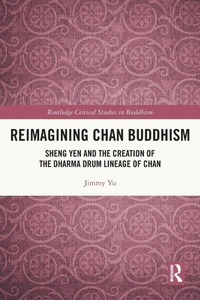
Reimagining Chan Buddhism
Sheng Yen and the Creation of the Dharma Drum Lineage of Chan
1st Edition
Published on 31. May 2023
Book
Paperback/Softback
216 pages
978-1-032-05168-0 (ISBN)
Description
This book is the first socio-intellectual history of the Dharma Drum Lineage of Chan (Zen), a new lineage of Buddhism founded by the late Chinese Buddhist cleric, Sheng Yen (1931-2009)-arguably one of the most influential Chan masters in contemporary times.
The book challenges the received academic and popular image of Chan Buddhism as a meditation school that bypasses scriptural learning. Using Sheng Yen's doctrinal classification (Chn. panjiao) chart as an example, the book shows Sheng Yen's Chan as a synthesis of both Indian and Chinese premodern forms of Buddhism, and as the summum bonum of Han transmission of Chinese Buddhism (Chn. Hanchuan fojiao). The book demonstrates how Sheng Yen's presentation of Chan was intimately related to the volatile social and political realities of his life-the Communist takeover of China and the subsequent industrial boom that impacted Taiwanese society. In short, this book presents a historically and culturally embodied approach to the formation of Buddhist doctrine and practice. Drawing on the works of postcolonial theories that integrate the role of the researcher into the research, the book also offers a more integrated approach between emic and etic, insider and outsider perspectives to research.
Advancing the field of Buddhist studies, the book will be of interest to scholars of Buddhism in the modern period, twentieth-century religious history of China and Taiwan, Chan/Zen studies, World Religions, Asian civilizations, and Modern Biographies.
The book challenges the received academic and popular image of Chan Buddhism as a meditation school that bypasses scriptural learning. Using Sheng Yen's doctrinal classification (Chn. panjiao) chart as an example, the book shows Sheng Yen's Chan as a synthesis of both Indian and Chinese premodern forms of Buddhism, and as the summum bonum of Han transmission of Chinese Buddhism (Chn. Hanchuan fojiao). The book demonstrates how Sheng Yen's presentation of Chan was intimately related to the volatile social and political realities of his life-the Communist takeover of China and the subsequent industrial boom that impacted Taiwanese society. In short, this book presents a historically and culturally embodied approach to the formation of Buddhist doctrine and practice. Drawing on the works of postcolonial theories that integrate the role of the researcher into the research, the book also offers a more integrated approach between emic and etic, insider and outsider perspectives to research.
Advancing the field of Buddhist studies, the book will be of interest to scholars of Buddhism in the modern period, twentieth-century religious history of China and Taiwan, Chan/Zen studies, World Religions, Asian civilizations, and Modern Biographies.
More details
Series
Language
English
Place of publication
London
United Kingdom
Publishing group
Taylor & Francis Ltd
Target group
College/higher education
Postgraduate
Illustrations
20 s/w Abbildungen, 20 s/w Photographien bzw. Rasterbilder
20 Halftones, black and white; 20 Illustrations, black and white
Dimensions
Height: 234 mm
Width: 156 mm
Thickness: 12 mm
Weight
354 gr
ISBN-13
978-1-032-05168-0 (9781032051680)
Copyright in bibliographic data and cover images is held by Nielsen Book Services Limited or by the publishers or by their respective licensors: all rights reserved.
Schweitzer Classification
Other editions
Additional editions
Book
11/2021
1st Edition
Routledge
€206.30
Shipment within 10-20 days
E-Book
11/2021
1st Edition
Routledge
€59.49
Available for download
E-Book
11/2021
1st Edition
Routledge
€59.49
Available for download
Person
Jimmy Yu is Associate Professor of Chinese Buddhism and Religions in the Department of Religion, Florida State University, USA.
Content
Introduction: Biography, History, and Positionality 1. A Life of Contingencies and Crises 2. An Imagined Orthodoxy 3. Chan as the Doctrinal Culmination of the Han Transmission of Chinese Buddhism 4. Chan as the Experiential Fulfillment of the Han Transmission of Chinese Buddhism Conclusion