

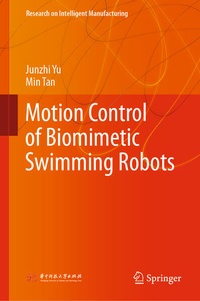
Motion Control of Biomimetic Swimming Robots
Published on 1. July 2019
Book
Hardback
VIII, 203 pages
978-981-13-8770-8 (ISBN)
Description
This book reports on the latest advances in the study of motion control in biomimetic swimming robots with high speed and high manoeuvrability. It presents state-of-the-art studies on various swimming robots including robotic fish, dolphins and jellyfish in a unified framework, and discusses the potential benefits of applying biomimetic underwater propulsion to autonomous underwater vehicle design, such as: speed, energy economy, enhanced manoeuvrability, and reduced detectability. Given its scope, the book will be of interest to researchers, engineers and graduate students in robotics and ocean engineering who wish to learn about the core principles, methods, algorithms, and applications of biomimetic underwater robots.
More details
Series
Edition
2020 ed.
Language
English
Place of publication
Singapore
Singapore
Target group
Professional and scholarly
Illustrations
18 s/w Abbildungen, 103 farbige Abbildungen
VIII, 203 p. 121 illus., 103 illus. in color.
Dimensions
Height: 241 mm
Width: 160 mm
Thickness: 18 mm
Weight
489 gr
ISBN-13
978-981-13-8770-8 (9789811387708)
DOI
10.1007/978-981-13-8771-5
Schweitzer Classification
Other editions
Additional editions
Junzhi Yu | Min Tan
Motion Control of Biomimetic Swimming Robots
Book
08/2020
Springer
€106.99
Shipment within 15-20 days
Junzhi Yu | Min Tan
Motion Control of Biomimetic Swimming Robots
E-Book
06/2019
1st Edition
Springer
€96.29
Available for download
Persons
Dr. Yu's research interests include biomimetic robots, intelligent control, and intelligent mechatronic systems. In these areas, he (co-)authored 2 monographs, and published over 80 SCI papers in the prestigious robotics and automation related journals, among which 40 papers are published in IEEE Transactions journals (including 18 first-author papers). He was successively listed among Most Cited Researchers in China in 2014, 2015, and 2016. In addition, he has authorized 22 invention patents and 13 software copyright registrations. Some of the achievements have been applied to water quality monitoring and underwater robot competition, while some have been transferred and industrialized. He received the Humboldt Research Fellowship for Experienced Researchers from the Alexander von Humboldt Foundation in 2009, the First Prize of Beijing Science and Technology Award (in second place) in 2013, the Second Prize of National Natural Science Award (in third place) in 2017, as well as 9 BestPaper Awards like IEEE ROBIO Best Paper Award in Biomimetics. Currently he serves as Associate Editors of several top international journals involving IEEE Transactions on Robotics and IEEE/ASME Transactions on Mechatronics.
Professor Min Tan is a researcher at the Chinese Academy of Sciences Institute of Automation, doctoral supervisor, he is also the winner of National Science Fund for Distinguished Young Scholars, and the principal of the NSFC innovation research group, the state council degree committee of the Seventh Discipline Appraisal group members, and National candidate of the New Century Hundred Million Talent Project, the 100-member program of the Chinese Academy of Sciences, he also won the National Natural Science Award. In recent years, Professor Min Tan has made outstanding achievements in the research and development of advanced robot control, bionic robot and multi-robot coordination and control.
Professor Min Tan is a researcher at the Chinese Academy of Sciences Institute of Automation, doctoral supervisor, he is also the winner of National Science Fund for Distinguished Young Scholars, and the principal of the NSFC innovation research group, the state council degree committee of the Seventh Discipline Appraisal group members, and National candidate of the New Century Hundred Million Talent Project, the 100-member program of the Chinese Academy of Sciences, he also won the National Natural Science Award. In recent years, Professor Min Tan has made outstanding achievements in the research and development of advanced robot control, bionic robot and multi-robot coordination and control.
Content
Introduction.- Bio-inspired Fish Body Wave Model Considering Linear Density.- Motion Control of Fishlike Swimming in 2D.- CPG-based Swimming Control.- 3D Maneuvering Control of Robotic Fish.- Control of Yaw and Pitch Maneuvers of Robotic Dolphin.- Leaping Control of Self-propelled Robotic Dolphin.- Motion Control of Self-propelled Robotic Jellyfish.- Summary and Outlook.