

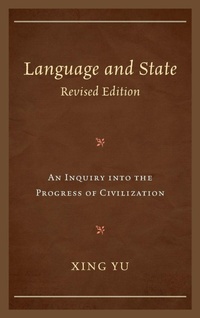
Language and State
An Inquiry Into the Progress of Civilization
Published on 19. May 2017
Book
Hardback
506 pages
978-0-7618-6903-0 (ISBN)
Description
This book argues that a tribe of the primitive society is formed because of kinship, while a state of the civilized society is formed because of language. When humans communicate using language, they extend the distance and the reaches of communication. They expand their communities. States replace tribes. Language underlies the formation of the state. Then, accordingly, language also underlies the organization of the state as men create language solutions in the organization of the state such as constitution, election and representation. The extension of linguistic communication distance also underlies the formation of three juxtaposing branches of government ? administrative, legislative and judicial body. It also enables men to create various forms of civilization such as history, philosophy, literature, art, religion and law which play a role in the construction of men's spirit that guides the operation of the state. Language presets the whole process of the progress of civilization.
More details
Edition
Revised edition
Language
English
Place of publication
Lanham, MD
United States
Publishing group
University Press of America
Target group
Professional and scholarly
Edition type
Revised edition
Dimensions
Height: 235 mm
Width: 157 mm
Thickness: 34 mm
Weight
965 gr
ISBN-13
978-0-7618-6903-0 (9780761869030)
Copyright in bibliographic data and cover images is held by Nielsen Book Services Limited or by the publishers or by their respective licensors: all rights reserved.
Schweitzer Classification
Other editions
Additional editions
E-Book
05/2017
Hamilton Books
€107.99
Available for download
E-Book
05/2017
1st Edition
Hamilton Books
€107.99
Available for download
Person
Xing Yu, a political scientist who was born and graduated from two universities in China, is now an independent researcher in the Province of British Columbia, Canada.
Content
Prologue
Part One: Language and State Formation
Introduction
Chapter One: People
Chapter Two: Community
Chapter Three: Nation
Chapter Four: State
Part Two: Language and State Governance
Introduction
Chapter Five: Appellation
Chapter Six: Constitution
Chapter Seven: Election
Chapter Eight: Representation
Chapter Nine: Government
Part Three: Language and State Spirit
Introduction
Chapter Ten: History
Chapter Eleven: Philosophy
Chapter Twelve: Literature and Art
Chapter Thirteen: Religion
Chapter Fourteen: Law
Conclusion
Epilogue
Bibliography
Acknowledgments
Index
About the Author
Part One: Language and State Formation
Introduction
Chapter One: People
Chapter Two: Community
Chapter Three: Nation
Chapter Four: State
Part Two: Language and State Governance
Introduction
Chapter Five: Appellation
Chapter Six: Constitution
Chapter Seven: Election
Chapter Eight: Representation
Chapter Nine: Government
Part Three: Language and State Spirit
Introduction
Chapter Ten: History
Chapter Eleven: Philosophy
Chapter Twelve: Literature and Art
Chapter Thirteen: Religion
Chapter Fourteen: Law
Conclusion
Epilogue
Bibliography
Acknowledgments
Index
About the Author