

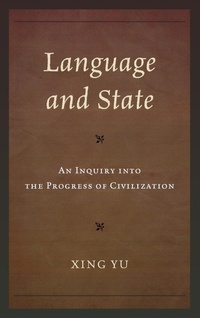
Language and State
An Inquiry into the Progress of Civilization
Published on 12. September 2013
Book
Hardback
460 pages
978-0-7618-6200-0 (ISBN)
Description
This book argues that a primitive society is formed on the basis of kinship ties while a civilized society is formed on the basis of linguistic communication. When humans communicate with each other through language, they extend the distance of communication. The extension of communication distance helps expand communities. States are gradually formed. This means that as these communities grow, they become too large to be supported only by the ties of kinship. The use of language and the development of linguistic communication underlies the establishment of governments, the introduction of laws, the holding of elections, and the flourishing of history, philosophy, literature, art, religion, etc. This book presents a new theory about the importance of language in the growth of the states.
More details
Language
English
Place of publication
Lanham, MD
United States
Target group
Professional and scholarly
Dimensions
Height: 235 mm
Width: 157 mm
Thickness: 31 mm
Weight
892 gr
ISBN-13
978-0-7618-6200-0 (9780761862000)
Copyright in bibliographic data and cover images is held by Nielsen Book Services Limited or by the publishers or by their respective licensors: all rights reserved.
Schweitzer Classification
Other editions
Additional editions
E-Book
09/2013
1st Edition
University Press of America
€107.99
Available for download
E-Book
09/2013
1st Edition
University Press of America
€107.99
Available for download
Person
Xing Yu is a political scientist who taught at two universities in China in the 1980s and 1990s. He obtained a bachelor's degree in art from Sichuan Foreign Languages Institute in Chongqing, China in 1982, and a master's degree in law from Fudan University in Shanghai, China in 1985. He now works as a freelance writer and translator in British Columbia, Canada.
Content
Prologue
Part One Language and State Formation
Introduction
Chapter One: People
Chapter Two: Community
Chapter Three: Nation
Chapter Four: State
Part Two Language and State Governance
Introduction
Chapter Five: Appellation
Chapter Six: Constitution
Chapter Seven: Election
Chapter Eight: Representation
Chapter Nine: Government
Part Three Language and State Spirit
Introduction
Chapter Ten: History
Chapter Eleven: Philosophy
Chapter Twelve: Literature and Art
Chapter Thirteen: Religion
Chapter Fourteen: Law
Conclusion
Epilogue
Bibliography
Acknowledgments
Index
About the Author
Part One Language and State Formation
Introduction
Chapter One: People
Chapter Two: Community
Chapter Three: Nation
Chapter Four: State
Part Two Language and State Governance
Introduction
Chapter Five: Appellation
Chapter Six: Constitution
Chapter Seven: Election
Chapter Eight: Representation
Chapter Nine: Government
Part Three Language and State Spirit
Introduction
Chapter Ten: History
Chapter Eleven: Philosophy
Chapter Twelve: Literature and Art
Chapter Thirteen: Religion
Chapter Fourteen: Law
Conclusion
Epilogue
Bibliography
Acknowledgments
Index
About the Author