

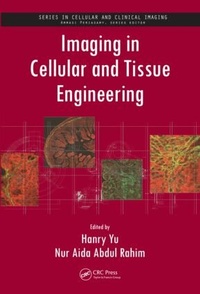
Imaging in Cellular and Tissue Engineering
1st Edition
Published on 16. May 2013
Book
Hardback
298 pages
978-1-4398-4803-6 (ISBN)
Description
Details on specific imaging modalities for different cellular and tissue engineering applications are scattered throughout articles and chapters in the literature. Gathering this information into a single reference, Imaging in Cellular and Tissue Engineering presents both the fundamentals and state of the art in imaging methods, approaches, and applications in regenerative medicine.
The book underscores the broadening scope of imaging applications in cellular and tissue engineering. It covers a wide range of optical and biological applications, including the repair or replacement of whole tissues (such as bone, cartilage, blood vessels, and bladder) and more novel artificially created support systems (such as artificial pancreas and bioartificial liver). Each chapter describes a particular application, relevant optical instrumentation, physical principles governing the imaging method, and strengths and weaknesses of the technique. The book also presents current and emerging data processing procedures.
As the field of tissue engineering moves from creating simpler outer body parts to more sophisticated internal organs, researchers need to evaluate and control how well the tissues are engineered and integrated into the living body. Suitable for both experts and newcomers in bioengineering and biomedical imaging, this book shows researchers how to apply imaging techniques to next-generation engineered cells and tissues. It helps them assess the suitability of specific imaging modalities for applications with various functional requirements.
The book underscores the broadening scope of imaging applications in cellular and tissue engineering. It covers a wide range of optical and biological applications, including the repair or replacement of whole tissues (such as bone, cartilage, blood vessels, and bladder) and more novel artificially created support systems (such as artificial pancreas and bioartificial liver). Each chapter describes a particular application, relevant optical instrumentation, physical principles governing the imaging method, and strengths and weaknesses of the technique. The book also presents current and emerging data processing procedures.
As the field of tissue engineering moves from creating simpler outer body parts to more sophisticated internal organs, researchers need to evaluate and control how well the tissues are engineered and integrated into the living body. Suitable for both experts and newcomers in bioengineering and biomedical imaging, this book shows researchers how to apply imaging techniques to next-generation engineered cells and tissues. It helps them assess the suitability of specific imaging modalities for applications with various functional requirements.
More details
Language
English
Place of publication
Bosa Roca
United States
Publishing group
Taylor & Francis Inc
Target group
Professional and scholarly
Academic and Professional Practice & Development
Illustrations
114 b/w images and Less than 50
Dimensions
Height: 254 mm
Width: 178 mm
Weight
702 gr
ISBN-13
978-1-4398-4803-6 (9781439848036)
Copyright in bibliographic data and cover images is held by Nielsen Book Services Limited or by the publishers or by their respective licensors: all rights reserved.
Schweitzer Classification
Other editions
Additional editions
Hanry Yu | Nur Aida Abdul Rahim
Imaging in Cellular and Tissue Engineering
Book
06/2020
1st Edition
CRC Press
€76.74
Shipment within 15-20 days
Hanry Yu | Nur Aida Abdul Rahim
Imaging in Cellular and Tissue Engineering
E-Book
05/2013
CRC Press
€86.99
Available for download
Hanry Yu | Nur Aida Abdul Rahim
Imaging in Cellular and Tissue Engineering
E-Book
05/2013
CRC Press
€86.99
Available for download
Persons
Hanry Yu is a professor in the Department of Physiology, Yong Loo Lin School of Medicine, National University of Singapore. He is also the group leader in the Institute of Bioengineering and Nanotechnology (A*STAR), principal investigator in the Research Centre of Excellence in Mechanobiology, and visiting associate professor in the Department of Biological Engineering at the Massachusetts Institute of Technology. His research activities over the past decade involve interfacing biomaterials with tissue engineering. Dr. Yu earned a PhD in cell biology from Duke University.
Nur Aida Abdul Rahim was a postdoctoral researcher in the Department of Physiology, Yong Loo Lin School of Medicine, National University of Singapore. Her research interests range from imaging intracellular fluorescent fusion protein interaction kinetics to stem cell migration and differentiation in microfluidic devices. She earned a PhD in mechanical engineering from the Massachusetts Institute of Technology.
Nur Aida Abdul Rahim was a postdoctoral researcher in the Department of Physiology, Yong Loo Lin School of Medicine, National University of Singapore. Her research interests range from imaging intracellular fluorescent fusion protein interaction kinetics to stem cell migration and differentiation in microfluidic devices. She earned a PhD in mechanical engineering from the Massachusetts Institute of Technology.
Content
Overview. In Vitro Applications. In Vivo Applications. Data Analysis.