

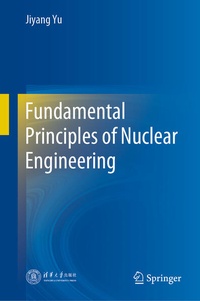
Fundamental Principles of Nuclear Engineering
Published on 12. January 2022
Book
Hardback
XIII, 699 pages
978-981-16-0838-4 (ISBN)
Description
This book highlights a comprehensive and detailed introduction to the fundamental principles related to nuclear engineering. As one of the most popular choices of future energy, nuclear energy is of increasing demand globally. Due to the complexity of nuclear engineering, its research and development as well as safe operation of its facility requires a wide scope of knowledge, ranging from basic disciplines such as mathematics, physics, chemistry, and thermodynamics to applied subjects such as reactor theory and radiation protection. The book covers all necessary knowledge in an illustrative and readable style, with a sufficient amount of examples and exercises. It is an easy-to-read textbook for graduate students in nuclear engineering and a valuable handbook for nuclear facility operators, maintenance personnel and technical staff.
More details
Edition
2022 ed.
Language
English
Place of publication
Singapore
Singapore
Target group
Primary & secondary/elementary & high school
Illustrations
459 s/w Abbildungen
XIII, 699 p. 459 illus.
Dimensions
Height: 241 mm
Width: 160 mm
Thickness: 44 mm
Weight
1226 gr
ISBN-13
978-981-16-0838-4 (9789811608384)
DOI
10.1007/978-981-16-0839-1
Schweitzer Classification
Other editions
Additional editions
Book
01/2023
Springer
€85.59
Shipment within 3-4 weeks
E-Book
01/2022
Springer
€85.59
Available for download
Person
Dr. Jiyang Yu
Dr. Jiyang Yu receives his PhD in Nuclear Science and Engineering from the Department of Engineering Physics, Tsinghua University. He works as Associate Professor in the same department, and serves as Committee Member of the Nuclear Reactor Thermal Fluid Specialty Committee of Chinese Nuclear Society. His research focuses on the thermal hydraulics and safe operation of nuclear reactors.
Content
Chapter 1 Fundamentals of mathematics and physics.- Chapter 2 Thermodynamics.- Chapter 3 Heat transfer.- Chapter 4 Fluid flow.- Chapter 5 Electrical Science.- Chapter 6 Instrumentation & control.- Chapter 7 Chemistry and chemical engineering.- Chapter 8 Material Science.- Chapter 9 Mechanical Science.- Chapter 10 Nuclear physics.- Chapter 11 Reactor theory.- Chapter 12 Radiation protection.