

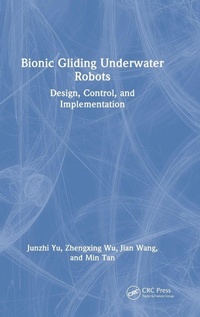
Bionic Gliding Underwater Robots
Design, Control, and Implementation
1st Edition
Published on 8. December 2022
Book
Hardback
304 pages
978-1-032-38913-4 (ISBN)
Description
Underwater robots play a significant role in ocean exploration. This book provides full coverage of the theoretical and practical aspects of bionic gliding underwater robots, including system design, modeling control, and motion planning.
To overcome the inherent shortcomings of traditional underwater robots that can simultaneously lack maneuverability and endurance, a new type of robot, the bionic gliding underwater robot, has attracted much attention from scientists and engineers. On the one hand, by imitating the appearance and swimming mechanisms of natural creatures, bionic gliding underwater robots achieve high maneuverability, swimming efficiency, and strong concealment. On the other hand, borrowing from the buoyancy adjustment systems of underwater gliders, bionic gliding underwater robots can obtain strong endurance, which is significant in practical applications. Taking gliding robotic dolphin and fish as examples, the designed prototypes and proposed methods are discussed, offering valuable insights into the development of next-generation underwater robots that are well suited for various oceanic applications.
This book will be of great interest to students and professionals alike in the field of robotics or intelligent control. It will also be a great reference for engineers or technicians who deal with the development of underwater robots.
To overcome the inherent shortcomings of traditional underwater robots that can simultaneously lack maneuverability and endurance, a new type of robot, the bionic gliding underwater robot, has attracted much attention from scientists and engineers. On the one hand, by imitating the appearance and swimming mechanisms of natural creatures, bionic gliding underwater robots achieve high maneuverability, swimming efficiency, and strong concealment. On the other hand, borrowing from the buoyancy adjustment systems of underwater gliders, bionic gliding underwater robots can obtain strong endurance, which is significant in practical applications. Taking gliding robotic dolphin and fish as examples, the designed prototypes and proposed methods are discussed, offering valuable insights into the development of next-generation underwater robots that are well suited for various oceanic applications.
This book will be of great interest to students and professionals alike in the field of robotics or intelligent control. It will also be a great reference for engineers or technicians who deal with the development of underwater robots.
More details
Language
English
Place of publication
London
United Kingdom
Publishing group
Taylor & Francis Ltd
Target group
Professional and scholarly
College/higher education
General, Postgraduate, Professional, Professional Practice & Development, Professional Reference, Professional Training, Undergraduate Advanced, and Undergraduate Core
Illustrations
72 s/w Photographien bzw. Rasterbilder, 125 s/w Zeichnungen, 21 s/w Tabellen, 197 s/w Abbildungen
21 Tables, black and white; 125 Line drawings, black and white; 72 Halftones, black and white; 197 Illustrations, black and white
Dimensions
Height: 240 mm
Width: 161 mm
Thickness: 21 mm
Weight
637 gr
ISBN-13
978-1-032-38913-4 (9781032389134)
Copyright in bibliographic data and cover images is held by Nielsen Book Services Limited or by the publishers or by their respective licensors: all rights reserved.
Schweitzer Classification
Other editions
Additional editions
Junzhi Yu | Zhengxing Wu | Jian Wang
Bionic Gliding Underwater Robots
Design, Control, and Implementation
E-Book
12/2022
1st Edition
CRC Press
€65.99
Available for download
Junzhi Yu | Zhengxing Wu | Jian Wang
Bionic Gliding Underwater Robots
Design, Control, and Implementation
E-Book
12/2022
1st Edition
CRC Press
€65.99
Available for download
Junzhi Yu | Zhengxing Wu | Jian Wang
Bionic Gliding Underwater Robots
Design, Control, and Implementation
Book
12/2022
1st Edition
CRC Press
€72.90
Shipment within 10-20 days
Persons
Junzhi Yu is a professor in the Department of Advanced Manufacturing and Robotics, Peking University, China, and a guest researcher at the Institute of Automation, Chinese Academy of Sciences. His research interests include bionic robots, intelligent control, and intelligent mechatronic systems. He has authored or co-authored five monographs and published more than 100 science citation index papers in prestigious robotics and automation-related journals. He has successively been listed among the Most Cited Researchers in China between 2014 and 2020. He is a fellow of the Institute of Electrical and Electronics Engineers.
Zhengxing Wu is currently a professor with the State Key Laboratory of Management and Control for Complex Systems at the Institute of Automation, Chinese Academy of Sciences. His current research interests include bio-inspired robots and intelligent control systems.
Jian Wang is currently an assistant professor with the State Key Laboratory of Management and Control for Complex Systems at the Institute of Automation, Chinese Academy of Sciences. His research interests include bio-inspired underwater robots and intelligent control systems.
Min Tan is currently a professor with the State Key Laboratory of Management and Control for Complex Systems at the Institute of Automation, Chinese Academy of Sciences. He has published more than 200 papers in journals, books, and conference proceedings. His research interests include robotics and intelligent control systems.
Zhengxing Wu is currently a professor with the State Key Laboratory of Management and Control for Complex Systems at the Institute of Automation, Chinese Academy of Sciences. His current research interests include bio-inspired robots and intelligent control systems.
Jian Wang is currently an assistant professor with the State Key Laboratory of Management and Control for Complex Systems at the Institute of Automation, Chinese Academy of Sciences. His research interests include bio-inspired underwater robots and intelligent control systems.
Min Tan is currently a professor with the State Key Laboratory of Management and Control for Complex Systems at the Institute of Automation, Chinese Academy of Sciences. He has published more than 200 papers in journals, books, and conference proceedings. His research interests include robotics and intelligent control systems.
Content
Chapter 1 ? Development and Control of Underwater Gliding Robots: A Review
Chapter 2 ? Design and Implementation of Typical Gliding Robotic Dolphins
Chapter 3 ? 3-D Motion Modeling of the Gliding Underwater Robot
Chapter 4 ? Depth Control of the Gliding Underwater Robot with Multiple Modes
Chapter 5 ? Heading and Pitch Regulation of Gliding Motion Based on Controllable Surfaces
Chapter 6 ? Gliding Motion Optimization for a Bionic Gliding Underwater Robot
Chapter 7 ? Real-Time Path Planning and Following of a Gliding Underwater Robot within a Hierarchical Framework
Chapter 8 ? 3-D Maneuverability Analysis and Path Planning for Gliding Underwater Robots
Chapter 2 ? Design and Implementation of Typical Gliding Robotic Dolphins
Chapter 3 ? 3-D Motion Modeling of the Gliding Underwater Robot
Chapter 4 ? Depth Control of the Gliding Underwater Robot with Multiple Modes
Chapter 5 ? Heading and Pitch Regulation of Gliding Motion Based on Controllable Surfaces
Chapter 6 ? Gliding Motion Optimization for a Bionic Gliding Underwater Robot
Chapter 7 ? Real-Time Path Planning and Following of a Gliding Underwater Robot within a Hierarchical Framework
Chapter 8 ? 3-D Maneuverability Analysis and Path Planning for Gliding Underwater Robots