

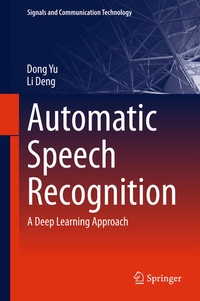
Automatic Speech Recognition
A Deep Learning Approach
Published on 28. November 2014
Book
Hardback
XXVI, 321 pages
978-1-4471-5778-6 (ISBN)
Description
This book provides a comprehensive overview of the recent advancement in the field of automatic speech recognition with a focus on deep learning models including deep neural networks and many of their variants. This is the first automatic speech recognition book dedicated to the deep learning approach. In addition to the rigorous mathematical treatment of the subject, the book also presents insights and theoretical foundation of a series of highly successful deep learning models.
Reviews / Votes
"Deep Learning (DL) has demonstrated a phenomenal success in various AI applications. . This book by two leading experts in Deep Learning is certainly a welcome addition to the literature of the field, particularly in automatic speech recognition. . this book presents a very valuable vista of the state-of-art of Deep Learning, focusing on speech recognition applications." (Robert Kozma, Mathematical Reviews, September, 2017)"The book addresses real-world problems of current interest regarding automatic speech recognition. . This book is useful for all researchers working in automatic speech recognition as well as in real-world applications of deep learning." (Ruxandra Stoean, zbMATH 1356.68004, 2017)
More details
Series
Edition
2015 ed.
Language
English
Place of publication
London
United Kingdom
Target group
Professional and scholarly
Research
Illustrations
62 s/w Abbildungen
XXVI, 321 p. 62 illus.
Dimensions
Height: 241 mm
Width: 160 mm
Thickness: 25 mm
Weight
688 gr
ISBN-13
978-1-4471-5778-6 (9781447157786)
DOI
10.1007/978-1-4471-5779-3
Schweitzer Classification
Other editions
Additional editions
Book
09/2016
Springer
€160.49
Shipment within 15-20 days
E-Book
11/2014
1st Edition
Springer
€149.79
Available for download
Content
Section 1: Automatic speech recognition: Background.- Feature extraction: basic frontend.- Acoustic model: Gaussian mixture hidden Markov model.- Language model: stochastic N-gram.- Historical reviews of speech recognition research: 1st, 2nd, 3rd, 3.5th, and 4th generations.- Section 2: Advanced feature extraction and transformation.- Unsupervised feature extraction.- Discriminative feature transformation.- Section 3: Advanced acoustic modeling.- Conditional random field (CRF) and hidden conditional random field (HCRF).- Deep-Structured CRF.- Semi-Markov conditional random field.- Deep stacking models.- Deep neural network - hidden Markov hybrid model.- Section 4: Advanced language modeling.- Discriminative Language model.- Log-linear language model.- Neural network language model.