

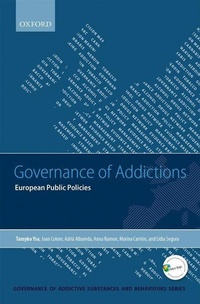
Governance of Addictions
European Public Policies
Published on 15. May 2014
Book
Paperback/Softback
262 pages
978-0-19-870330-3 (ISBN)
Description
Why is governance of addiction so difficult? What can we learn from recent experiences and efforts in Europe? Governance of Addictions analyses the multidisciplinary research which has been used as a framework for understanding how governments formulate and implement addiction policies in 27 European Union member states plus Norway, looking in detail at four substances: heroin, cannabis, alcohol and tobacco.
Presenting the methodological design for the study research, this book comprehensively analysing international trends, with a special focus on the role of the EU and its governance of addictions modes, this volume sheds light on the current situation of the governance of addictive substances and behaviours and facilitate new approaches to dealing with addiction.
Based on the research from ALICE RAP (Addiction and Lifestyles in Contemporary Europe, Reframing Addictions Project), a unique project studying the place of addictive substances and behaviours in contemporary European society, Governance of Addictions is essential reading for policy-makers, public managers, practitioner and stakeholders influencing policy for addictive substances and behaviours, as well as academics and public health professionals.
Presenting the methodological design for the study research, this book comprehensively analysing international trends, with a special focus on the role of the EU and its governance of addictions modes, this volume sheds light on the current situation of the governance of addictive substances and behaviours and facilitate new approaches to dealing with addiction.
Based on the research from ALICE RAP (Addiction and Lifestyles in Contemporary Europe, Reframing Addictions Project), a unique project studying the place of addictive substances and behaviours in contemporary European society, Governance of Addictions is essential reading for policy-makers, public managers, practitioner and stakeholders influencing policy for addictive substances and behaviours, as well as academics and public health professionals.
Reviews / Votes
The real value of the book lies, as the sub-title indicates, in its innovative synthesis of European public policies on drugs, alcohol and tobacco, looking at policies on all three types of substances together an approach which produces an interesting and rather different picture from that which conventionally arises where the three are looked at separately. * Susanne MacGregor, Drugs: Education, Prevention and Policy *More details
Series
Language
English
Place of publication
Oxford
United Kingdom
Target group
College/higher education
Professional and scholarly
Product notice
Paperback (trade)
Unsewn / adhesive bound
Dimensions
Height: 233 mm
Width: 151 mm
Thickness: 20 mm
Weight
402 gr
ISBN-13
978-0-19-870330-3 (9780198703303)
Copyright in bibliographic data and cover images is held by Nielsen Book Services Limited or by the publishers or by their respective licensors: all rights reserved.
Schweitzer Classification
Other editions
Additional editions
E-Book
05/2014
1st Edition
OUP eBook
€24.99
Available for download
E-Book
05/2014
1st Edition
OUP eBook
€27.49
Available for download
Persons
Dr Tamyko Ysa, PhD in Political Science, Executive Master in Public Management, MSc in Public Administration and Public Policies (LSE), BA in Political Science, BA in Law. Dr Ysa is Associate Professor of the Department of Strategy and General Management and of the Institute for Public Governance and Management at ESADE Business School. She has published in journals such as Journal of Public Administration Research and Theory, International Public Management Journal, Journal of Business Ethics or Public Money & Management. Her previous books and chapters include Governments and Corporate Social Responsibility: Public Policies beyond Regulation and Voluntary Compliance and New Steering Concepts in Public Management.
Joan Colom is a medical doctor, Executive Master in Public Management (ESADE Business School) and Master in Addiction (University of Barcelona). He is the Director of the Program on Substance Abuse, at the Catalan Agency of Public Health of the Government of Catalonia, and Advisor to the World Health Organization. He has promoted the legislation currently in force covering the prevention of drug abuse and addictions in Catalonia. He is also the manager of numerous projects co-financed by the European Commission in the field of alcohol and drugs policies: PHEPA I and II, IMHPA, DATAPREV, MH-BASIS, IMPACT and EWA. He has published in journals on addictions such as Journal of Drug Alcohol Abuse and Psicothema, and won the Queen Sofia Award for Prevention of substances abuse.
Adria Albareda, MSc in International Relations and BA in Political Sciences is a Researcher at the Institute of Public Governance and Management of ESADE Business School. He is working on research projects bearing on governance, public management, management of networks and public-private partnerships. He has previously worked at the Barcelona Center for International Affairs (CIDOB), where he published on Euro-Mediterranean relations and on Spanish foreign policy.
Dr Anna Ramon has a PhD in Sociology from the University of Barcelona. Her thesis was "The Structure and Dynamics of Social Capital in Europe". She is currently working as a researcher at the Government of Catalonia and is an associate professor at the University of Barcelona. Her major field of expertise is social network analysis. She has published on the behavioural consequences and risks derived from alcohol and drugs consumption in Psychology in Spain and in BMC Public Health.
Marina Carrion, BA in Political Science is currently working as a researcher at the Public Health Department of the Government of Catalonia. She worked on the Qualitative Research in Political Science handbook. Her areas of interest are public health and the relationship between the government policy and the health of society and individuals.
Lidia Segura is a Clinical Psychologist, Addiction and Public Health specialist. She is the coordinator of the implementation of policies and prevention programs on alcohol in Catalonia. Her research background covers the biological bases of addictions, validation of instruments, clinical trials, and implementation of programs. She has worked as a coordinator of three European projects: PHEPA I, PHEPA II and EWA.
Joan Colom is a medical doctor, Executive Master in Public Management (ESADE Business School) and Master in Addiction (University of Barcelona). He is the Director of the Program on Substance Abuse, at the Catalan Agency of Public Health of the Government of Catalonia, and Advisor to the World Health Organization. He has promoted the legislation currently in force covering the prevention of drug abuse and addictions in Catalonia. He is also the manager of numerous projects co-financed by the European Commission in the field of alcohol and drugs policies: PHEPA I and II, IMHPA, DATAPREV, MH-BASIS, IMPACT and EWA. He has published in journals on addictions such as Journal of Drug Alcohol Abuse and Psicothema, and won the Queen Sofia Award for Prevention of substances abuse.
Adria Albareda, MSc in International Relations and BA in Political Sciences is a Researcher at the Institute of Public Governance and Management of ESADE Business School. He is working on research projects bearing on governance, public management, management of networks and public-private partnerships. He has previously worked at the Barcelona Center for International Affairs (CIDOB), where he published on Euro-Mediterranean relations and on Spanish foreign policy.
Dr Anna Ramon has a PhD in Sociology from the University of Barcelona. Her thesis was "The Structure and Dynamics of Social Capital in Europe". She is currently working as a researcher at the Government of Catalonia and is an associate professor at the University of Barcelona. Her major field of expertise is social network analysis. She has published on the behavioural consequences and risks derived from alcohol and drugs consumption in Psychology in Spain and in BMC Public Health.
Marina Carrion, BA in Political Science is currently working as a researcher at the Public Health Department of the Government of Catalonia. She worked on the Qualitative Research in Political Science handbook. Her areas of interest are public health and the relationship between the government policy and the health of society and individuals.
Lidia Segura is a Clinical Psychologist, Addiction and Public Health specialist. She is the coordinator of the implementation of policies and prevention programs on alcohol in Catalonia. Her research background covers the biological bases of addictions, validation of instruments, clinical trials, and implementation of programs. She has worked as a coordinator of three European projects: PHEPA I, PHEPA II and EWA.
Author
Associate Professor, Institute for Public Management and Governance and Department of Strategy and General ManagementAssociate Professor, Institute for Public Management and Governance and Department of Strategy and General Management, ESADE Business School, Barcelona, Spain
Deputy Director General for Drug AddictionsDeputy Director General for Drug Addictions, Generalitat de Catalunya, Spain
Researcher, Institute for Public Governance and ManagementResearcher, Institute for Public Governance and Management, ESADE Business School, Barcelona, Spain
Researcher, Public Health Department, Government of Catalonia and Associate Professor, University of Barcelona, SpainResearcher, Public Health Department, Government of Catalonia and Associate Professor, University of Barcelona, Spain
Researcher, Public Health DepartmentResearcher, Public Health Department, Government of Catalonia, Spain
Coordinator, Implementation of policies and prevention programmes on alcohol, Catalonia, SpainCoordinator, Implementation of policies and prevention programmes on alcohol, Catalonia, Spain
Content
BIBLIOGRAPHY; ANNEXES