

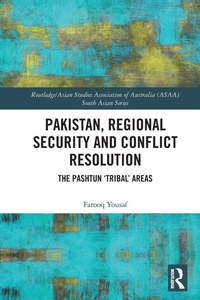
Pakistan, Regional Security and Conflict Resolution
The Pashtun 'Tribal' Areas
1st Edition
Published on 1. August 2022
Book
Paperback/Softback
214 pages
978-0-367-61211-5 (ISBN)
Description
This book explains how colonial legacies and the postcolonial state of Pakistan negatively influenced the socio-political and cultural dynamics and the security situation in Pakistan's Pashtun 'tribal' areas, formerly known as the Federally Administered Tribal Areas (FATA). It offers a local perspective on peace and conflict resolution in Pakistan's Pashtun 'tribal' region.
Discussing the history and background of the former-FATA region, the role of Pashtun conflict resolution mechanism of Jirga, and the persistence of colonial-era Frontier Crimes Regulations (FCR) in the region, the author argues that the persistence of colonial legacies in the Pashtun 'tribal' areas, especially the FCR, coupled with the overarching influence of the military on security policy has negatively impacted the security situation in the region. By focusing on the Jirga and Jirga-based Lashkars (or Pashtun militias), the book demonstrates how Pashtuns have engaged in their own initiatives to handle the rise of militancy in their region. Moreover, the book contends that, even after the introduction of constitutional reforms and FATA's merger with the Khyber Pakhtunkhwa province, little has changed in the region, especially regarding the treatment of 'tribal' Pashtuns as equal citizens of Pakistan. This book explains, in detail, why indigenous methods of peace and conflict resolution, such as the Jirga, could play "some" role towards long-term peace in the South Asian region.
Historically and contextually informed with a focus on North-West Pakistan, this book will be of interest to academics researching South Asian Studies, International Relations, Peace and Conflict Studies, terrorism, and traditional justice and restorative forms of peace-making.
Discussing the history and background of the former-FATA region, the role of Pashtun conflict resolution mechanism of Jirga, and the persistence of colonial-era Frontier Crimes Regulations (FCR) in the region, the author argues that the persistence of colonial legacies in the Pashtun 'tribal' areas, especially the FCR, coupled with the overarching influence of the military on security policy has negatively impacted the security situation in the region. By focusing on the Jirga and Jirga-based Lashkars (or Pashtun militias), the book demonstrates how Pashtuns have engaged in their own initiatives to handle the rise of militancy in their region. Moreover, the book contends that, even after the introduction of constitutional reforms and FATA's merger with the Khyber Pakhtunkhwa province, little has changed in the region, especially regarding the treatment of 'tribal' Pashtuns as equal citizens of Pakistan. This book explains, in detail, why indigenous methods of peace and conflict resolution, such as the Jirga, could play "some" role towards long-term peace in the South Asian region.
Historically and contextually informed with a focus on North-West Pakistan, this book will be of interest to academics researching South Asian Studies, International Relations, Peace and Conflict Studies, terrorism, and traditional justice and restorative forms of peace-making.
Reviews / Votes
"This easy-to-read, well-structured book discusses a very sensitive issue. It details the story of FATA in Pakistan's history, focussing especially on the last 20 years after the Taliban and its fellow ideological travellers were chased out of Kabul and fled across the border into Pakistan to find refuge in the tribal areas along the border with Afghanistan. This is also a timely book given the recent peace deal that was signed between the US and the Taliban, which is meant to be the first step towards a political solution in Afghanistan. If and when it happens, peace in Afghanistan would have significant positive consequences for the people of the tribal areas in Pakistan, given Pakistan has played an important role in getting the US and the Taliban to the negotiation table."Dr Claude Rakisits, Australian Institute of International Affairs
More details
Series
Language
English
Place of publication
London
United Kingdom
Publishing group
Taylor & Francis Ltd
Target group
College/higher education
Postgraduate
Illustrations
1 s/w Zeichnung, 1 s/w Abbildung, 1 s/w Tabelle
1 Tables, black and white; 1 Line drawings, black and white; 1 Illustrations, black and white
Dimensions
Height: 234 mm
Width: 156 mm
Thickness: 12 mm
Weight
354 gr
ISBN-13
978-0-367-61211-5 (9780367612115)
Copyright in bibliographic data and cover images is held by Nielsen Book Services Limited or by the publishers or by their respective licensors: all rights reserved.
Schweitzer Classification
Other editions
Additional editions
Book
10/2020
1st Edition
Routledge
€205.50
Shipment within 15-20 days
E-Book
10/2020
1st Edition
Routledge
€59.49
Available for download
E-Book
10/2020
1st Edition
Routledge
€59.49
Available for download
Person
Farooq Yousaf received his PhD from the University of Newcastle, Australia. He is also an assistant editor of the journal South Asia Research.
Content
INTRODUCTION 1. A BRIEF INTRODUCTION TO PASHTUNS 2. PAKISTAN'S POSTCOLONIAL DILEMMA 3. PAKISTAN'S PASHTUN 'TRIBAL' AREAS (FORMERLY KNOWN AS FATA) 4. JIRGA AND LASHKAR IN PASHTUN 'TRIBAL' AREAS 5. FORMAL EFFORTS TOWARDS PEACE AND CONFLICT RESOLUTION IN ERSTWHILE FATA 6. TRADITIONAL EFFORTS TOWARDS PEACE AND CONFLICT RESOLUTION IN ERSTWHILE FATA 7. PASHTUN TAHAFUZ MOVEMENT (PTM) AND THE FUTURE OF ERSTWHILE FATA CONCLUSION