

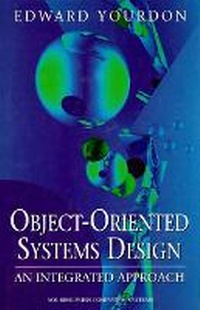
Object-Oriented Systems Design
An Integrated Approach
Published on 1. January 1994
Book
Hardback
400 pages
978-0-13-636325-5 (ISBN)
Description
This book gathers together and synthesizes all that is best and correct in object-oriented technology - emphasizing such areas as CASE tools, reuse, project management, metrics, configuration. The text explains why some organizations are consciously choosing not to implement OO software methodologies, and discusses a number of "management" issues associated with the OO paradigm. It also considers the broad area of object-oriented analysis (OOA) and explains CASE technology for OO methodologies and surveys of some of the more popular products in the marketplace.
More details
Language
English
Place of publication
Upper Saddle River
United States
Publishing group
Pearson Education (US)
Target group
College/higher education
Dimensions
Height: 235 mm
Width: 160 mm
Thickness: 23 mm
Weight
660 gr
ISBN-13
978-0-13-636325-5 (9780136363255)
Copyright in bibliographic data and cover images is held by Nielsen Book Services Limited or by the publishers or by their respective licensors: all rights reserved.
Schweitzer Classification
Other editions
Previous edition

Book
12/1993
Pearson Education (US)
€63.13
Article exhausted; check for reprint
Person
Edward Yourdon is an independent management consultant, author, and the widely known developer of the "Yourdon method" of structured systems analysis and design. He is the author of over one hundred technical articles. Currently, Mr. Yourdon is the publisher of the newsletter, The American Programmer, and speaks regularly at major computer conferences around the world.
Content
I. INTRODUCTION.
1. What Is OO All About?
2. Pros and Cons of OO.
II. MANAGEMENT ISSUES.
3. OO Life Cycle Issues.
4. Project Management.
5. OO Configuration Management.
6. Software Reuse with OO.
7. Beyond Objects: Critical Success Factors.
III. OOA.
8. Overview/Introduction.
9. Finding Object and Subjects.
10. Object Structures.
11. Object Relationships.
12. Object Attributes.
13. Object Behavior.
14. Object Methods.
IV. DESIGN AND CONSTRUCTION.
15. Introduction.
16. OOS Notation.
17. OOD Design Architectures.
18. Designing the Human Interface.
19. Designing the Database.
20. OOP and the Impact of Programming Languages.
21. Goodness Criteria.
22. Testing.
V. CASE FOR OO.
23. Introduction: What You Need.
24. What's Available/Likely Trends.
VI. HOW TO GET STARTED.
25. Revolution versus Evolution.
26. OO Training.
27. The Battle Plan: How to Get Started.
APPENDICES.
A. Bibliography.
B. The Full Small Bytes Case Study.
C. The Full Elevator Control System Case Study.
1. What Is OO All About?
2. Pros and Cons of OO.
II. MANAGEMENT ISSUES.
3. OO Life Cycle Issues.
4. Project Management.
5. OO Configuration Management.
6. Software Reuse with OO.
7. Beyond Objects: Critical Success Factors.
III. OOA.
8. Overview/Introduction.
9. Finding Object and Subjects.
10. Object Structures.
11. Object Relationships.
12. Object Attributes.
13. Object Behavior.
14. Object Methods.
IV. DESIGN AND CONSTRUCTION.
15. Introduction.
16. OOS Notation.
17. OOD Design Architectures.
18. Designing the Human Interface.
19. Designing the Database.
20. OOP and the Impact of Programming Languages.
21. Goodness Criteria.
22. Testing.
V. CASE FOR OO.
23. Introduction: What You Need.
24. What's Available/Likely Trends.
VI. HOW TO GET STARTED.
25. Revolution versus Evolution.
26. OO Training.
27. The Battle Plan: How to Get Started.
APPENDICES.
A. Bibliography.
B. The Full Small Bytes Case Study.
C. The Full Elevator Control System Case Study.