

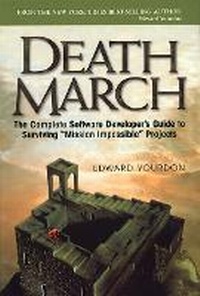
Death March
Published on 14. September 1999
Book
Paperback/Softback
240 pages
978-0-13-014659-5 (ISBN)
Description
In the course of a career, practically every software developer will encounter several projects that are objectively "doomed to fail." In this best-selling book, now in paperback, Ed Yourdon presents specific techniques for surviving those projects -- and even for helping them succeed, to the extent possible. Yourdon brings his unique technology and management insight to the software development projects that need it most: those "death march" projects that have outrageous staffing, schedule or budget or feature constraints which make them extremely likely to fail. Yourdon shows how to make sure your career survives projects like that -- and how to manage "death march" projects to maximize the chance of success. Yourdon walks step-by-step through the entire project lifecycle, starting with up-front negotiation. He presents never-before-published, specific tips and techniques will ring true to any developer or manager faced with the impossible. For all developers, IT professionals, and managers.
More details
Language
English
Place of publication
Upper Saddle River
United States
Publishing group
Pearson Education (US)
Target group
College/higher education
Dimensions
Height: 229 mm
Width: 152 mm
Thickness: 16 mm
Weight
386 gr
ISBN-13
978-0-13-014659-5 (9780130146595)
Copyright in bibliographic data and cover images is held by Nielsen Book Services Limited or by the publishers or by their respective licensors: all rights reserved.
Schweitzer Classification
Other editions
New editions

Edward Yourdon
Death March
Book
11/2003
2nd Edition
Prentice Hall
€55.07
Article exhausted; check for reprint
Person
Edward Yourdon is an independent management consultant, author, and developer of the Yourdon Method of structured system analysis. He is publisher of American Programmer Magazine, and best-selling author of Time Bomb 2000 (Prentice Hall PTR).
Content
1. Introduction.
Death March Defined. Categories of Death March Projects. Why Do Death March Projects Happen? Why Do People Participate in Death March Projects? Summary.
2. Politics.
Identifying the Political "Players" Involved in the Project. Determining the Basic Nature of the Project. Identifying the Levels of Commitment of Project Participants. Summary.
3. Negotiations.
Rational Negotiations. Identifying Acceptable Trade-offs. Negotiating Games. Negotiating Strategies. What to Do When Negotiating Fails.
4. People in Death March Projects.
Hiring and Staffing Issues. Loyalty, Commitment, Motivation, and Rewards. The Importance of Communication. Team-Building Issues. Workplace Conditions for Death March Projects. Summary.
5. Processes.
The Concept of "Triage". The Importance of Requirements Management. SEI, ISO-9000, and Formal vs Informal Processes. "Good Enough" Software. Best Practices and Worst Practices. The "Daily Build" Concept. Risk Management. Summary.
6. Tools and Technology.
The Minimal Toolset. Tools and Process. The Risks of Choosing New Tools. Summary.
7. Death March as a Way of Life.
Why Would Death March Projects Become the Norm? Establishing a Death March "Culture". Death March Training. The Concept of "War Games". Summary.
Index.
Death March Defined. Categories of Death March Projects. Why Do Death March Projects Happen? Why Do People Participate in Death March Projects? Summary.
2. Politics.
Identifying the Political "Players" Involved in the Project. Determining the Basic Nature of the Project. Identifying the Levels of Commitment of Project Participants. Summary.
3. Negotiations.
Rational Negotiations. Identifying Acceptable Trade-offs. Negotiating Games. Negotiating Strategies. What to Do When Negotiating Fails.
4. People in Death March Projects.
Hiring and Staffing Issues. Loyalty, Commitment, Motivation, and Rewards. The Importance of Communication. Team-Building Issues. Workplace Conditions for Death March Projects. Summary.
5. Processes.
The Concept of "Triage". The Importance of Requirements Management. SEI, ISO-9000, and Formal vs Informal Processes. "Good Enough" Software. Best Practices and Worst Practices. The "Daily Build" Concept. Risk Management. Summary.
6. Tools and Technology.
The Minimal Toolset. Tools and Process. The Risks of Choosing New Tools. Summary.
7. Death March as a Way of Life.
Why Would Death March Projects Become the Norm? Establishing a Death March "Culture". Death March Training. The Concept of "War Games". Summary.
Index.