

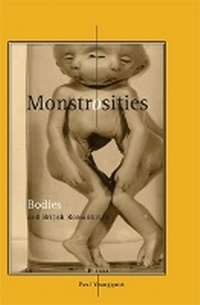
Monstrosities
Bodies and British Romanticism
Published on 10. November 2003
Book
Paperback/Softback
260 pages
978-0-8166-3980-9 (ISBN)
Description
A surprising evaluation of the role of the physical body in the construction of British identity
Eighteenth-century medicine used the word "monstrosities" to describe physically deformed bodies-those irreducible to the "proper body" in their singular, sometimes startling difference. Considering British society in confrontation with such monstrosities, Paul Youngquist reveals the cultural politics of embodiment in Britain during the late eighteenth and early nineteenth centuries. Drawing on the histories of medicine, economics, liberalism, and nationalism, his work shows that bodies are not simply born but rather built by cultural practices directed toward particular social ends.
Among the phenomena Youngquist treats are the science of comparative anatomy, the annual festivity of Bartholomew Fair, the social status of black Britons, opium habituEs, pregnant women, and wounded war veterans. The authors he engages include John Locke, William Blake, Olaudah Equiano, Samuel Taylor Coleridge, Thomas De Quincey, Mary Wollstonecraft, Lord Byron, and Mary Shelley. Uniquely interdisciplinary, formidably researched, and replete with curious illustrations, this remarkable book should be of interest to anyone concerned with the historical and cultural fate of bodies in liberal society-and with the importance of deviance in determining that fate.
Eighteenth-century medicine used the word "monstrosities" to describe physically deformed bodies-those irreducible to the "proper body" in their singular, sometimes startling difference. Considering British society in confrontation with such monstrosities, Paul Youngquist reveals the cultural politics of embodiment in Britain during the late eighteenth and early nineteenth centuries. Drawing on the histories of medicine, economics, liberalism, and nationalism, his work shows that bodies are not simply born but rather built by cultural practices directed toward particular social ends.
Among the phenomena Youngquist treats are the science of comparative anatomy, the annual festivity of Bartholomew Fair, the social status of black Britons, opium habituEs, pregnant women, and wounded war veterans. The authors he engages include John Locke, William Blake, Olaudah Equiano, Samuel Taylor Coleridge, Thomas De Quincey, Mary Wollstonecraft, Lord Byron, and Mary Shelley. Uniquely interdisciplinary, formidably researched, and replete with curious illustrations, this remarkable book should be of interest to anyone concerned with the historical and cultural fate of bodies in liberal society-and with the importance of deviance in determining that fate.
More details
Language
English
Place of publication
Minnesota
United States
Target group
Professional and scholarly
College/higher education
Dimensions
Height: 229 mm
Width: 149 mm
Thickness: 15 mm
ISBN-13
978-0-8166-3980-9 (9780816639809)
Copyright in bibliographic data and cover images is held by Nielsen Book Services Limited or by the publishers or by their respective licensors: all rights reserved.
Schweitzer Classification
Person
Paul Youngquist is associate professor of English at Penn State University. He is the author of Madness and Blake's Myth (1990).