

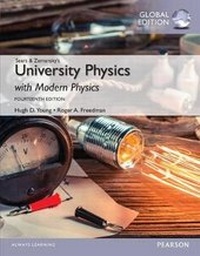
University Physics with Modern Physics, Global Edition
14th Edition
Published on 20. August 2015
Book
Paperback/Softback
1608 pages
978-1-292-10031-9 (ISBN)
Description
Since its first edition, University Physics has been revered for its emphasis on fundamental principles and how to apply them. This text is known for its clear and thorough narrative, as well as its uniquely broad, deep, and thoughtful sets of worked examples that provide students with key tools for developing both conceptual understanding and problem-solving skills.
KEY TOPICS: Units, Physical Quantities, and Vectors; Motion Along a Straight Line; Motion in Two or Three Dimensions; Newton's Laws of Motion; Applying Newton's Laws; Work and Kinetic Energy; Potential Energy and Energy Conservation; Momentum, Impulse, and Collisions; Rotation of Rigid Bodies; Dynamics of Rotational Motion; Equilibrium and Elasticity; Fluid Mechanics; Gravitation; Periodic Motion; Mechanical Waves; Sound and Hearing ; Temperature and Heat; Thermal Properties of Matter; The First Law of Thermodynamics; The Second Law of Thermodynamics ; Electric Charge and Electric Field; Gauss's Law; Electric Potential; Capacitance and Dielectrics; Current, Resistance, and Electromotive Force; Direct-Current Circuits; Magnetic Field and Magnetic Forces; Sources of Magnetic Field; Electromagnetic Induction; Inductance; Alternating Current; Electromagnetic Waves ; The Nature and Propagation of Light; Geometric Optics; Interference; Diffraction ;Relativity; Photons: Light Waves Behaving as Particles; Particles Behaving as Waves; Quantum Mechanics I: Wave Functions; Quantum Mechanics II: Atomic Structure; Molecules and Condensed Matter; Nuclear Physics; Particle Physics and Cosmology
MARKET: Intended for those who would like to gain a basic knowledge of physics.
KEY TOPICS: Units, Physical Quantities, and Vectors; Motion Along a Straight Line; Motion in Two or Three Dimensions; Newton's Laws of Motion; Applying Newton's Laws; Work and Kinetic Energy; Potential Energy and Energy Conservation; Momentum, Impulse, and Collisions; Rotation of Rigid Bodies; Dynamics of Rotational Motion; Equilibrium and Elasticity; Fluid Mechanics; Gravitation; Periodic Motion; Mechanical Waves; Sound and Hearing ; Temperature and Heat; Thermal Properties of Matter; The First Law of Thermodynamics; The Second Law of Thermodynamics ; Electric Charge and Electric Field; Gauss's Law; Electric Potential; Capacitance and Dielectrics; Current, Resistance, and Electromotive Force; Direct-Current Circuits; Magnetic Field and Magnetic Forces; Sources of Magnetic Field; Electromagnetic Induction; Inductance; Alternating Current; Electromagnetic Waves ; The Nature and Propagation of Light; Geometric Optics; Interference; Diffraction ;Relativity; Photons: Light Waves Behaving as Particles; Particles Behaving as Waves; Quantum Mechanics I: Wave Functions; Quantum Mechanics II: Atomic Structure; Molecules and Condensed Matter; Nuclear Physics; Particle Physics and Cosmology
MARKET: Intended for those who would like to gain a basic knowledge of physics.
More details
Edition
14th edition
Language
English
Place of publication
Harlow
United Kingdom
Target group
College/higher education
Dimensions
Height: 275 mm
Width: 216 mm
Thickness: 48 mm
Weight
3110 gr
ISBN-13
978-1-292-10031-9 (9781292100319)
Copyright in bibliographic data and cover images is held by Nielsen Book Services Limited or by the publishers or by their respective licensors: all rights reserved.
Schweitzer Classification
Other editions
New editions
Hugh Young | Hugh D. Young | Roger A. Freedman
University Physics with Modern Physics, Global Edition
Book
10/2019
15th Edition
Pearson Education Limited
€96.99
Available immediately
Previous edition
Hugh D. Young | Roger A. Freedman | A. Lewis Ford
University Physics Pearson New International Edition, plus MasteringPhysics with Pearson eText
Book
09/2013
Pearson Education Limited
€84.31
Article exhausted; check for reprint
Persons
Roger A. Freedman is a Lecturer in Physics at the University of California, Santa Barbara. He was an undergraduate at the University of California campuses in San Diego and Los Angeles and did his doctoral research in nuclear theory at Stanford University under the direction of Professor J. Dirk Walecka. Dr. Freedman came to UCSB in 1981 after three years of teaching and doing research at the University of Washington.
At UCSB, Dr. Freedman has taught in both the Department of Physics and the College of Creative Studies, a branch of the university intended for highly gifted and motivated undergraduates. He has published research in nuclear physics, elementary particle physics, and laser physics. In recent years, he has worked to make physics lectures a more interactive experience through the use of classroom response systems and pre-lecture videos.
IN MEMORIAM: HUGH YOUNG (1930-2013)
Hugh D. Young was Emeritus Professor of Physics at Carnegie Mellon University. He earned both his undergraduate and graduate degrees from that university. He earned his Ph.D. in fundamental particle theory under the direction of the late Richard Cutkosky. He joined the faculty of Carnegie Mellon in 1956 and retired in 2004. He also had two visiting professorships at the University of California, Berkeley.
Dr. Young's career was centered entirely on undergraduate education. He wrote several undergraduate-level textbooks, and in 1973 he became a coauthor with Francis Sears and Mark Zemansky for their well-known introductory textbooks. In addition to his role on Sears and Zemansky's University Physics, he was the author of Sears and Zemansky's College Physics, Dr. Young earned a bachelor's degree in organ performance from Carnegie Mellon in 1972 and spent several years as Associate Organist at St. Paul's Cathedral in Pittsburgh.
At UCSB, Dr. Freedman has taught in both the Department of Physics and the College of Creative Studies, a branch of the university intended for highly gifted and motivated undergraduates. He has published research in nuclear physics, elementary particle physics, and laser physics. In recent years, he has worked to make physics lectures a more interactive experience through the use of classroom response systems and pre-lecture videos.
IN MEMORIAM: HUGH YOUNG (1930-2013)
Hugh D. Young was Emeritus Professor of Physics at Carnegie Mellon University. He earned both his undergraduate and graduate degrees from that university. He earned his Ph.D. in fundamental particle theory under the direction of the late Richard Cutkosky. He joined the faculty of Carnegie Mellon in 1956 and retired in 2004. He also had two visiting professorships at the University of California, Berkeley.
Dr. Young's career was centered entirely on undergraduate education. He wrote several undergraduate-level textbooks, and in 1973 he became a coauthor with Francis Sears and Mark Zemansky for their well-known introductory textbooks. In addition to his role on Sears and Zemansky's University Physics, he was the author of Sears and Zemansky's College Physics, Dr. Young earned a bachelor's degree in organ performance from Carnegie Mellon in 1972 and spent several years as Associate Organist at St. Paul's Cathedral in Pittsburgh.
Content
MECHANICS
1. Units, Physical Quantities, and Vectors
2. Motion Along a Straight Line
3. Motion in Two or Three Dimensions
4. Newton's Laws of Motion
5. Applying Newton's Laws
6. Work and Kinetic Energy
7. Potential Energy and Energy Conservation
8. Momentum, Impulse, and Collisions
9. Rotation of Rigid Bodies
10. Dynamics of Rotational Motion
11. Equilibrium and Elasticity
12. Fluid Mechanics
13. Gravitation
14. Periodic Motion
WAVES/ACOUSTICS
15. Mechanical Waves
16. Sound and Hearing
THERMODYNAMICS
17. Temperature and Heat
18. Thermal Properties of Matter
19. The First Law of Thermodynamics
20. The Second Law of Thermodynamics
ELECTROMAGNETISM
21. Electric Charge and Electric Field
22. Gauss's Law
23. Electric Potential
24. Capacitance and Dielectrics
25. Current, Resistance, and Electromotive Force
26. Direct-Current Circuits
27. Magnetic Field and Magnetic Forces
28. Sources of Magnetic Field
29. Electromagnetic Induction
30. Inductance
31. Alternating Current
32. Electromagnetic Waves
OPTICS
33. The Nature and Propagation of Light
34. Geometric Optics
35. Interference
36. Diffraction
MODERN PHYSICS
37. Relativity
38. Photons: Light Waves Behaving as Particles
39. Particles Behaving as Waves
40. Quantum Mechanics I: Wave Functions
41. Quantum Mechanics II: Atomic Structure
42. Molecules and Condensed Matter
43. Nuclear Physics
44. Particle Physics and Cosmology
1. Units, Physical Quantities, and Vectors
2. Motion Along a Straight Line
3. Motion in Two or Three Dimensions
4. Newton's Laws of Motion
5. Applying Newton's Laws
6. Work and Kinetic Energy
7. Potential Energy and Energy Conservation
8. Momentum, Impulse, and Collisions
9. Rotation of Rigid Bodies
10. Dynamics of Rotational Motion
11. Equilibrium and Elasticity
12. Fluid Mechanics
13. Gravitation
14. Periodic Motion
WAVES/ACOUSTICS
15. Mechanical Waves
16. Sound and Hearing
THERMODYNAMICS
17. Temperature and Heat
18. Thermal Properties of Matter
19. The First Law of Thermodynamics
20. The Second Law of Thermodynamics
ELECTROMAGNETISM
21. Electric Charge and Electric Field
22. Gauss's Law
23. Electric Potential
24. Capacitance and Dielectrics
25. Current, Resistance, and Electromotive Force
26. Direct-Current Circuits
27. Magnetic Field and Magnetic Forces
28. Sources of Magnetic Field
29. Electromagnetic Induction
30. Inductance
31. Alternating Current
32. Electromagnetic Waves
OPTICS
33. The Nature and Propagation of Light
34. Geometric Optics
35. Interference
36. Diffraction
MODERN PHYSICS
37. Relativity
38. Photons: Light Waves Behaving as Particles
39. Particles Behaving as Waves
40. Quantum Mechanics I: Wave Functions
41. Quantum Mechanics II: Atomic Structure
42. Molecules and Condensed Matter
43. Nuclear Physics
44. Particle Physics and Cosmology