

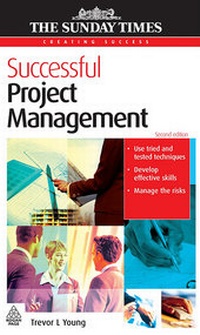
Successful Project Management
Apply Tried and Tested Techniques Develop Effective PM Skills and Plan Implement and Evaluate
2nd Edition
Published on 3. July 2006
Book
Paperback/Softback
208 pages
978-0-7494-4561-4 (ISBN)
Description
Project management has become an area of interest in all types of organization and the skills required are recognized as highly desirable at all levels. The role of project manager requires maintaining a balance between the demands of the customer, project, team and the organization. This provides a real challenge in the fields of time management and prioritization.
Successful Project Management will enable any manager to significantly raise the probability of success with their projects and contains practical and well-tested techniques.
This step-by-step guide will help you with:
project conception and start-up;
managing project stakeholders;
managing risks;
project planning;
project launch and execution;
closure and evaluation.
Complete with checklists and specific guidance notes, this essential book covers the entire project management process and will improve your chances of success.
Successful Project Management will enable any manager to significantly raise the probability of success with their projects and contains practical and well-tested techniques.
This step-by-step guide will help you with:
project conception and start-up;
managing project stakeholders;
managing risks;
project planning;
project launch and execution;
closure and evaluation.
Complete with checklists and specific guidance notes, this essential book covers the entire project management process and will improve your chances of success.
Reviews / Votes
"a concise and easy to use set of instructions that can be applied to practically any project." refreshMore details
Series
Edition
2nd Revised edition
Language
English
Place of publication
London
United Kingdom
Target group
Professional and scholarly
Edition type
Revised edition
Product notice
Paperback (trade)
Dimensions
Height: 216 mm
Width: 135 mm
ISBN-13
978-0-7494-4561-4 (9780749445614)
Copyright in bibliographic data and cover images is held by Nielsen Book Services Limited or by the publishers or by their respective licensors: all rights reserved.
Schweitzer Classification
Other editions
New editions
Trevor L. Young
Successful Project Management
Apply Tried and Tested Techniques Develop Effective PM Skills and Plan Implement and Evaluate
Book
05/2010
3rd Edition
Kogan Page Ltd
€32.37
Article exhausted; check for reprint
Previous edition
Trevor L. Young
Successful Project Management
Apply Tried and Tested Techniques Develop Effective PM Skills and Plan Implement and Evaluate
Book
11/2000
1st Edition
Kogan Page Ltd
€29.89
Article exhausted; check for reprint
Person
Trevor L Young was, for many years, a senior consultant for the Industrial Society where he designed and conducted two public training courses in project management techniques and project leadership. He is now an independent consultant specializing in the introduction of programme management. He is a member of the Institute of Personnel and Development and is also the author of How to be a Better Project Manager and Successful Project Management (both published by Kogan Page).
Content
1. what is success? what happens to the project?; defining success; your view of success; success depends on who is measuring; what are the perceived causes of failure; reduce the probability of failure 2. the climate for success why do initiatives appear to fail?; some definitions; projects - are they just an accident?; a common misconception; what's the current climate?; what influences the climate?; operating climate for success; the key activities; defined roles and responsibilities - the key players; influence of organisational culture 3. the project process - key steps for success the project phases; the phase gates; the phase gate - a constraint?; the key steps to success; 4. project conception and start-up selecting the right project; the start-up process; customer needs and expectations; identifying the project constraints; assumptions; the kick-off meeting; recording essential information 5. the definition phase the project brief and specification; defining the project; risk assessment; getting your project definition approved 6. managing the stakeholders what is a stakeholder; identifying stakeholders; the two most important stakeholders; stakeholder influence; gathering information about stakeholders; the stakeholder influence matrix; what happens next with stakeholders 7. managing the risks what is a risk; why bother?; the risk management process; identifying the risks; a typical starter checklist; decide the primary response strategy; quantifying the risks; risk score; what do i do now? monitoring risks 8. planning the project a common misconception; who needs to be involved; where does planning start?; identifying the key stages; allocating responsibility; estimating; the critical path of your project; analyse resource requirements; optimising your schedule; review the project risk log; review the project budget; freezing the baseline schedule; seeking approval to launch 9. launching and executing the project preparing for project execution; the control environment; monitoring the progress; managing the issues arising; tracking your project 10. closure and post-project evaluation project drift; set the completion criteria; the acceptan
1. What is success?
What happens to the project?; Defining
success; Your view of success; Success
depends on who is measuring; What are the
perceived causes of failure; Reduce the
probability of failure
2. The climate for success
Why do initiatives appear to fail?; Some
definitions; Projects - are they just an
accident?; A common misconception;
What's the current climate?; What influences
the climate?; Operating climate for success;
The key activities; Defined roles and
responsibilities - the key players; Influence
of organisational culture
3. The project process - key steps for success
The project phases; The phase gates;
The phase gate - a constraint?; The key
steps to success;
4. Project conception and start-up
Selecting the right project; The start-up process;
Customer needs and expectations; Identifying
the project constraints; Assumptions; The
kick-off meeting; Recording essential information
5. The definition phase
The project brief and specification; Defining
the project; Risk assessment; Getting
your project definition approved
6. Managing the stakeholders
What is a stakeholder; Identifying
stakeholders; The two most important
stakeholders; Stakeholder influence;
Gathering information about stakeholders;
The stakeholder influence matrix; What
happens next with stakeholders
7. Managing the risks
What is a risk; Why bother?; The risk
management process; Identifying the risks;
A typical starter checklist; Decide the primary
response strategy; Quantifying the risks;
Risk score; What do I do now?
Monitoring risks
8. Planning the project
A common misconception; Who needs to
be involved; Where does planning start?;
Identifying the key stages; Allocating
responsibility; Estimating; The critical
path of your project; Analyse resource
requirements; Optimising your schedule;
Review the project risk log; Review the project
budget; Freezing the baseline schedule;
Seeking approval to launch
9. Launching and executing the project
Preparing for project execution; The control
environment; Monitoring the progress;
Managing the issues arising; Tracking your
project
10. Closure and post-project evaluation
Project drift; Set the completion criteria;
The acceptance process checklist; The closeout
meeting; Post-project evaluation;
And finally.
Standard formats for data recording
Further reading
What happens to the project?; Defining
success; Your view of success; Success
depends on who is measuring; What are the
perceived causes of failure; Reduce the
probability of failure
2. The climate for success
Why do initiatives appear to fail?; Some
definitions; Projects - are they just an
accident?; A common misconception;
What's the current climate?; What influences
the climate?; Operating climate for success;
The key activities; Defined roles and
responsibilities - the key players; Influence
of organisational culture
3. The project process - key steps for success
The project phases; The phase gates;
The phase gate - a constraint?; The key
steps to success;
4. Project conception and start-up
Selecting the right project; The start-up process;
Customer needs and expectations; Identifying
the project constraints; Assumptions; The
kick-off meeting; Recording essential information
5. The definition phase
The project brief and specification; Defining
the project; Risk assessment; Getting
your project definition approved
6. Managing the stakeholders
What is a stakeholder; Identifying
stakeholders; The two most important
stakeholders; Stakeholder influence;
Gathering information about stakeholders;
The stakeholder influence matrix; What
happens next with stakeholders
7. Managing the risks
What is a risk; Why bother?; The risk
management process; Identifying the risks;
A typical starter checklist; Decide the primary
response strategy; Quantifying the risks;
Risk score; What do I do now?
Monitoring risks
8. Planning the project
A common misconception; Who needs to
be involved; Where does planning start?;
Identifying the key stages; Allocating
responsibility; Estimating; The critical
path of your project; Analyse resource
requirements; Optimising your schedule;
Review the project risk log; Review the project
budget; Freezing the baseline schedule;
Seeking approval to launch
9. Launching and executing the project
Preparing for project execution; The control
environment; Monitoring the progress;
Managing the issues arising; Tracking your
project
10. Closure and post-project evaluation
Project drift; Set the completion criteria;
The acceptance process checklist; The closeout
meeting; Post-project evaluation;
And finally.
Standard formats for data recording
Further reading