

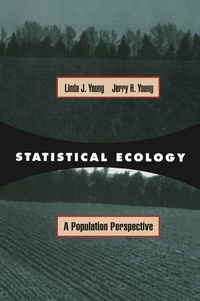
Statistical Ecology
Published on 20. February 2013
Book
Paperback/Softback
XVI, 566 pages
978-1-4757-2831-6 (ISBN)
Description
Covering a wide range of disciplines, this book explains the formulae, techniques, and methods used in field ecology. By providing an awareness of the statistical foundation for existing methods, the book will make biologists more aware of the strengths and possible weaknesses of procedures employed, and statisticians more appreciative of the needs of the field ecologist.
Unique to this book is a focus on ecological data for single-species populations, from sampling through modeling. Examples come from real situations in pest management, forestry, wildlife biology, plant protection, and environmental studies, as well as from classical ecology. All those using this book will acquire a strong foundation in the statistical methods of modern ecological research.
This textbook is for late undergraduate and graduate students, and for professionals.
Unique to this book is a focus on ecological data for single-species populations, from sampling through modeling. Examples come from real situations in pest management, forestry, wildlife biology, plant protection, and environmental studies, as well as from classical ecology. All those using this book will acquire a strong foundation in the statistical methods of modern ecological research.
This textbook is for late undergraduate and graduate students, and for professionals.
More details
Edition
Softcover reprint of the original 1st ed. 1998
Language
English
Place of publication
New York
United States
Target group
Professional and scholarly
Research
Illustrations
XVI, 566 p.
Dimensions
Height: 229 mm
Width: 152 mm
Thickness: 32 mm
Weight
834 gr
ISBN-13
978-1-4757-2831-6 (9781475728316)
DOI
10.1007/978-1-4757-2829-3
Schweitzer Classification
Other editions
Additional editions
Book
07/1998
1st Edition
Chapman and Hall
€160.49
Shipment within 10-20 days
Content
1: Probability Distributions.- 2: Goodness-of-Fit Tests.- 3: Models and Sampling.- 4: Sequential Estimation.- 5: Sequential Hypothesis Testing.- 6: Sequentially Testing Three Hypotheses.- 7: Aggregation and Spatial Correlation.- 8: Spatial Point Patterns.- 9: Capture-Recapture: Closed Populations.- 10: Capture-Recapture: Open Populations.- 11: Transect Sampling.- 12: Degree-Day Models.- 13: Life-Stage Analysis.- 14: Probit and Survival Analysis.- 15: Chaos.- References.