

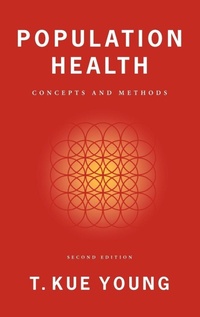
Population Health
Concepts and methods
2nd Edition
Published on 28. October 2004
Book
Hardback
403 pages
978-0-19-515854-0 (ISBN)
Description
Population health encompasses traditional public health and preventive medicine but emphasizes the full range of health determinants affecting the entire population rather than only ill or high-risk individuals. The population health approach integrates the social and biological, the quantitative and qualitative, recognizing the importance of social and cultural factors in practice and research.
This text is organized around the logical sequence of studying and attempting to improve the health of populations; measuring health status and disease burden, identifying and modelling health determinants, assessing health risks and inferring causation, designing research studies, planning interventions, and evaluating health programs. The second edition incorporates many new topics that reflect changes in contemporary public health concerns and our response to them; as well as shifts in research directions. These include lifecourse approaches to health, gene-environment interactions, emergent infections, and bioterrorism. Among the specific changes are new or expanded discussions of confidence intervals for commonly used rates, the impact of population ageing on mortality trends, health survey questionnaires, summary measures of population health, the new International Classification of Functioning, Disability and Health, migrant studies, race and ethnicity, psychoneuroendocrine pathways, social epidemiology, risk perception, communicating the SARS epidemic, ecologic studies, the odds radio, participatory research, suicide, evidence-based community interventions, evaluation methods and health economics, the Cochrane Collaboration, and systemic reviews.
The many positive features of the first edition have been retained, such as the extensive use of boxes, case studies, and exercises; the selection of examples representing a variety of health problems, geographic regions, and historical periods; and a multidisciplinary orientation bridging the quantitative and qualitative, the social and biomedical sciences. The book aims to spark a new kind of broad-based training for researchers and practitioners of population health.
This text is organized around the logical sequence of studying and attempting to improve the health of populations; measuring health status and disease burden, identifying and modelling health determinants, assessing health risks and inferring causation, designing research studies, planning interventions, and evaluating health programs. The second edition incorporates many new topics that reflect changes in contemporary public health concerns and our response to them; as well as shifts in research directions. These include lifecourse approaches to health, gene-environment interactions, emergent infections, and bioterrorism. Among the specific changes are new or expanded discussions of confidence intervals for commonly used rates, the impact of population ageing on mortality trends, health survey questionnaires, summary measures of population health, the new International Classification of Functioning, Disability and Health, migrant studies, race and ethnicity, psychoneuroendocrine pathways, social epidemiology, risk perception, communicating the SARS epidemic, ecologic studies, the odds radio, participatory research, suicide, evidence-based community interventions, evaluation methods and health economics, the Cochrane Collaboration, and systemic reviews.
The many positive features of the first edition have been retained, such as the extensive use of boxes, case studies, and exercises; the selection of examples representing a variety of health problems, geographic regions, and historical periods; and a multidisciplinary orientation bridging the quantitative and qualitative, the social and biomedical sciences. The book aims to spark a new kind of broad-based training for researchers and practitioners of population health.
Reviews / Votes
From reviews of the first edition: This beautifully crafted textbook fills a long-empty niche in public health training. It provides between one set of covers a comprehensive introduction to all the quantitative methods for the assessment of population health status that the average health professional needs to know... The whole effect is very refreshing and holistic - this is a book that can really be used to give a broad... picture of how we know what we do about the health of populations... Another great strength of this book is the rich, up-to-date examples of all the main ideas presented. * Chronic Diseases in Canada * This text fills a significant need for public health students and practitioners alike... In accomplishing its primary purpose, this book brings epidemiology to life while arming current and future public health professionals with tools and skills to measure and improve the health of populations. * Choice *More details
Edition
2nd Revised edition
Language
English
Place of publication
New York
United States
Target group
Professional and scholarly
Edition type
Revised edition
Illustrations
numerous figures & tables
Dimensions
Height: 240 mm
Width: 161 mm
Thickness: 26 mm
Weight
775 gr
ISBN-13
978-0-19-515854-0 (9780195158540)
Copyright in bibliographic data and cover images is held by Nielsen Book Services Limited or by the publishers or by their respective licensors: all rights reserved.
Schweitzer Classification
Other editions
Additional editions
E-Book
09/2004
2nd Edition
OUP eBook
€52.99
Available for download
Previous edition

T. Kue Young
Population Health
Book
09/1998
Oxford University Press Inc
€37.20
Article exhausted; check for reprint
Person
T. Kue Young, Professor and Chair, Department of Public Health Sciences, Faculty of Medicine, University of Toronto, Canada
Content
1. Introduction ; 2. Measuring health and disease in populations (I) ; 3. Measuring health and disease in populations (II) ; 4. Modelling determinants of population health ; 5. Assessing health risks in populations ; 6. Designing population health studies ; 7. Planning population health interventions ; 8. Evaluating health programs for populations ; 9. Improving the health of populations